Regulation BEFORE repealed by BC Reg 312/2004, effective January 1, 2005.
| B.C. Reg. 146/93 W.C.B. | Deposited April 28, 1993 |
Workers Compensation Act
Regulations for Agricultural Operations
Definitions
1 In these regulations:
"acute exposure" means a single exposure to a substance or multiple exposures over a short time;
"agricultural tractor" means a vehicle on wheels with more than 20 engine horsepower, designed to furnish the power to pull, carry, propel or drive an implement that is designed or used for agriculture, but does not include a self-propelled implement;
"avicide, predicide, rodenticide" mean a pesticide used to kill or control birds, predators and rodents respectively;
"closed system" means a device and procedure for transferring a pesticide from one container to another in a manner that does not expose the operator to the pesticide;
"confined space" means a tank, silo, storage bin, pit, process vessel or other enclosure, not designated or intended for human occupancy, in respect of which, when a person is required to enter therein, special precautions are necessary to
(a) protect a person from a harmful atmosphere therein, or
(b) otherwise ensure the person's safety therein;
"farming industry" means the farming industry as defined in B.C. Regulation 434/82;
"field" means any area, excluding a body of water, on or in which one or more crops are grown and includes but is not limited to a field of row crops, orchard, mushroom farm, greenhouse, nursery, turf farm and similar areas;
"fumigant" means a pesticide applied in the form of a gas or vapour to kill pests and which is typically applied in an enclosed space;
"hazard" means a condition, material, substance or behaviour that has the potential to cause harm to a person;
"infectious organism" means an organism capable of producing an infection or infectious disease in a person;
"low-profile tractor" means an agricultural tractor with the following characteristics:
(a) the front wheel spacing is equal to the rear wheel spacing, as measured from the center line of each right wheel to the center line of the corresponding left wheel;
(b) the clearance from the bottom of the tractor chassis to the ground does not exceed 46 cm (18 inches);
(c) the highest point of the hood does not exceed 1.5 m (60 inches);
(d) the tractor is designed so that the operator straddles the transmission when seated;
"orchard ladder" means a self-supporting portable ladder of the tripod type, wide at the bottom and tapering towards the top, non-adjustable in length, consisting of side rails, flat steps and a hinged, single leg back section;
"pest" means an injurious, noxious or troublesome insect, fungus, weed, rodent, parasite or other organism;
"pesticide" means an organism or material that is represented, sold, used or intended to be used to prevent, destroy, repel or mitigate a pest and includes
(a) a plant growth regulator, plant defoliator or plant desiccant, and
(b) a control product, other than a device, that is a control product under the Pest Control Products Act (Canada);
"potable water" means water fit for human consumption;
"professional engineer" means a person who is registered under the provisions of the Engineers and Geoscientists Act;
"protective clothing and equipment" includes coveralls, headgear, eye protection, respirators, footwear, gloves, aprons, spray suits and faceshields;
"restricted entry interval" means the length of time that must elapse after the application of a pesticide before a worker not wearing suitable protective clothing and equipment is permitted to enter a field to which the pesticide has been applied;
"ROPS" means rollover protective structure;
"slightly toxic, moderately toxic, or very toxic pesticide" means a pesticide containing active ingredients which have acute mammalian toxicities determined by an authority acceptable to the Board, expressed as the Lethal Dose 50% (LD50) by oral or dermal routes of entry as follows:
| Category | Oral LD50 | Dermal LD50 |
| Very toxic | 0-50 mg/kg | 0-200 mg/kg |
| Moderately toxic | over 50-500 mg/kg | over 200-1000 mg/kg |
| Slightly toxic | over 500 mg/kg | over 1 000 mg/kg |
The lowest LD50 in either the oral or dermal route of entry shall determine the category of the pesticide. Where the LD50 is reported as a range, the lowest reported LD50 shall be used for the classification.
Scope of application of regulations
2 These regulations apply to all employers, workers and all other persons working in or contributing to any agricultural production of the farming industry other than aquaculture, within the scope of Part 3 of the Workers Compensation Act and within the inspectional jurisdiction of the Board. They are intended to address hazards specific to agricultural production.
[am. B.C. Reg. 187/99, s. 1.]
Conflict with codes and standards
3 If there is any conflict between these regulations and any code or standard with which compliance is required by these regulations, the provision of these regulations prevails.
Conditions of Places of Employment
Maintenance of safe conditions
5 Where a worker is required to use or operate tools, equipment or machinery or to handle animals the employer shall ensure that
(a) the tools, equipment and machinery are in a safe operating condition,
(b) the worker is effectively instructed and trained and is competent to perform the required work,
(c) the clothing and personal protective clothing and equipment worn by the worker meet the requirements of these regulations, and
(d) equipment is used according to the manufacturer's instructions and good work practices.
Condition of structures
6 Barns, equipment sheds, silos and other buildings and structures shall be maintained in such a condition that workers entering or working in or around them are not endangered.
Elevated tanks and bins
7 Structures supporting elevated tanks or bins shall be of adequate strength to support the maximum load imposed on the structures.
Cold storage rooms
8 Cold storage rooms shall have at least one door that can be opened from inside the room at all times.
Bridges and culverts
9 Bridges and culverts under roadways within the agricultural workplace shall be
(a) designed, constructed and maintained so as to safely support the heaviest load expected to be imposed on them,
(b) of sufficient width to permit equipment and machinery to cross safely, and
(c) provided, in the case of bridges, with bullrails not less than 25 cm (10 in.) in height.
Guardrail exemptions
10 Where it is impracticable to provide guardrails as specified in regulations 8.66 to 8.76 of the Industrial Health and Safety Regulations, fall prevention or fall arresting devices shall be provided and used to protect workers from injury through falling when they are working at elevations 3m (10 ft.) or more above grade or floor level.
Barriers for manure pits
11 (1) Where manure or other material is loaded into pits by self-propelled equipment, the employer shall install barriers sufficient to stop and hold the equipment along the edge of the pit.
(2) If the use of barriers required in clause (1) is not practicable, the employer shall adopt procedures which provide equivalent protection for workers.
Guarding of hatchways and floor openings
12 Hatchways and floor openings shall be safely guarded by
(a) bars or grids, or
(b) a cover, or
(c) barricades, or
(d) guardrails.
Sloping, shoring, bracing
13 A worker shall not enter any excavation over 1.2 m (4 ft.) in depth unless
(a) the sides of the excavation are sloped at a safe angle; that is, an angle dependent on soil conditions which will provide a stable face, which in no case exceeds 3 horizontal to 4 vertical, or
(b) the sides have been supported by the use of sheet piling or shoring and bracing meeting standards acceptable to the Board, or
(c) the workers are protected by other effective means.
Entry prohibited without protection
14 A worker shall not enter any bin, bunker, hopper, tank, pit or similar space where there is danger that material could collapse upon the worker, unless the worker wears a safety belt or harness that is attached to a lifeline tended by another worker equipped and capable of effecting rescue.
Adequate supply
15 The employer shall ensure an adequate supply of potable drinking water is available to workers during the workday.
Portable dispensers
16 Where drinking water is provided in portable dispensers, the dispensers shall be equipped with a tap, shall be capable of being covered and shall be maintained in a sanitary condition.
Information on unsafe water
17 Workers shall be informed of any water supplies that are unsafe to drink.
Instruction in safe performance of work
19 (1) The employer and supervisor shall ensure the instruction of workers in the safe performance of their duties as required by sections 115 and 117 of Part 3 of the Workers Compensation Act.
(2) Instruction required under clause (1) includes the instruction of seasonal workers and temporary work crews on commencement of employment.
[am. B.C. Reg. 187/99, s. 3.]
Hazard identification, procedures and training
20 If a worker may be exposed to any substance likely to cause adverse health effects, the employer shall ensure that
(a) the substance, the nature of its harmful characteristics, and the precautions required for the safety of workers are clearly identified by signs or other similar means,
(b) emergency procedures have been established for use in the event of an accidental spill or release of a harmful substance, and that all workers who may be affected have been adequately trained in those procedures,
(c) supervisors and workers are trained in the safe handling, use, storage and disposal of the substance, and
(d) safe means of handling, use, storage and disposal of the substance are followed.
Hand and eye protection
21 A person working on or with equipment containing anhydrous ammonia shall wear hand and eye protective equipment in accordance with regulations 79 to 84.
Emergency washing facilities and equipment safety
22 Where anhydrous ammonia is stored or used, the employer shall ensure that
(a) the requirements of regulation 23 for emergency washing facilities are complied with,
(b) the equipment containing anhydrous ammonia is inspected before each use to prevent accidental leakage or spillage,
(c) the hose end-valves are in the closed position when the equipment is not operating, and
(d) the relief and vapour valves are positioned so that any discharge is directed upwards and away from the worker's operating position.
Immediately available
23 (1) Where workers may be exposed to corrosive or other chemicals harmful to the eyes and skin, facilities shall be immediately available to cleanse effectively the contaminated body areas.
(2) The facilities shall include emergency water baths, showers, eye wash equipment or other effective means.
Information and control measures
24 Where workers may be exposed in the workplace to an infectious organism which is harmful to human health, the employer shall ensure that
(a) workers are informed of the likely presence of the infectious organism, its harmful characteristics and the means by which the organism is transmitted to humans, and
(b) proper control and preventive measures are observed.
Labelling and use
25 The employer shall ensure that pesticides for use in fields
(a) have been registered and labelled by the manufacturer in accordance with the Pest Control Products Act (Canada),
(b) are used in accordance with the requirements stated on the label, and
(c) are used in accordance with good application practice.
Mixing, Loading and Applying Pesticides
Qualifications of workers
26 The employer shall ensure that workers who mix, load or apply moderately or very toxic pesticides for use in fields or who clean or maintain equipment used in these operations
(a) are over the age of 16, and
(b) hold, after March 31, 1994, a valid applicator certificate issued pursuant to the British Columbia Pesticide Control Act and the Pesticide Control Act Regulation.
Emergency medical care
27 When pesticides are mixed, loaded or applied in fields, the employer shall
(a) post in a prominent place at the worksite or on the application vehicle the address and telephone number of the nearest hospital emergency department,
(b) ensure that a worker who has been severely exposed to a pesticide or is suspected of pesticide poisoning is taken to a physician without delay for medical examination, and
(c) notify the Board's Occupational Safety and Health Division immediately of any accident which involved an acute exposure to pesticides requiring treatment by a registered medical practitioner.
Health surveillance program
28 Where, in the opinion of the Board, a health surveillance program is necessary to monitor worker exposure to pesticides, workers and their employer shall participate in the program as required by the Board.
Checking worker's well-being
29 (1) Where a worker is mixing, loading or applying very toxic pesticides, the employer shall provide a means for periodically checking the well-being of the worker.
(2) Where a worker is applying moderately or very toxic pesticides in a greenhouse, mushroom barn or similar enclosed space the work shall be done in such a manner that a rescue can be effected by a worker equipped and able to do so.
Washing facilities
30 (1) The employer shall provide washing facilities
(a) at the mixing or loading site for a worker who mixes or loads pesticides, and
(b) in close proximity to places where pesticides are used.
(2) A worker shall use the washing facilities to immediately cleanse any contaminated body area.
Personal protective clothing and equipment
31 Where a worker mixes, loads or applies pesticides or where a worker cleans or maintains contaminated equipment used in these activities, the employer shall ensure that
(a) the worker is provided with and wears suitable protective clothing and equipment in accordance with regulations 66 to 100,
(b) contaminated protective clothing and equipment is stored in a secure place and not used until it is laundered or otherwise cleaned,
(c) all protective clothing and equipment is maintained in good working order and in a sanitary condition, including respirators which must be sanitized before being used by another worker,
(d) at least one change of outer protective clothing for each worker is available at the mixing and loading site,
(e) shower facilities to wash effectively at the end of a work period are provided, and
(f) a sheltered place is provided where workers can change clothes and store personal clothing while wearing protective clothing.
Illumination
32 Where pesticides are mixed and loaded, the employer shall ensure there is sufficient illumination to enable workers to read the pesticide label.
Design and use
33 The employer shall ensure that equipment used to mix, load or apply pesticides is
(a) constructed of materials which are chemically compatible with the pesticide in use where contact with the pesticide is likely to occur,
(b) used in accordance with instructions from the equipment manufacturer and pesticide supplier,
(c) maintained in a safe operating condition, and
(d) rendered in a safe condition before maintenance or repair work is carried out.
Authorization and instruction
34 Equipment used to mix, load or apply pesticides shall be
(a) operated only by trained and authorized persons, and
(b) cleaned, repaired and maintained by workers who have been adequately instructed in safe work procedures.
Fixed station requirements
35 A fixed pesticide mixing, loading or application station shall have
(a) openings on tanks secured to prevent accidental worker entry,
(b) shut off devices at the discharge end of hoses and pipes leading from mixing tanks, and
(c) when required by the Board, a closed system for the mixing, loading or transferring of pesticides.
Mobile pesticide application equipment requirements
36 A tank, having a capacity of 200 litres (44 gal.) or more, on mobile pesticide application equipment shall have
(a) a device which indicates the fluid level, for equipment sold for first use after December 31, 1993,
(b) the openings secured to prevent spillage while the equipment is in use, and
(c) shut-off devices at the discharge end of hoses and pipes leading from the mixing tanks.
Removal of workers
37 Before pesticides are applied the employer shall ensure that all workers not required for the application of pesticides are removed to a safe location.
Posting warning signs
38 Before any fumigants or other moderately or very toxic pesticides are applied, the employer shall ensure that
(a) warning signs acceptable to the Board are conspicuously posted at normal points of worker entry, and
(b) where pesticides are applied in an enclosed space all entrances are secured to prevent unauthorized persons from entering.
Design of warning signs
39 Warning signs shall be of a design, construction and durability to be clearly identifiable for the prescribed posting period, and shall provide information in a manner that can be readily understood by workers.
Information on warning signs — non-fumigants
40 (1) Warning signs for the application of moderately and very toxic pesticides, other than fumigants in enclosed spaces, shall display
(a) a skull and crossbones symbol,
(b) the word WARNING in a language that can be readily understood by the workers and in letters large enough to be read at a distance of 8 m (25 ft.),
(c) the name of the pesticide and the date of application,
(d) the expiry date of the restricted entry interval, as determined in regulation 42, and
(e) instructions to obtain permission to enter before the expiry date of the restricted entry interval.
(2) Figure 1 illustrates an acceptable design for the non-fumigant warning sign.
Figure 1:

Information on warning signs — fumigants
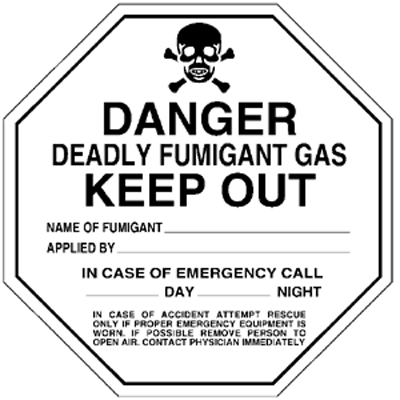
41 (1) The warning sign for the application of a fumigant in an enclosed space shall display
(a) a skull and crossbones symbol,
(b) the words DANGER, DEADLY FUMIGANT GAS, KEEP OUT in a language that can be readily understood by the workers and in letters large enough to be read at a distance of 8 m (25 ft.),
(c) the name of the fumigant,
(d) the name of the applicator, and
(e) emergency telephone numbers for both day and night.
(2) Figure 2 illustrates an acceptable design for the fumigant warning sign.
Figure 2:
Restricted entry intervals
42 (1) Except as provided in regulation 43, the employer shall ensure a person does not enter a field or portion of a field on which a pesticide has been applied, until the restricted entry interval has elapsed.
(2) The length of the restricted entry interval is a minimum of
(a) 24 hours for a pesticide which is classified as slightly toxic,
(b) 48 hours for a pesticide which is classified as moderately or very toxic,
(c) the sum of the 48 hour intervals for each of the moderately and very toxic pesticides in a mixture of pesticides, and
(d) the interval specified on a pesticide label when that interval is longer than the interval determined in clauses (a) to (c).
Authorization to enter
43 Where the employer, before the expiry of the restricted entry interval, authorizes a worker to enter the field where pesticides have been applied, the employer shall ensure that the worker is provided with and wears the proper personal protective clothing and equipment as required by regulations 66 to 100 and that the worker follows proper procedures.
Restriction on pesticide application
44 A person shall not apply a pesticide in such a manner that it creates a risk of adverse health effect or injury to another person.
Washing facilities for field workers
45 For workers who enter a field after the expiry of the restricted entry interval, the employer shall ensure that
(a) handwashing facilities are readily available to and are used by workers, and
(b) adequate facilities to shower and to wash clothes are available to workers residing on the employer's premises.
Prevention of drift
46 Employers shall ensure that all reasonable precautions are taken to prevent the drift or spread of pesticides from lands under their control.
Information on drift
47 Where a pesticide under the control of an employer has drifted or spread to the land occupied or used by another employer, the first employer shall notify the second of the identity of the pesticide, the nature of its harmful characteristics and the precautions required for the safety of workers.
Protection from drift
48 The employer to whose property a pesticide has drifted or spread shall take all reasonable steps to
(a) identify the pesticide and advise any persons who may be exposed to it of the nature of the pesticide, its harmful characteristics and the precautions required for safety, and
(b) ensure that any hazards to persons from exposure to the pesticide are eliminated or controlled.
Records
49 The employer shall maintain a record of pesticide applications which includes the
(a) type of crop treated,
(b) number of acres or hectares of crop treated,
(c) pesticides used,
(d) rate of application,
(e) location of the crop treated,
(f) date and time at which the pesticide application was completed, and
(g) date on which workers were allowed to enter the field.
Avicides, Predicides, Rodenticides
Exemption
50 (1) Regulations 29 (2), 30 and 38 to 45 do not apply where avicides, predicides or rodenticides are applied in solid or liquid form.
Preventive measures
51 For pesticides exempted under regulation 50 the employer shall ensure that
(a) adequate measures are taken for the protection of the applicator including the use of safe work procedures, the provision and use of personal protective equipment as required by regulations 66 to 100 and the provision of adequate handwashing facilities,
(b) the pesticide, where practicable, is applied in areas safely removed from areas of normal work activity not readily accessible to unauthorized persons, and
(c) workers who are required to enter the area or location where the pesticide has been applied are notified of
(i) the location of the pesticide application,
(ii) the physical description of the pesticide and the device, if any, in which it is placed, and
(iii) the precautions that need to be observed.
Application of Pesticides by Aircraft
Protective equipment for flagpersons
55 Flagpersons who may be exposed to pesticide spray or drift shall wear protective clothing covering the head, body, hands and feet, and respirators appropriate for the pesticide being applied.
Isolation requirements
56 Before a worker enters a confined space the employer shall ensure that piping which contains substances under pressure or other hazardous substances, and which leads into the space or is located so as to permit these substances to enter the space, is isolated from the space in accordance with the requirements of regulation 13.19 in the Industrial Health and Safety Regulations.
Work procedures and pretesting
57 A worker shall not enter a tank, silo, storage bin, pit or other confined space in which a harmful atmosphere exists or may develop until
(a) safe work procedures have been developed and the worker has been instructed in these procedures, and
(b) steps have been taken, including testing, to ensure that no harmful concentrations of gases or other contaminants are present in the air and that the oxygen concentration is greater than 19.5% by volume.
[am. B.C. Reg. 315/2003, App. B, s. 1.]
Ventilation and precleaning
58 If tests made under section 57 indicate unsafe conditions, the employer must
(a) ventilate or clean the confined space, or both, and then retest it to ensure that harmful substances are at or below the exposure limits established under section 5.48 of the Occupational Health and Safety Regulation, and
(b) ensure that the oxygen concentration in the confined space is greater than 19.5% by volume before a worker enters or re-enters the confined space.
[en. B.C. Reg. 315/2003, App. B, s. 2.]
Precautions During Entry and Work
Hazard control
59 If tests made under regulation 57 indicate the presence of harmful or explosive substances and it is not practicable to provide a safe respirable atmosphere during worker entry into or work in the confined space
(a) the worker entering the space shall wear respiratory and other protective equipment required by regulations 66 to 100,
(b) the concentration of flammable substances shall be maintained below 20% of the lower explosive limit as determined through repeated testing, and
(c) where flammable or explosive gases or liquids are present all sources of ignition shall be eliminated or controlled.
Rescue
60 A worker who is required or permitted to enter a confined space in which a harmful atmosphere exists or may develop which could affect the ability of a worker to escape without assistance shall, in addition to the requirements of regulation 59 (a), wear
(a) a safety belt or harness of a type that will keep the worker in a position to permit rescue, and
(b) a lifeline attached to the belt or harness which is tended at all times by another worker stationed outside the entrance to the confined space and who is equipped and capable of effecting rescue.
Life-line entanglement
61 If one or more workers enter a confined space, provision shall be made to prevent the entanglement of life-lines and other equipment.
Provision of assistance
62 A worker entering a confined space shall be
(a) attended by and in communication with another worker stationed at or near the entrance, or
(b) provided with a means of continuous communication with a worker outside and be visually checked by a designated worker at intervals as often as may be required by the nature of the work to be performed.
Ventilation and testing during work
63 Where work is carried out in a confined space
(a) the confined space shall be ventilated continuously, and
(b) tests for harmful or explosive substances and oxygen deficiency shall be made and recorded immediately before entry, after any interruptions in the work procedure, and at intervals to ensure the continuing safety of workers in the confined space.
Warning signs
64 A sign warning of the dangers of the confined space shall be posted at the entrance to
(a) a silo or a similar structure, and
(b) a pit or a tank containing liquid manure.
Ventilation of manure tanks
65 (1) A worker shall not enter or remain in a building or structure adjoining a liquid manure tank while the manure is being agitated.
(2) Following agitation of the manure, the adjoining building or structure shall be thoroughly ventilated before a worker is permitted to enter it.
Personal Protective Clothing and Equipment
Provision and use of protective clothing and equipment
66 Personal protective clothing and equipment shall be provided to workers in accordance with the requirements of regulation 8.14 of the Industrial Health and Safety Regulations.
Maintenance
67 (1) A worker shall not intentionally remove, impair, or render ineffective any safeguard provided for the protection of workers.
(2) All personal protective equipment shall be maintained in good working order and in a sanitary condition.
Personal wearing apparel
68 The personal wearing apparel of a worker shall be of a type and condition that will not expose the worker to any unnecessary and avoidable hazards.
Moving machinery and electrical contact hazards
69 (1) If there is a danger of contact with moving parts of machinery or with electrically energized equipment, or if the work process is such that a similar hazard exists
(a) the clothing of workers shall fit closely about the body,
(b) workers shall not wear dangling neckwear, bracelets, wristwatches, rings, or similar articles, and
(c) cranial and facial hair shall be confined, or worn at a length that will prevent it being snagged or caught in the work process.
(2) A medic-alert bracelet may be worn if the bracelet is used with a transparent band that fits snugly over the bracelet.
General requirement
70 Adequate footwear made of leather or other material appropriate to the protection required shall be worn by workers.
Safety footwear
71 If there is a hazard of injury to the foot, safety footwear meeting the requirements of Canadian Standards Association Standard Z195 Safety Footwear or other standard acceptable to the Board shall be worn.
Non-slip materials
72 Except in work activity involving horseback riding, the soles and heels of footwear shall be of a material that will not create a danger of slipping.
Deteriorated footwear
73 Footwear that has deteriorated to a point where it does not provide the required protection shall not be used.
Chainsaw operation
74 A worker, when regularly operating a chainsaw in circumstances where a hazard of leg injury exists, shall wear leg protective devices meeting requirements of
(a) CAN/BNQ 1923-450-M91, Leg Protective Device for Chain Saw Users,
(b) WCB Standard Leg Protection for Chain Saw Users (WCB PPE 14.1),
(c) American Pulpwood Association Standard, Leg Protection for Chainsaw Users, June 1992, or
(d) other standard acceptable to the Board.
Where required
75 Safety headgear shall be worn by workers in all work areas in which a potential hazard to the head exists from falling, flying or thrown objects, or from other harmful contacts.
Electrical hazards
76 Workers exposed to electrical hazards shall wear non-conductive safety headgear having resistance appropriate to the voltage involved.
Conformity with standards
77 All safety headgear shall meet the requirements of the Canadian Standards Association Standard Z94.1, Industrial Protective Headwear or other standard acceptable to the Board.
Chin straps
78 Chin straps, or other effective means of ensuring retention of safety headgear, shall be fitted and worn when workers are exposed to high winds or other conditions which might cause the loss of the headgear.
When required
79 A worker handling materials likely to puncture, abrade or irritate hands or arms shall wear personal protective equipment to prevent such injuries, except when the use of this equipment introduces equal or greater hazards.
Protection Against Acids, Caustics and Hot Materials
When required
80 A worker handling or using acids, caustics, steam, abrasives, hot fluid jets, or similar harmful substances shall use suitable personal protective equipment, or other means shall be adopted that provide protection against these hazards.
When required
81 Properly fitting goggles, face shields or other eye protective equipment, appropriate to the work being done, shall be worn by a worker who
(a) is handling or is exposed to any material which is likely to injure or irritate the eyes, or
(b) is engaged in any work in which there is a hazard of eye injury, or
(c) has 6/60 (20/200) vision or worse in either eye or is blind in either eye.
Compliance with standards
82 Industrial eye protectors shall meet the requirements of Canadian Standards Association Standard Z94.3-M88 Industrial Eye and Face Protectors or other standard acceptable to the Board.
Notification of employer
83 When a worker intends to wear contact lenses at the place of employment, the worker shall immediately notify the employer.
Prohibition of contact lenses
84 A worker shall not wear contact lenses where
(a) gases, vapours or other materials are present which, when absorbed by the contact lenses, may harm the eyes, or
(b) dusts or other materials are present which may harm the eyes or cause distraction which may expose the worker to other injury.
When required
85 (1) If workers are or may be exposed to an atmosphere with less than 19.5% oxygen or to concentrations of air contaminants in excess of the exposure limits established under section 5.48 of the Occupational Health and Safety Regulation, mechanical means or engineering design must be used to prevent or to eliminate the hazardous exposure conditions.
(2) If
(a) the prevention or elimination of the hazardous exposure conditions is not reasonably practicable, or
(b) if the exposure results from temporary or emergency conditions only,
every worker who may be exposed must wear protective respiratory equipment.
[en. B.C. Reg. 315/2003, App. B, s. 3.]
Compliance with standards
86 Protective respiratory equipment shall
(a) provide adequate protection against contaminants in the workplace,
(b) be maintained in good working order in accordance with the manufacturer's instructions, and
(c) meet the requirements of standards acceptable to the Board such as those of the National Institute for Occupational Safety and Health (NIOSH) and Mine Safety and Health Administration (MSHA).
Pre-job instruction
87 The employer shall give every worker who is required to use respiratory protective equipment pre-job instruction so that the worker understands the use, the limitations, and the maintenance requirements of the equipment, as far as these relate to its correct use by the worker.
Respirator sealing
88 When a worker is required to use a respirator which is of a design that requires an effective seal with the face, an effective seal with the face shall be obtained.
Availability and training of rescue workers
89 The employer shall ensure that
(a) sufficient workers, who are trained in rescue procedures, are immediately available whenever workers are working in areas where an oxygen deficient atmosphere or harmful concentrations of air contaminants exists or is likely to develop, and
(b) the rescue workers have immediate access to appropriate breathing apparatus or other aids necessary to effect a rescue.
Air-line type respirators
90 When a worker is wearing an air-line or air-hose type respirator in an atmosphere immediately harmful to the worker
(a) the air supply source shall be attended by another worker who is equipped to effect rescue or provide assistance if the worker is rendered unconscious or otherwise incapacitated, and
(b) the worker shall be provided with and carry an auxiliary supply of compressed respirable air of sufficient capacity to enable the worker to escape from the area in an emergency or until rescue is effected.
Abrasive blasting
91 Abrasive blasters operating in an otherwise harmless atmosphere are exempt from regulation 90 if they are provided with and wear an air supplied hood with a rate of flow of air which
(a) is sufficient to prevent entry of contaminants into the hood, and
(b) is not less than 0.17 cubic metres per minute (6 ft 3 per minute).
Air purity
92 (1) The employer shall ensure that respirable air supplied by mechanical ventilation devices is free of dust, oil vapours and toxic or noxious fumes and gases.
(2) Compressed air used for breathing purposes in self-contained breathing apparatus shall meet the requirements of Canadian Standards Association Standard 3-Z180.1, Purity of Compressed Air for Breathing Purposes or other standards acceptable to the Board.
Exposure limits
93 A worker's exposure to steady state noise shall be limited as follows:
| Steady State Noise | |
| Noise Level (dBA) | Maximum Daily Exposure Time Without Hearing Protection (hours) |
| 87 | 16 |
| 90 | 8 |
| 93 | 4 |
| 96 | 2 |
| 99 | 1 |
| 102 | 1/2 |
| 105 | 1/4 |
| over 105 | 0 |
Provision of hearing protection and other controls
94 (1) When a worker's exposure to steady state noise exceeds the permitted noise exposure levels the employer shall, where practicable, institute engineering controls to reduce the noise levels to or below the permitted values.
(2) All workers exposed to excessive noise levels shall be provided with and shall wear a hearing protection device in accordance with Canadian Standards Association Standard Z94.2-M1984, Hearing Protectors, part of which is reproduced in this regulation, or other standard acceptable to the Board.
| Noise Level, dBA | Class of Hearing Protectors |
| 85 - 89 | Class C |
| 90 - 95 | Class B |
| 96 - 105 | Class A |
| over 105 | A plug + A or B muff |
Exemption to hearing protection
95 When hearing protection is required to be worn but for medical reasons hearing protective devices should not be worn by a particular worker, the employer shall notify the Board of the medical reasons involved and shall follow the directions of the Board.
Fitting of muffs
96 When a muff type hearing protector is worn, the worker shall be responsible for wearing hair and personal apparel in such a manner that the muff maintains an effective seal around the ears.
Restriction of muff types
97 Workers shall not wear muff type hearing protectors or headsets which have been designed or modified to accept AM or FM radio or other music sources.
Exemption
98 Regulation 97 does not apply to muff type hearing protectors designed and used for the express purpose of two-way radio or speech communication.
Safety Harnesses, Safety-Belts, Safety-Straps and Life-Lines
When required
99 (1) Where it is impracticable to provide adequate work platforms, scaffolds or staging, as specified in these regulations and those in Section 8 of the Industrial Health and Safety Regulations or which would be required in the exercise of good practice for the safe conduct of work, safety harnesses or safety-belts, and life-lines or safety-straps shall be worn by all persons working at elevations 3 m (10 ft.) or more above grade or floor level.
(2) The safety harnesses, safety-belts, life-lines and safety-straps shall meet standards acceptable to the Board.
When required
100 Every worker employed under conditions which involve a risk of drowning shall wear a personal flotation device that
(a) has a buoyant effect sufficient to keep the worker's head above water,
(b) does not require manual manipulation to produce the buoyant effect, and
(c) meets standards acceptable to the Board.
Tools, Machinery and Equipment
Power take-off (PTO) guarding
101 (1) Each power take-off (PTO) shaft, including rear, mid or side mounted shafts, shall be guarded by
(a) a master shield, or
(b) where the attachment of PTO driven equipment requires the removal of the master shield, a guard of equivalent protection.
(2) PTO driven equipment shall be guarded to prevent contact with the rotating members of the power drive system.
Warning signs
102 Warning signs specifying that shields must be kept in place shall be placed at conspicuous locations near PTO driven rotating shafts.
Equipment guarding
103 The employer shall ensure that adequate guards are in place at
(a) mesh or nip-points of all power driven gears, belts, chains, sheaves, pulleys, sprockets and idlers, and
(b) all revolving shafts including protruding bolts, keys or set screws.
Signs and procedures
104 If the removal of a guard or access door will expose a worker to a component which continues to rotate after the power to the component has been disengaged
(a) the employer shall apply signs to the guards or access doors warning of the danger, and
(b) guards shall not be removed or access doors opened until enough time has elapsed to bring all components to a complete stop.
Rollover protective structures (ROPS)
106 (1) Agricultural tractors manufactured after January 1, 1985 shall be equipped with ROPS designed, fabricated and attached in accordance with the standards identified in regulation 107.
(2) A period of time for installation and retrofit of ROPS required under clause (1) is provided as follows:
(a) tractors purchased after December 31, 1993 must be equipped with ROPS before being placed in service;
(b) all other tractors must be fitted with ROPS no later than December 31, 1996.
(3) Tractors meeting the following criteria are exempt from the requirement for ROPS:
(a) low profile tractors used in agricultural situations where there is low overhead clearance, such as in orchards, hop yards and in farm buildings and green houses where overhead clearance is not adequate to allow a ROPS equipped tractor to operate, and while their use is incidental to the work therein;
(b) agricultural tractors fitted with implements incompatible with the ROPS.
Acceptable standards
107 (1) On agricultural tractors manufactured after January 1, 1985 the means of operator protection shall conform to
(a) Canadian Standards Association Standard B352 - M1980, Rollover Protective Structures (ROPS) for Agricultural, Construction, Earthmoving, Forestry, Industrial and Mining Machines, or
(b) SAE Standard J2194, December 1987, Rollover Protective Structures (ROPS) for Wheeled Agricultural Tractors, or
(c) SAE Standard J1194, May 1989, Rollover Protective Structures (ROPS) for Wheeled Agricultural Tractors, or
(d) ASAE Standard S383, March 1977, Rollover Protective Structures (ROPS) for Wheeled Agricultural Tractors, or
(e) other standards acceptable to the Board.
(2) In operations where there is a hazard to the operator from falling or flying objects, while operating agricultural tractors manufactured after January 1, 1985, the means of operator protection shall conform to SAE Standard J167, December 1986, Overhead Protection for Agricultural Tractors — Test Procedures and Performance Requirements (A).
Certification
108 (1) ROPS manufactured and installed in accordance with the requirements of regulations 106 and 107 shall be certified by a professional engineer.
(2) When non-ROPS canopies are modified to meet the requirements of regulations 106 and 107, these structures shall be certified by a professional engineer.
Damaged ROPS
109 Damaged or deteriorated ROPS shall be replaced by an acceptable ROPS except when recertified under regulation 110.
Recertification
110 (1) A professional engineer may recertify a damaged or deteriorated ROPS if, in the engineer's opinion, the integrity of the ROPS has not been impaired.
(2) All ROPS which are recertified under the provisions of clause (1) shall be permanently identified as required by regulation 112.
Who may certify
111 For the purposes of regulations 108 to 110, a ROPS manufacturer or representative may certify or recertify a ROPS provided the manufacturer or representative has a professional engineer on staff or on retainer to authorize the certification or recertification.
ROPS identification
112 For ROPS required by these regulations, the following identification shall be provided after December 31, 1993:
(a) permanently and conspicuously marked on the ROPS there shall be
(i) the name and address of the manufacturer or the professional engineer who certified the ROPS,
(ii) the model or other effective means of identifying the machine for which the ROPS was designed, and
(iii) the identity of the standard or standards to which the ROPS conforms;
(b) the serial number or other effective means of identifying the ROPS shall be readily available at the workplace.
Additions and modifications
113 (1) No addition, modification, welding or cutting of ROPS is permitted except in accordance with the instructions of a professional engineer.
(2) All ROPS modified in accordance with clause (1) shall be permanently marked with
(a) an identification of the modifications effected,
(b) the date of recertification, and
(c) the name and address of the recertifying engineer.
Effects of ROPS on visibility
114 ROPS and other structures required by these regulations for the protection of the operator shall be designed and fabricated so as to provide a field of vision sufficient to enable the operator to safely operate the machine.
Seat belts
115 (1) All mobile equipment which has been fitted with ROPS shall have seatbelts which meet the requirements of SAE Recommended Practice J386, Seat Belts for Construction Equipment or other standards acceptable to the Board.
(2) Seat-belts shall
(a) have a minimum webbing width of 50 mm (2 inches),
(b) be maintained in good condition, and
(c) be used whenever the equipment is in motion, or in operations which could cause the equipment to become unstable.
(3) Alternative proposals designed to provide equivalent protection and operator comfort may be submitted to the Board for consideration.
General requirements
116 A mobile elevating work platform used in an orchard shall
(a) not exceed a maximum platform height of 3.6 m (12 feet),
(b) have a bucket equipped with
(i) a gate that does not swing outwardly and that can be securely fastened in the closed position to minimize the risk of accidental or inadvertent opening,
(ii) a top rail approximately 90 cm (36 inches) in height above the floor and capable of withstanding a load of 890 N (200 pounds) applied in any direction at any point on the top rail,
(iii) a toe rail, on the sides not serviced by a gate, which is approximately 8 cm (3 inches) in height with a maximum clearance between the floor and the bottom edge of the toe rail of 5 cm (2 inches), and
(iv) non-skid platforms,
(c) be provided with a drive system that ensures there will be no unintended movement of the unit, and
(d) not be operated on sloping ground unless
(i) specific instructions from the manufacturer for such operation are followed, and
(ii) the unit is equipped with a braking system capable of restraining the machine under any condition of use, or is equipped with wheels which will not turn unless driven.
Exceptions
117 (1) In regulation 116, clauses (a) and (b) (i), (ii) and (iii) do not apply to mobile elevating work platforms which meet the requirements of Canadian Standards Association Standard CAN 3-B354.4 M82, Boom-Type Elevating Work Platforms, or other standard acceptable to the Board.
(2) Regulation 116 (a) does not apply to mobile elevating work platforms manufactured before December 31, 1993.
Identification
118 Mobile elevating work platforms that are used in orchards and that are manufactured after December 31, 1993 shall have the following information permanently and conspicuously marked upon them
(a) certification to confirm the standard met by the device,
(b) the make, model, serial number and manufacturer's name,
(c) the rated platform workload,
(d) the maximum platform height and travel height, and
(e) the maximum slope on which the device may be operated when the platform is elevated.
Safety belt
119 A worker using a mobile elevating work platform in an orchard shall wear a safety belt and lanyard if the platform height is more than 3.6 m (12 feet) above ground.
Operation and Maintenance of Mobile Equipment
Pulling Loads
120 When tractors or other mobile equipment are used for pulling loads
(a) the point of pull on the tractor or other mobile equipment shall be the point specified by the manufacturer's instructions, and
(b) the weight of a load pulled shall not exceed that specified by the manufacturer.
Instruction and authorization of operators
121 The employer shall ensure that no person operates any mobile equipment unless the person
(a) has received proper instruction and has demonstrated the competence and physical ability to operate the equipment safely,
(b) possesses a valid driver's licence where required by provincial law,
(c) is familiar with manufacturer's operating instructions for the vehicle, and
(d) has been authorized to operate the equipment.
Unattended equipment
122 The operators of mobile equipment shall not leave the controls of such equipment unattended, unless the equipment has been secured against inadvertent movement by setting parking brakes and transmission locks, lowering any blades, buckets or forks to ground and by chocking wheels where necessary.
Transportation of workers
123 When workers are transported within the workplace
(a) the workers shall be safely seated, and
(b) if the mobile equipment was not designed for the transportation of workers, it shall not be operated in excess of 10 kilometers per hour (6 mph).
Prohibitions on riding machinery and equipment
124 Workers shall not ride on
(a) tongues or drawbars connected to equipment in tandem, or
(b) buckets, forks or other equipment which pose a risk of injury to workers.
Maintenance of braking systems
125 Brakes on mobile equipment shall be maintained in good working order.
Ladder design
126 An orchard ladder shall
(a) meet the construction requirements of Canadian Standards Association Standard, CAN3-Z11-M81, Portable Ladders except that the spreader requirement does not apply to orchard ladders,
(b) have a rail spread which increases at least an average of 6 cm (2 1/2 inches) for each 30 cm (12 inches) of ladder length, and
(c) where necessary have the feet of the ladder equipped with steel points or other nonslipping bases designed for the ground on which it will be used.
Inspection
127 The employer shall inspect at regular intervals orchard ladders in use, to ensure that
(a) loose, broken or missing rungs, split side rails or other hazard producing defects are repaired, and
(b) moveable parts operate freely without binding or excessive play.
Instruction and use
128 The employer shall ensure that
(a) a worker using an orchard ladder is instructed in its proper use, and
(b) the ladder used is appropriate for the task.
Worker responsibility
129 A worker using an orchard ladder shall
(a) inspect the ladder prior to its use and if a defect is observed, not use the ladder until the defect is repaired, and
(b) ensure that the rungs are free of materials which would make them hazardous if stepped on.
Alternatives to guards
131 Where the nature of the work process makes it impracticable to guard feed points, transfer points or sampling locations on conveyors, workers shall be provided with and use tools or other means designed to prevent contact by the workers with moving parts of the conveyors.
Preventing fall of material from auger conveyors
132 Conveyors which operate over areas where workers are or may be required to work shall be designed to prevent material which could be hazardous to workers from falling into those areas.
Access on auger conveyors
133 (1) Conveyors shall be crossed only at established walkways.
(2) A worker shall not be permitted on a conveyor until it is stopped, de-energized and cannot be inadvertently started.
Emergency stopping
134 (1) Conveyors, including automatically starting conveyors, which pose a danger to workers shall have emergency stopping devices or equivalent procedures, and the devices shall be designed so they have to be manually reset before the conveyor can be restarted.
(2) A conveyor shall not be restarted after an emergency stop until it has been determined that the conveyor can be operated safely.
Hand winch controls
135 The hand winch for raising the auger shall have a control which will hold the auger at any angle and respond only when the handle is turned.
Work procedures
136 Workers using hay balers shall
(a) not attempt to clear hay from the collection area unless the engine is stopped and cannot be inadvertently started, and
(b) keep clear of the discharge area of round balers and the area under the hatch unless the hatch is blocked open.
Post-hole diggers
137 Post-hole diggers shall have
(a) the tractor or machine brakes set before digging,
(b) shear bolts as specified by the manufacturer, and
(c) a hold-to-run control (deadman switch) when operated as a hand-held unit.
Postdrivers
138 Workers operating post drivers shall
(a) lower the hammer and stop the engine when adjustment or maintenance is required,
(b) where necessary, steady the post with a steady fork or guide, and
(c) lower or block the hammer when the machine is not in use.
Guards
139 A portable, power-driven saw, except a pruning or chain saw, shall be guarded as follows:
(a) there shall be guards above and below the base plate or shoe;
(b) the guards shall cover the saw blade to the depth of the teeth except for
(i) the minimum arc required by the upper guard to permit the base to tilt for bevel cuts, and
(ii) the arc required by the lower guard to allow proper retraction and contact with work;
(c) when the saw is withdrawn from the work the lower guard must automatically and instantly return to the covering position.
Standards for saws
141 A chain saw purchased for first use after December 31, 1993 shall
(a) meet the requirements of Canadian Standard Association Standard CAN3-Z62.1-M85, Chain Saws or other standard acceptable to the Board, and
(b) be fitted with a cutting chain that meets the requirements of Canadian Standards Association Standard Z62.3 M1990, Chain Saw Kickback or other standard acceptable to the Board.
Conformity with standards
143 Electric and gas welding and cutting equipment, installations and operations shall conform to
(a) the manufacturer's specifications, and
(b) Canadian Standards Association Standard W-117, Code for Safety in Electric and Gas Welding and Cutting Operations or other standard acceptable to the Board.
Restrictions
144 Gas welding and burning equipment, including regulators, automatic reducing valves and hoses, shall be used only for the gas and the pressures for which they were designed.
Acetylene fittings
145 Copper fittings or tubing shall not be used in systems carrying acetylene gas.
Reverse flow and flashback
146 Approved safety devices that prevent reverse gas flow and flash back shall be fitted at either the torch or regulator connections on hoses carrying fuel or oxygen gases, and these devices shall be regularly inspected and maintained.
Cleanliness of equipment
147 Oil or grease shall not be permitted to contact oxygen cylinder fittings, valves or regulators.
Handling and storing compressed gas cylinders
148 (1) Compressed gas cylinders shall be secured to prevent falling or rolling during storage, transportation and use, and shall, where practicable, be kept in an upright position.
(2) Acetylene cylinders shall
(a) be used only in an upright position, and
(b) be placed in an upright position for at least one hour before use if they have been stored or transported in a horizontal position.
(3) Compressed gas cylinders shall not be hoisted by slings or magnets, dropped, subjected to impact, handled by the regulators, or used as rollers or work supports.
(4) Compressed gas cylinders, except those which have integral guards, shall have valve protection covers in position when the cylinders are not connected for use.
Regulators on compressed gas cylinders
149 (1) Valves on compressed gas cylinders shall be kept closed when cylinders are empty or not in use.
(2) A suitable device shall be immediately available for closing valves on acetylene cylinders whenever the cylinders are connected for use.
(3) Workers shall not stand directly in front of regulator pressure gauges while the valve on the compressed gas cylinder is being opened.
(4) Valves, regulators and fittings shall be those designed for the type of cylinder and gas for which they will be used.
Electrode holders
150 Only manual electrode holders which are specifically designed for arc welding and cutting, and capable of safely handling the maximum rated current required by the electrodes, shall be used.
Insulation of equipment
151 Parts of the arc welder which carry current and to which the operator may be exposed during operation shall be insulated to protect against shock.
Work interruptions
152 When the worker doing arc welding or cutting has occasion to stop work for any appreciable length of time, or when the arc welding or cutting machine is to be moved, the power supply to the equipment shall be shut off.
Shielding and ventilation
153 (1) An area in which arc welding is being done shall, when practicable, be screened or barricaded to protect workers from arc flash and be provided with adequate ventilation.
(2) If the welding process cannot be isolated, all persons who may be exposed to the hazard of arc flash shall wear protective eyewear that meet standards acceptable to the Board.
Fire extinguisher
154 At least one fire extinguisher shall be available at the location where welding or burning is done.
Housekeeping
155 Work areas in which welding is done shall be kept free of electrode stubs, metal scrap or other slipping or tripping hazards.
Protective clothing and equipment
156 Workers who carry out welding or burning operations shall wear
(a) flame retardant work clothing,
(b) leather gauntlet type gloves and arm protection,
(c) an apron of leather or other suitable material for heavy work,
(d) eye and face protection while chipping or grinding welds and for protection against harmful radiation and particles of molten metal, and
(e) substantial safety footwear, made of leather or other equally firm material.
Presence of flammable or explosive substances
157 (1) Burning, welding, or other hot work shall not be done on any vessel, tank, pipe, structure or other place where there is a likelihood of the presence of a flammable or explosive atmosphere.
(2) Work may proceed when suitable procedures have been adopted to ensure the possibility of fire or explosion has been eliminated.
Precautions
158 (1) The operation and maintenance of abrasive wheels shall be in accordance with the manufacturer's instructions and standards acceptable to the Board.
(2) Abrasive wheels or discs shall have protective hoods of sufficient strength to contain fragments of ruptured wheels or discs, except as provided in clause (3).
(3) Protective hoods are not required for abrasive wheels or discs where the nature of the work would prevent fragments of ruptured wheels from injuring a worker.
Work rest on grinder
159 A grinder, on which the work is hand held, shall be fitted with an adjustable work rest that is adjusted so that its upper edge is not below the centre line of the abrasive wheel and no further than 3 mm (1/8 inch) from the cutting surface.
Prohibition on use of grinding wheels
160 Grinding shall not be done on the sides of abrasive wheels unless the wheels are designed for such use.
Safe means of escape
161 The employer shall ensure that workers have a safe means of escape from any enclosure occupied by animals which are potentially dangerous to workers.
[Provisions of the Workers Compensation Act, R.S.B.C. 1996, c. 492, relevant to the enactment of this regulation: section 71 (1)]