Regulation BEFORE repealed by 2017-22-13, effective November 30, 2017.
| B.C. Reg. 21/2015 O.C. 54/2015 | Deposited February 13, 2015 |
Election Act
Plebiscite 2015 (Regional Transportation System Funding) Regulation
Definitions
1 In this regulation:
"Act" means the Election Act;
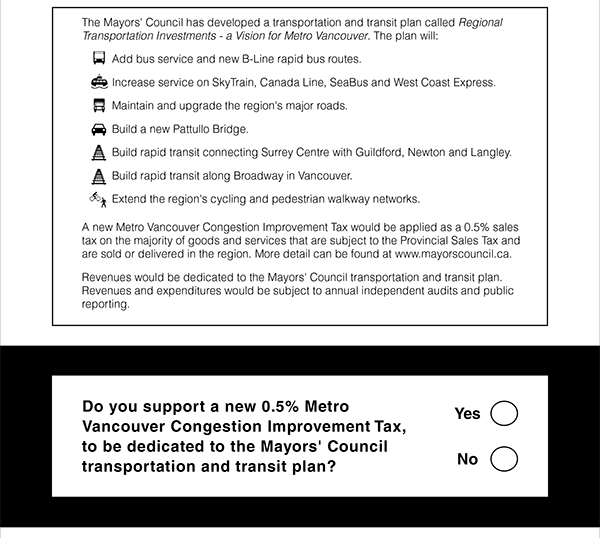
"ballot" means a ballot in the form of the ballot set out in the Schedule to this regulation;
"close of voting" means the end of voting under section 4 [voting in the plebiscite closes on May 29, 2015];
"Elections BC" means the office administered by the chief electoral officer under the Act;
"mayors' council on regional transportation" has the same meaning as in the South Coast British Columbia Transportation Authority Act;
"Mayors' Council transportation and transit plan" means the plan entitled "Regional Transportation Investments — a Vision for Metro Vancouver", also known as the "Mayors' Transportation and Transit Plan", published on the website maintained by or on behalf of the mayors' council on regional transportation;
"plebiscite" means the plebiscite conducted under this regulation;
"plebiscite official" means
(a) the chief electoral officer, or
(b) an individual appointed by the chief electoral officer to act as a plebiscite official;
"plebiscite official responsible" means, in relation to plebiscite proceedings, the plebiscite official assigned responsibility for those proceedings by or under this regulation;
"registered", in relation to a voter, means an individual who is registered as a voter under the Act;
"transportation service region" has the same meaning as in the South Coast British Columbia Transportation Authority Act;
"voter" means an individual who meets the qualifications in section 7 (1) [who may vote in the plebiscite];
"voting package" means the set of materials for the conduct of the plebiscite described in section 11 (1) [what is to be included in a voting package].
Part 2 — Plebiscite to Be Conducted
Plebiscite to be conducted by mail-in ballot
2 The plebiscite must be conducted by the distribution of a voting package
(a) to each registered voter in the transportation service region, and
(i) is eligible to vote under section 7 [who may vote in the plebiscite], and
(ii) applies to Elections BC requesting a voting package in accordance with section 8 [how to apply for a voting package].
Form of ballot
3 The ballot for the plebiscite is to be in the form set out in the Schedule to this regulation.
Voting in the plebiscite closes on May 29, 2015
4 (1) Distribution of the voting packages must commence no later than March 16, 2015.
(2) The close of voting in the plebiscite is 8:00 p.m. on May 29, 2015.
(3) For a ballot to be considered, the certification envelope containing a marked ballot must be
(a) mailed or delivered to Elections BC, and
(b) received by Elections BC not later than the close of voting.
Elections BC responsible for administration of the plebiscite
5 (1) The chief electoral officer is responsible for
(a) arranging the preparation of the voting packages and other materials required for the conduct of the plebiscite, and
(b) conducting the plebiscite.
(2) Subject to subsection (3), the chief electoral officer may appoint those plebiscite officials and other persons the chief electoral officer considers necessary to conduct the plebiscite.
(3) The following individuals must not be appointed, accept appointment or act as a plebiscite official:
(a) a member of the Legislative Assembly or of the Executive Council;
(b) an individual who has served as a member of the Legislative Assembly in the session immediately before the plebiscite, or in the session then being held, if the plebiscite takes place during a session of the Legislature;
(c) a member of the House of Commons of Canada, of the Senate of Canada or of Her Majesty's Privy Council of Canada;
(d) a judge of the Court of Appeal, the Supreme Court or the Provincial Court;
(e) a master, registrar, district registrar or deputy district registrar of the Supreme Court;
(f) an individual who has been convicted of an offence under the Act or the Recall and Initiative Act within the period of 7 years immediately before the appointment;
(g) a member of the mayors' council on regional transportation or a delegate of a member appointed under section 210 (3) of the South Coast British Columbia Transportation Authority Act;
(h) a councillor, within the meaning of the Community Charter and the Vancouver Charter, of a council of a municipality in the transportation service region;
(i) a director of the board of directors of the Greater Vancouver Regional District;
(j) a member of the governing body of the treaty first nation whose treaty lands are included in the transportation service region;
(k) a director of the board of directors of the South Coast British Columbia Transportation Authority continued under section 2 of the South Coast British Columbia Transportation Authority Act.
Oath of office
6 Before undertaking duties under the Act and this regulation, an individual appointed as a plebiscite official must make a solemn declaration that the individual
(a) will faithfully and impartially fulfill the duties,
(b) has not received and will not accept any inducement to perform the duties otherwise than impartially and in accordance with the Act and this regulation or to otherwise subvert the plebiscite, and
Part 3 — Voting in the Plebiscite
Who may vote in the plebiscite
7 (1) In order to vote in the plebiscite, an individual must
(b) be 18 years of age or older on May 29, 2015,
(c) have been a resident of British Columbia for at least 6 months immediately before May 29, 2015,
(d) be a resident of the transportation service region,
(e) be registered as a voter in British Columbia or be qualified to register as a voter in the plebiscite, and
(f) not be disqualified by the Act or any other enactment from voting in the plebiscite or be otherwise disqualified by law.
(2) An individual must not vote more than once in the plebiscite.
(3) Without limiting subsection (1) (f), the following individuals are not entitled to vote in the plebiscite:
(a) the chief electoral officer and the deputy chief electoral officer;
(b) an individual who is prohibited from voting under Part 12 of the Act.
How to apply for a voting package
8 (1) An individual who is, under section 7, otherwise eligible to vote, but who is not a registered voter, may apply to Elections BC to register as a voter and request a voting package.
(2) An individual who is, under section 7, eligible to vote, but who did not receive a voting package, may apply to Elections BC to request a voting package.
(3) An application under subsection (1) or (2) for a voting package may be made at any time before midnight on May 15, 2015.
(4) Subject to section 13 [how to arrange for replacement of a voting package], an individual must not apply for more than one voting package.
Who may register as a voter
9 An individual must meet all the following qualifications in order to register as a voter for the purposes of section 7 (1):
(a) the individual must be a Canadian citizen;
(b) the individual must be 18 years of age or older on May 29, 2015;
(c) the individual must have been a resident of British Columbia for the 6 months immediately preceding May 29, 2015;
(d) the individual must not be disqualified by the Act or any other enactment from voting in an election or be otherwise disqualified by law.
How to update voter residential address in conjunction with plebiscite voting
10 If a registered voter has changed the place where he or she is resident, the voter may apply to update his or her residential address in conjunction with the plebiscite voting by entering his or her correct residential address in the space provided on the certification envelope.
What is to be included in a voting package
11 (1) A voting package for the plebiscite must include all of the following:
(a) an outer envelope for shipping the voting package;
(c) a secrecy envelope for the marked ballot;
(e) instructions advising the voter on the procedure for marking the ballot and how the secrecy envelope and certification envelope are to be used;
(f) a postage-paid return envelope.
(2) Certification envelopes must be prepared as follows:
(a) with a space in which to record the date of birth of the individual who is voting;
(b) with a printed declaration, to be signed by the individual who is voting, stating as follows:
"I declare that I am the voter identified on the certification envelope, that I am resident in the transportation service region and that I have not previously voted in this plebiscite.";
(c) with a space for change of residential address.
(3) If the chief electoral officer considers this advisable for the purpose of conducting the plebiscite, certification envelopes may request further information from the individual who is voting and may provide information for the voter respecting voting in the plebiscite.
How to vote using the voting package
12 To vote using a voting package, a voter must do the following:
(a) review for accuracy the voter's name and residential address printed on the certification envelope;
(b) mark the ballot in accordance with the instructions referred to in section 11 (1) (e);
(c) place the ballot in the secrecy envelope provided and seal the secrecy envelope;
(d) place the secrecy envelope in the certification envelope provided and seal the certification envelope;
(e) complete the certification envelope by
(i) providing the voter's date of birth, and
(ii) signing the declaration printed on the certification envelope;
(f) place the certification envelope in the return envelope provided;
(h) deliver the sealed return envelope containing the voting materials referred to in the previous paragraphs to
(i) Elections BC at the official address printed on the return envelope, or
(ii) another location designated by the chief electoral officer
so that it is received by 8:00 p.m. on May 29, 2015.
How to arrange for replacement of a voting package
(a) receives a voting package with the incorrect name recorded on the outer shipping envelope or certification envelope,
(b) loses, mutilates or destroys his or her voting package, or
(c) spoils a ballot or certification envelope before it is returned under section 12 (h) [how to vote using the voting package]
may request a replacement voting package from Elections BC.
(2) If Elections BC issues a replacement voting package under this section, the plebiscite official responsible must
(a) designate the replaced voting package as cancelled on the record maintained for that purpose, and
(b) instruct the voter on what is to be done with the cancelled voting package.
Individuals needing assistance
14 (1) Subject to this section, a voter who
(a) is unable to vote, or request a voting package, because of physical disability or difficulty with reading or writing, or
(b) requires the assistance of a translator to read the ballot and the instructions for voting
may be assisted by another individual.
(2) Except as permitted under subsection (3), an individual other than a plebiscite official who provides the assistance referred to in subsection (1) must not provide such assistance to more than one voter in the plebiscite.
(3) An individual may assist more than one member of the individual's family.
(4) An individual who is assisting under this section must
(a) preserve the secrecy of the ballot in accordance with section 90 of the Act as it applies to the plebiscite,
(b) mark the ballot in accordance with the directions of the voter, and
(c) refrain from attempting in any manner to influence the voter as to how the voter should vote.
(5) If a voter referred to in subsection (1) (a) is unable to sign the declaration on the certification envelope, the person assisting the voter must sign and provide the information required on the certification envelope.
(6) For the purposes of section 15 [proof of vote], the signature of the person assisting the voter in accordance with subsection (5) is considered to be the signature of an individual who is assisted in voting under this section.
(7) An individual must not provide assistance as a translator under this section unless the individual is able to make the translation and makes it to the best of his or her abilities.
(8) An individual is not considered to have voted or to have applied for a voting package by providing assistance under this section.
Proof of vote
15 The signed declaration of the voter on the certification envelope, received as required by section 12 (h), is proof for the purposes of this regulation that the individual to whom the voting package was provided has voted in the plebiscite.
Part 4 — Counting the Plebiscite Vote
Initial review of return envelopes for plebiscite
16 (1) A return envelope that is received as required by section 12 (h) [how to vote using the voting package] must be dealt with by the plebiscite official responsible as follows:
(a) on receipt, the plebiscite official must open the return envelope;
(b) the certification envelope must remain unopened and any ballot in it must not be considered on the count for the plebiscite if one or more of the following applies:
(i) the envelope is not completed as required under this regulation;
(ii) the individual identified on the envelope as using the envelope to vote is not the individual to whom the envelope was issued;
(iii) the individual identified on the envelope as using the envelope to vote is not entitled to vote in the plebiscite;
(iv) the individual identified on the envelope as using the envelope to vote appears to be voting more than once in the plebiscite.
(2) If a certification envelope is to remain unopened under subsection (1) (b), the plebiscite official responsible must mark this on the envelope, together with the applicable reason.
(3) A return envelope that is not received as required by section 12 (h) must be dealt with by the plebiscite official responsible as follows:
(a) on receipt, the plebiscite official must open the return envelope and record the date and time of receipt on the certification envelope;
(b) the certification envelope must remain unopened and must not be considered in the plebiscite.
Consideration of certification envelopes accepted for opening
17 (1) Subject to section 16, the certification envelopes must be opened one at a time and dealt with as follows:
(a) if a certification envelope contains more than one secrecy envelope,
(i) the secrecy envelopes must be resealed in the certification envelope,
(ii) the certification envelope must be marked as having been dealt with under this provision, and
(iii) the certification envelope must not be reopened and the secrecy envelopes must remain unopened and any ballots in them must not be considered or counted;
(b) if a certification envelope contains a ballot but no secrecy envelope, the plebiscite official responsible must place the ballot with other ballots to be counted, taking care to conceal any marking on the ballot from other individuals present;
(c) if a secrecy envelope is uniquely marked, or otherwise uniquely dealt with, in such a manner that the voter could reasonably be identified, the plebiscite official responsible must open the secrecy envelope, remove the ballot and place it with other ballots to be counted, taking care to conceal any marking on the secrecy envelope and ballot from other individuals present;
(d) if not otherwise dealt with under paragraphs (a) to (c), a secrecy envelope must be removed from its certification envelope for opening in accordance with subsection (2).
(2) The remaining secrecy envelopes referred to in subsection (1) (d) are to be opened one at a time and dealt with as follows:
(a) if a secrecy envelope contains more than one ballot,
(i) the ballots must be resealed in the secrecy envelope,
(ii) the secrecy envelope must be marked as having been dealt with under this provision, and
(iii) the secrecy envelope must not be reopened and the ballots in it must not be considered or counted;
(b) if a secrecy envelope contains only one ballot, the ballot must be placed with other ballots for counting.
Counting the votes — criteria for accepting or rejecting a ballot
18 (1) Subject to subsection (2), any of the following marks on a ballot is to be accepted and counted as a vote:
(a) a cross in or partly in either the blank space marked "Yes" or the blank space marked "No" opposite the question;
(b) a tick mark that is placed in the location referred to in paragraph (a);
(c) a filling in of the blank space marked "Yes" or the blank space marked "No" opposite the question;
(d) a mark other than one referred to in paragraph (a), (b) or (c) that
(i) is placed in either location referred to in paragraph (a), and
(ii) clearly indicates the intention of the voter to vote on the question.
(2) Under any of the following circumstances, a ballot must be rejected by the plebiscite official responsible:
(a) the ballot does not clearly indicate the intention of the voter respecting the question;
(b) there is any mark or notation on the ballot other than as permitted by subsection (1);
(c) the ballot is uniquely marked, or has been otherwise uniquely dealt with, in such a manner that the voter could reasonably be identified;
(d) the ballot has been altered in any way by the voter, including, without limitation, by the amendment of the wording of the question and any written comments;
(e) the ballot physically differs from the ballots officially provided for the plebiscite.
Who may be present at the counting proceedings
19 The only individuals who may be present at a place where counting proceedings are being conducted are
(b) individuals authorized to be present by the chief electoral officer.
Results of the plebiscite count
20 The chief electoral officer must
(a) report the results of the plebiscite to the Speaker of the Legislative Assembly, and
(b) announce the results of the plebiscite in a manner that the chief electoral officer considers will inform the electorate of those results.
Plebiscite materials to be retained for one year
21 (1) The ballots, opened certification envelopes and unopened or resealed certification and secrecy envelopes must be retained by the chief electoral officer for one year after the close of voting.
(2) During the retention period under subsection (1), the ballot accounts for the plebiscite must be available for public inspection in the office of the chief electoral officer during its regular office hours.
(3) At the end of the retention period under subsection (1), the materials referred to in that subsection must be destroyed unless a court orders otherwise.
Form of Ballot for the Plebiscite
[Provisions relevant to the enactment of this regulation: Election Act, R.S.B.C. 1996, c. 106, section 282]