Regulation BEFORE repealed by BC Reg 39/2016, effective February 29, 2016.
| B.C. Reg. 299/2004 O.C. 664/2004 | Deposited June 30, 2004 effective November 1, 2004 (sections 1 to 6); November 1, 2005 (remainder) |
Water Act
Ground Water Protection Regulation
[includes amendments up to B.C. Reg. 91/2009, March 6, 2009]
Definitions
"Act" means the Water Act;
"alter" means to undertake a structural modification to a well and includes deepening or reaming of the well and replacing or modifying screen assemblies, casings or sealant;
"annular space" or "annulus" means any open space between the outside of the casing of a well and the surrounding geologic formation or the open space or spaces between 2 or more well casings in the same well;
"approval" means an approval made under this regulation;
"borehole" means a sub-class of geotechnical well that is a hole drilled for the purpose of obtaining geotechnical, hydrologic or stratigraphic information and not intended to remain open for more than 30 days, unless required for that purpose for a longer period of time and then only if the well remains open under the supervision of a qualified professional who has competency in the field of hydrogeology or geotechnical engineering;
"casing" means pipe, tubing or other material installed in a well to support its sides;
"Code" means the Code of Practice for Construction, Testing, Maintenance, Alteration and Closure of Wells in British Columbia, set out in Appendix A;
"contaminant" means any physical, chemical, biological or radiological substance, other than a natural substance at a natural level, that adversely affects the environment or human health;
"depth" includes, in the case of a horizontal well, the length of the well;
"dewatering well" means a class of well that is used to divert or convey ground water by pumping for the purpose of
(a) facilitating construction of an excavation,
(b) stabilizing an area of land, buildings or other improvements, or
(c) reducing water pressures in geologic formations;
"drainage well" means a class of well that is used to divert or convey ground water without pumping for the purpose of
(a) facilitating construction of an excavation,
(b) stabilizing an area of land, buildings or other improvements, or
(c) reducing water pressures in geologic formations;
"existing" means, in relation to a well, a well completed before November 1, 2005;
"flood debris" means any material, natural or otherwise, that is disturbed and relocated by the movement of flood waters;
"flowing artesian well" means a well in which water
(a) naturally rises above the ground surface or the top of any casing, and
(b) is observed to flow naturally, either intermittently or continuously;
"geotechnical well" means a class of well, other than a monitoring well or other well that is used to extract ground water, that is drilled for the purpose of
(a) obtaining geotechnical, hydrologic or stratigraphic information, or
(b) heat exchange in a closed loop system,
and includes a special type of hole;
"horizontal" means, in relation to the orientation of a well, a well that is oriented at an angle that is within the range 0 to 45 degrees when measured from the horizontal;
"injection well" means a class of well used to convey water into a geologic formation with the aid of a pump;
"new" means, in relation to a well, a well completed after October 31, 2005;
"permanent" means, in relation to a well, a well that is intended to be used for a period of over 90 days;
"production casing" means, in relation to a well, the innermost casing of the well, but does not include a well liner or screen assembly;
"recharge well" means a class of well used to convey water into a geologic formation without the aid of a pump;
"remediation well" means a class of well used for the purpose of improving the quality of ground water;
"sealant" means
(a) a non-toxic, commercially available material or mixture of materials, including
(ii) bentonite clay and water mixture,
(iii) bentonite clay and sand and water mixture,
(b) a non-toxic material or mixture of materials that has a lower permeability than the surrounding geologic formation to be sealed;
"special type of hole" means a sub-class of geotechnical well used for special purposes;
"surface seal" means a sealant placed in the annular space around the outside of the outermost well casing and between multiple well casings and extending to or just below the ground surface;
"temporary" means, in relation to a well, a well that is intended to be used for a period of 90 days or less;
"vertical" means, in relation to the orientation of a well, a well that is oriented at an angle that is greater than 45 degrees when measured from the horizontal;
"water supply system" means a water supply system as defined in the Drinking Water Protection Act;
"water supply well" means a class of well for extracting and using ground water, but does not include a drainage well, dewatering well or remediation well;
"well cap" means a secure, vermin-proof cap or lid that prevents direct and unintended or unauthorized access to the interior of the production casing, and includes a sanitary well seal;
"well cover" means a secure, vermin-proof cover, lid or structure that prevents direct and unintended or unauthorized access to the well.
(2) The definitions in sections 1 and 68 of the Act apply to this regulation.
Part 1 — Registration and Qualification
Register of qualified well drillers and qualified well pump installers
(i) a register of qualified well drillers who are authorized to operate in British Columbia, and
(ii) a register of qualified well pump installers who are authorized to operate in British Columbia,
(b) issue an identification card to each person who is
(i) a qualified well driller, or
(ii) a qualified well pump installer,
(c) make readily available to the public during normal business hours, or available in electronic form on the internet, a list of qualified well drillers and qualified well pump installers whose names are in the registers, and
(d) remove from the register of qualified well drillers or the register of qualified well pump installers any person who
(i) fails to meet a requirement for registration,
(ii) fails to maintain a requirement for registration,
(iii) is no longer actively working in Canada as a well driller or well pump installer, or
(2) The registers referred to in subsection (1) (a) (i) and (ii) may list qualified well drillers and qualified well pump installers as belonging to a particular class of qualified well driller or qualified well pump installer.
(3) Subsection (1) (d) (ii) applies on and after November 1, 2010.
[am. B.C. Reg. 91/2009, s. 1.]
Registration and qualifications — qualified well driller
3 (1) A person may apply to the comptroller for registration as a qualified well driller by completing an application in the form specified by the comptroller.
(2) The applicant for registration under subsection (1) must provide with the application proof satisfactory to the comptroller that the applicant
(a) is at least 19 years of age, and
(b) holds one of the following:
(i) a Certificate of Qualification as a Water Well Driller issued by the Province of British Columbia;
(ii) an equivalent certificate issued by another province or territory of Canada;
(iii) a certificate as a Ground Water Drilling Technician issued by the Canadian Ground Water Association.
(3) On approving the application, the comptroller must register the person as a qualified well driller and issue an identification card to him or her.
(4) The registration of a person who provided documented evidence acceptable to the comptroller under section 3 (2) (b) (i) as that section was before its repeal on October 31, 2006 is not affected by that repeal or by section 2 (d) (ii).
[en. B.C. Reg. 91/2009, s. 2.]
Registration and qualifications — qualified well pump installer
4 (1) A person may apply to the comptroller for registration as a qualified well pump installer by completing an application in the form specified by the comptroller.
(2) The applicant for registration under subsection (1) must provide with the application proof satisfactory to the comptroller that the applicant
(a) is at least 19 years of age, and
(b) holds one of the following:
(i) a Certificate of Qualification as a Well Pump Installer issued by the Province of British Columbia;
(ii) an equivalent certificate issued by another province or territory of Canada;
(iii) a certificate as a Ground Water Pump Technician of a particular class issued by the Canadian Ground Water Association.
(3) On approving the application, the comptroller must register the person as a qualified well pump installer and issue an identification card to him or her.
(4) The registration of a person who provided documented evidence acceptable to the comptroller under section 4 (2) (b) (i) as that section was before its repeal on October 31, 2006 is not affected by that repeal or by section 2 (d) (ii).
[en. B.C. Reg. 91/2009, s. 2.]
Notice to comptroller
5 A person listed as a qualified well driller or qualified well pump installer in the register maintained by the comptroller must advise the comptroller in writing within 60 days
(a) of any changes to the information included in the register, or
(b) if the person is no longer actively working in Canada as a well driller or well pump installer.
[am. B.C. Reg. 91/2009, s. 3.]
Identification card
6 For the purposes of section 71 of the Act, the proof of qualification that must be provided by a qualified well driller or a qualified well pump installer under that section is the identification card issued to that person under section 2 (1) (b) of this regulation.
Part 2 — Ground Water Protection
Surface sealing
7 (1) A person responsible for drilling a new well must complete the well with an effective and permanent surface seal in accordance with the minimum specifications set out in section 4 of the Code to prevent contaminants from the surface or a shallow subsurface zone from entering
(b) any aquifer penetrated by the well.
(2) The owner of a new well with a surface seal must ensure that
(a) the integrity of any sealant placed around the well is maintained, and
(b) any annular space that may develop around the well or between multiple well casings including, for example, as a result of any alteration, maintenance, erosion, excavation or subsidence that occurs around the outermost well casing, is resealed.
(3) If an existing well is altered after October 31, 2005 and the alteration impairs the integrity of the existing surface seal or causes the creation of a visible annular space between the outermost casing and the surrounding geologic formation, the owner of the well must ensure that
(a) the integrity of the surface seal is restored, or
(b) the annular space created by the alteration is sealed with a surface seal to at least its original condition.
(4) If an engineer has reason to believe that an existing well may pose a threat of a contaminant entering a neighbouring well or to ground water, the engineer may require the well owner to install or upgrade a surface seal in accordance with
Well identification
8 (1) A person responsible for drilling a new water supply well must, immediately on completion of the drilling, attach to the well, in accordance with section 5 of the Code, a well identification plate obtained from the government.
(2) A person responsible for drilling
(a) a new recharge well made by drilling,
(b) a new injection well made by drilling, or
(c) a new permanent vertical dewatering well made by drilling
must, immediately on completion of the drilling, attach to the well, in accordance with section 5 of the Code, a well identification plate obtained from the government.
(3) The owner of an existing well that is for the purpose of supplying a water supply system must ensure that, by October 31, 2006, there is attached to the well, in accordance with section 5 of the Code, a well identification plate obtained from the government.
(4) A person who, after October 31, 2005, alters
(a) an existing water supply well, or
(b) if made by drilling, a recharge well, an injection well or a permanent vertical dewatering well
that does not have a well identification plate attached to it, must attach to the well, in accordance with section 5 of the Code, a well identification plate obtained from the government.
Deactivating or closing a well
9 (1) The owner of a well that is not used for 5 years must ensure that, promptly after the end of that period, the well is deactivated or closed in accordance with section 6 of the Code.
(2) The owner of a well that has been deactivated or not used for 10 years must ensure that, promptly after the end of that period, the well is closed in accordance with section 6 of the Code.
(3) Subsections (1) and (2) do not apply to
(a) a well that is actively maintained
(i) with the intent of future service,
(ii) for use as a backup water supply, or
(iii) that has yet to be put into use, or
(b) an existing geotechnical well.
(4) If an engineer has reason to believe that there is or may be
(a) a threat of a contaminant entering a well, ground water or the environment, or
(b) a threat to property or public safety,
the engineer may order the well owner to alter the well in accordance with specifications as directed by the engineer, or to close the well in accordance with the specifications set out in section 6 of the Code or specifications as directed by the engineer, and the owner must comply with the order within 90 days after the order is made or as otherwise directed by the engineer.
(5) If it is not feasible, within 90 days, either to comply with an order issued under subsection (4) or to meet the requirements for deactivating or closing a well under section 6 of the Code, the owner of a well may
(a) deactivate or close the well by applying to an engineer for approval of alternative specifications for deactivating or closing the well and, for that purpose,
(i) the engineer may require the owner of the well to obtain alternative specifications recommended by a qualified professional who has competency in the field of hydrogeology or geotechnical engineering with respect to the requirements for deactivating or closing the well,
(ii) the owner of the well must deactivate or close the well in accordance with the alternative specifications approved by the engineer, and
(iii) a copy of the alternative specifications must be
(A) attached to the well closure report, or
(B) retained by the owner for a period of 5 years if a well closure report is not required, or
(b) deactivate or close the well in accordance with alternative specifications recommended by a qualified professional who has competency in the field of hydrogeology or geotechnical engineering, provided that
(i) the qualified professional gives written confirmation to the owner that the alternative specifications achieve the same results for deactivating or closing a well as required by section 6 of the Code, and
(ii) a copy of the alternative specifications and the written confirmation is
(A) attached to the well closure report, or
(B) retained by the owner for a period of 5 years if a well closure report is not required.
(6) A person who voluntarily deactivates or closes a well must do so in accordance with section 6 of the Code.
(7) For the purposes of section 69 (3) (d) of the Act, a qualified well pump installer may deactivate a well.
Well caps and well covers
10 (1) On completion of the drilling of a new well, the person responsible for drilling the well or the well owner must install a secure well cap, or well cap and well cover, to the opening of the well to do all of the following:
(a) to prevent direct and unintended entry into the well of any water at the surface of the ground, including floodwater and ponded water, or anything that is set out in section 79 (1) of the Act;
(b) to prevent persons or animals entering the well;
(c) to prevent or minimize the flow of water from a flowing artesian well.
(2) On or before October 31, 2007, the owner of an existing well must install and maintain a secure well cap, or well cap and well cover, to the opening of the well to do all of the following:
(a) to prevent direct and unintended entry into the well of any water at the surface of the ground, including floodwater and ponded water, or anything that is set out in section 79 (1) of the Act;
(b) to prevent persons or animals entering the well;
(c) to prevent or minimize the flow of water from a flowing artesian well.
(3) Subsections (1) and (2) do not apply to a geotechnical well or drainage well.
(4) Well caps or well covers must meet the specifications required for well caps or well covers as set out in section 7 of the Code.
(5) If it is not feasible to install a well cap or well cover that meets the specifications set out in section 7 of the Code, the well owner must retain a qualified well driller, qualified well pump installer or qualified professional to design and install an effective well cap or well cover to do all of the following:
(a) to prevent direct and unintended entry into the well of any water at the surface of the ground, including floodwater and ponded water, or anything that is set out in section 79 (1) of the Act;
(b) to prevent persons or animals entering the well;
(c) to prevent or minimize the flow of water from a flowing artesian well.
Floodproofing of wells
11 (1) For the purposes of this section, flood debris and flood waters are a prescribed matter or substance under section 79 (1) (f) of the Act.
(2) The owner of a new well that is for the purpose of supplying a water supply system must locate, complete, equip and maintain the well
(a) to prevent the entry from the surface of anything set out in section 79 (1) of the Act, either directly into the top opening of the well or by entering the well through any annular space along the outside of the outermost well casing, and
(b) to protect the well or wellhead from physical damage due to flood debris, ice or erosion.
(3) An engineer may require the owner of a well that is for the purpose of supplying a water supply system to assess whether
(a) the well prevents the entry from the surface of anything set out in section 79 (1) of the Act, either directly into the top opening of the well or by entering the well through any annular space along the outside of the outermost well casing, and
(b) the well has been maintained in such a way that the well or wellhead is protected from physical damage due to flood debris, ice or erosion,
and the engineer may, after having considered the assessment, order the well owner to alter and maintain the well so that it complies with paragraphs (a) and (b) of this subsection.
(4) An engineer may order the owner of a well that is for the purpose of supplying a water supply system to engage a qualified professional who has competency in the field of hydrogeology to make the assessment required by subsection (3).
(a) require the owner of a well that is in proximity to a well that is for the purpose of supplying a water supply system and that may pose a threat of a contaminant entering the well that is for the purpose of supplying the water supply system, or entering the aquifer supplying the water supply system, to engage a qualified professional who has competency in the field of hydrogeology to assess the threat, and
(b) after having considered the assessment, order the owner of the well that is in proximity to, and that may pose a threat to, the well that is for the purpose of supplying the water supply system,
(i) to alter or maintain the well in accordance with subsection (3) (a) and (b), or
(ii) to deactivate or close the well in accordance with section 9.
(6) Any work to alter or close a well under subsection (3) or (5) must be done by
(b) a qualified professional who has competency in the field of hydrogeology, or
(c) a person under the direct supervision of a person referred to in paragraph (a) or (b).
Protection of wellhead
12 (1) On completion of a new well, the person responsible for drilling the well or the well owner must ensure that the completed production casing is continuous and extends a minimum of 12 inches (0.3 m) above the ground surface adjacent to the well or 12 inches (0.3 m) above the floor of the well sump, well pit or pumphouse.
(2) Subsection (1) does not apply to
(c) a temporary dewatering well, or
(d) a monitoring well drilled under the supervision of a qualified professional who has competency in the field of hydrogeology or geotechnical engineering.
(3) A new well sump, well pit or pumphouse completed after October 31, 2005 must be designed, constructed and maintained in such a manner that any water entering the well sump, well pit or pumphouse is conveyed away from the wellhead or, if it cannot be conveyed away, is dealt with in a manner recommended by a qualified professional who has competency in the field of hydrogeology or geotechnical engineering.
(4) Subsection (3) does not apply to a monitoring well designed by a qualified professional who has competency in the field of hydrogeology or geotechnical engineering.
(5) The immediate ground area around a new well, or around an existing well altered after October 31, 2005, must be finished to ensure that water does not pond
(b) in the area disturbed during drilling.
(6) If thermoplastic casing is utilized in a new well, the thermoplastic well casing must be completely protected from damage and material breakdown at the ground surface.
(7) Subsection (6) does not apply to a drainage well, borehole, temporary dewatering well or temporary monitoring well.
Temporary wells
13 (1) This section applies to
(a) a temporary well, other than a borehole, drilled after October 31, 2005, if the well remains open for more than 90 days, and
(b) a borehole drilled after October 31, 2005, if the well remains open for more than 30 days.
(2) The person responsible for the well or the well owner must ensure that one of the following takes place:
(a) the well is closed in accordance with section 9;
(b) written confirmation is obtained from a qualified professional who has competency in the field of hydrogeology or geotechnical engineering that the well may remain open for an additional 90 days without
(i) impairing the quality of the ground water in the aquifer, or
(ii) posing a threat to human health or public safety;
(c) the well is made a permanent well by meeting the minimum standards set out in this regulation for a permanent well of that class.
(3) If the person responsible for the well or the well owner obtains the confirmation referred to in subsection (2) (b), the well may remain open for an extension period of not more than 90 days after the expiry of the applicable period referred to in subsection (1), and, promptly after the end of that extension period, the person responsible for the well or the well owner, as the case may be, must ensure that
(a) the well is closed in accordance with section 9, or
(b) the well is made a permanent well by meeting the minimum standards set out in this regulation for a permanent well of that class.
Change of use or purpose
14 (1) If the use of a well changes, the well owner must ensure that the well meets the minimum standards set out in this regulation for the class of well applicable to that new use.
(2) If a well drilled for a particular purpose is altered or converted to serve a different purpose, the well owner must ensure that the well meets the minimum standards set out in this regulation for the class of well applicable to that new purpose.
Code of Practice for Construction, Testing, Maintenance,
Alteration and Closure of Wells in British Columbia
Definitions
"backfill materials" means
(a) any uncontaminated natural geologic materials,
(b) any uncontaminated drill cuttings, and
(c) any uncontaminated non-toxic synthetic materials;
"closed loop geothermal well" means a sub-class of geotechnical well used for heat exchange in a closed loop geothermal system in which there is no transfer of water between the aquifer and the well;
"closure plug" means a sealant placed in the uppermost portion of a well that is being closed;
"domestic" means, with reference to a water supply well, a sub-class of water supply well used for the purpose of supplying ground water for domestic purposes as that term is defined in the Drinking Water Protection Act;
"drive shoe" means a commercially manufactured forged or tempered steel sleeve with a cutting edge attached to the bottom of a drive pipe or casing to act as a cutting edge or protector for the lower edge of the casing as it advances;
"excavated well" means a well, commonly known as a dug well, excavated
(a) by digging or boring in unconsolidated materials using manual or mechanical methods, or
(b) by blasting in consolidated materials;
"non-domestic" means, with reference to a water supply well, a sub-class of water supply well used for the purpose of supplying ground water for non-domestic purposes;
"open loop geothermal well" means a type of non-domestic water supply well that is constructed for used in an open loop geothermal system in which there is a transfer of water between the aquifer and the well;
"pitless adapter" means a mechanical device attached to a well casing, usually below the frost level, for underground conveyance of water to or from the well;
"test pit" means a sub-class of geotechnical well that is a temporary excavation constructed for the purpose of obtaining geotechnical, hydrologic or stratigraphic information.
(2) The definitions in section 1 of the regulation apply to this Code.
Purposes
3 The purposes of this Code are
(a) to set out the minimum standards required under the Act for the construction, identification, reporting on, testing, maintenance, alteration and closure of wells,
(b) to safeguard and maintain the integrity of ground water,
(c) to promote the efficient use of ground water, and
(d) to require that activities related to well water and ground water are undertaken in an environmentally safe manner which precludes a contaminant entering the ground water and protects human health and safety.
Surface sealing
4 (1) If a surface seal is required for a new well under Column 5 of Table 1, that well must be completed as shown in Figure 1 of Schedule 1 with a continuous surface seal designed to prevent
(a) the lengthwise movement of water along the upper portion of the outermost casing,
(b) the movement of surface water into the well, and
(c) the introduction of anything that is set out in section 79 (1) of the Act into the well and ground water.
(2) All work undertaken to seal a well with a surface seal, except an excavated well 50 feet (15 m) or less in depth, must be carried out by
(b) a qualified well pump installer, or
(c) a person under the direct supervision of
(ii) a qualified well pump installer, or
(iii) a qualified professional who has competency in the field of hydrogeology or geotechnical engineering.
(3) The surface seal referred to in subsection (1) must be completed with an appropriate sealant and in accordance with the following conditions:
(a) the surface seal must be completed in the outermost annulus of the well, as shown in Figure 1 of Schedule 1, to a length that is not less than the minimum length specified in Column 6 of Table 1;
(b) the minimum thickness of the surface seal must be one inch (2.54 cm), including the wall thickness of the surface casing, provided the surface casing is left permanently in place;
(c) if either a surface casing is used with, for example, a drive shoe or if an annulus is created during the installation of a surface casing, the surface casing must be removed and the surface seal completed between the remaining production casing and the geologic formation;
(d) if a surface casing cannot be removed as required by paragraph (c),
(i) the immediate area around the surface casing must be excavated and sealed as shown in Figure 2 of Schedule 1 with 3 feet (0.9 m) of sealant that extends laterally from the surface casing to completely fill that excavated area, and
(ii) the next outermost annulus must also be sealed as shown in Figure 2 of Schedule 1 to a length that is not less than the minimum length specified in Column 6 of Table 1.
(4) Subject to subsection (3) (d) (ii), any open annular space between multiple well casings must be effectively capped or sealed.
(5) If bedrock is encountered at or within 15 feet (4.57 m) from the surface when drilling a water supply well greater than 15 feet (4.57 m) in depth, the surface seal must, as shown in Figure 3 of Schedule 1,
(a) meet the minimum length specified in Column 6 of Table 1,
(b) extend a minimum depth of 3 feet (0.9 m) into competent bedrock, and
(c) consist of an appropriate sealant.
(6) In the case of excavated wells, the surface seal must, as shown in Figure 4 of Schedule 1,
(a) meet the minimum length specified in Column 6 of Table 1,
(b) be a minimum of one inch (2.54 cm) thick, and
(c) extend laterally from the outermost casing to completely fill the area disturbed by excavation.
(7) All openings in the production casing, for example, joints, lifting holes, perforations or pitless adapter holes, within the length of the surface seal must be made water tight.
(8) If it is not desirable to have the sealant exposed at the surface, the seal may extend to within 1 foot (0.3 m) of ground surface to allow for 1 foot (0.3 m) of backfill materials but must still have a total length that is not less than the minimum length specified in Column 6 of Table 1.
Well identification
5 (1) If a well identification plate is required for a well under Column 5 of Table 2, a well identification plate as shown in Figure 5 of Schedule 1 must be securely attached to the well casing, well cap or well cover so that the well identification number set out on the well identification plate is plainly visible.
(2) If it is not possible to secure the well identification plate to the well casing, well cap or well cover, the well identification plate may be attached to a nearby post, pump house or building adjacent to the well so that the well identification number set out on the well identification plate is plainly visible.
(3) The well identification number must be recorded on the well construction report and the completed report must be submitted to the comptroller within 90 days after the well completion date.
(4) The owner of an existing well that is for the purpose of supplying a water supply system must, when attaching the well identification plate to the well, record the well identification number on the form set out in Schedule 2, complete that form and submit the completed form
(a) to the comptroller within 90 days after attaching the well identification plate, or
(b) if requested by an engineer, to that engineer within the timeframe specified by the engineer.
(5) On the permanent closure of a well, a person engaged in that work must remove any existing well identification plate, complete the well closure report form specified by the comptroller, and return the well identification plate and report form to the comptroller within 90 days after the work is completed.
(a) maintain and safeguard the well identification plate from any physical damage,
(b) without limiting paragraph (a), ensure that the well identification number set out on the well identification plate remains plainly visible,
(c) report any missing or damaged well identification plate to the comptroller, and
(d) request a replacement well identification plate within 30 days after discovering its loss or damage.
(7) The replacement well identification plate referred to in subsection (6) must be securely attached to the well casing, well cap or well cover, or be attached in accordance with subsection (2).
(8) If 2 or more wells with separate well identification numbers are contained in a single protective casing, each of those wells must have a well identification plate.
(9) If it is necessary to report the well identification number for a well under Column 6 of Table 2, the well identification number must be reported to the comptroller by the method set out for that well under Column 7 of that Table.
Deactivating or closing a well
6 (1) When deactivating a well, an owner of the well must
(a) equip the well with a secure well cap or well cap and well cover,
(b) make the well readily accessible for inspection purposes, and
(c) maintain the well in a safe and sanitary condition.
(2) All work undertaken to close a well must be carried out by
(a) a qualified well driller, or
(b) a person under the direct supervision of
(i) a qualified well driller, or
(ii) a qualified professional who has competency in the field of hydrogeology or geotechnical engineering.
(3) Subsection (2) does not apply to
(a) a well 15 feet (4.57 m) or less in depth,
(b) an excavated well 50 feet (15 m) or less in depth, or
(4) When closing a well, the well must be filled throughout its depth with a combination of appropriate sealants and backfill materials and with a closure plug in the upper portion of the well, as shown in Figure 6 of Schedule 1.
(5) If a closure plug is required for a well under Column 5 of Table 3, the closure plug must
(a) consist of an appropriate sealant, and
(b) be a length that is not less than the minimum length specified in Column 6 of Table 3.
(6) A sealant must be placed in a well in a manner that ensures the physical integrity and continuity of the seal at the appropriate depths.
(a) the well must be completely filled in a manner so as to preclude any lengthwise movement of liquids within the well or in any visible annular space surrounding the outer well casing or between well casings,
(b) if practicable, all equipment and instrumentation in the well must be removed before closing,
(c) the well casings may be left in place,
(d) the maximum interval between sealant layers must not exceed 20 feet within the uncased hole,
(e) each sealant layer must be a minimum of 3 feet long, and
(f) every attempt should be made to seal off water-bearing zones, if these are known, to prevent mixing of ground water.
(8) If there is a potential for entry of liquids into the well, any entry points or openings must be filled with sealant.
(b) a vertical recharge well made by drilling,
(c) an vertical injection well made by drilling, or
(d) a permanent vertical dewatering well made by drilling,
the person responsible for that work must promptly complete a well closure report that contains the information required by Schedule 3, and must submit that report to the comptroller, along with a copy to the well owners, within 90 days after the well is closed.
(a) a geotechnical well, other than a test pit or a special type of hole,
(b) a permanent monitoring well,
(c) a permanent remediation well, or
(d) a permanent vertical dewatering well, other than a permanent vertical dewatering well made by drilling,
the person responsible for that work must promptly complete a well closure report that contains the information required by Schedule 4 and retain that report for at least 5 years.
(11) If a well for which a well closure report is required under subsection (9) is equipped with a well identification plate, the well identification plate must, on the closure of the well, be removed and returned to the comptroller along with the well closure report referred to in subsection (9).
(b) a recharge well, other than a recharge well made by drilling, or
(c) an injection well, other than an injection well made by drilling,
the person responsible for that work is not required to complete a well closure report.
(13) A temporary well does not require a well closure report.
Well caps or well covers
7 (1) If required to do so under Column 5 of Table 4, a well must have a well cap.
(2) Well covers must be used for all wells, except a drainage well or geotechnical well, that are completed below the ground surface as shown in Figure 7 of Schedule 1.
(3) A person who installs a well cap or well cover for a well must
(a) use a well cap or well cover that is commercially available or manufactured, or
(b) fabricate the well cap or well cover from durable materials having strength suited to its location and environment.
(4) Despite subsection (3), a welded steel plate may be used as a well cap on a well that has yet to be put into use.
(5) If there is an annular space between well casings, the annulus must be capped or covered with a permanently installed water-tight well cap or well cover.
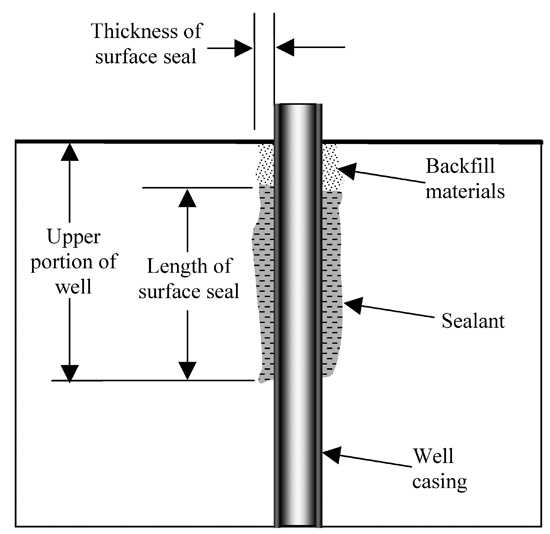
Figure 1. Surface seal in the outermost annulus of the well (surface casing removed).
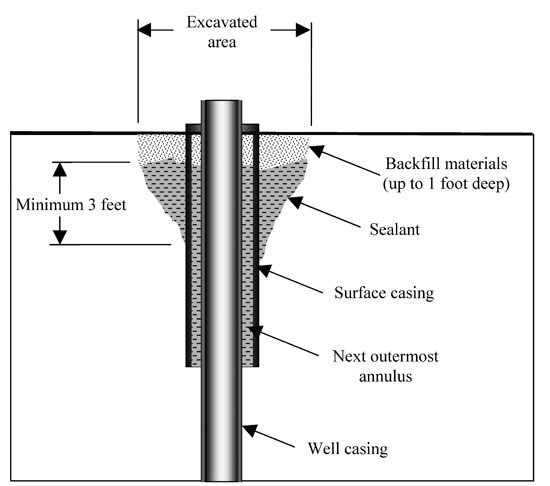
Figure 2. Surface seal in the outermost annulus of the well (where an annular space is created during the installation of the surface casing and the surface casing has not been removed) and in the next outermost annulus.
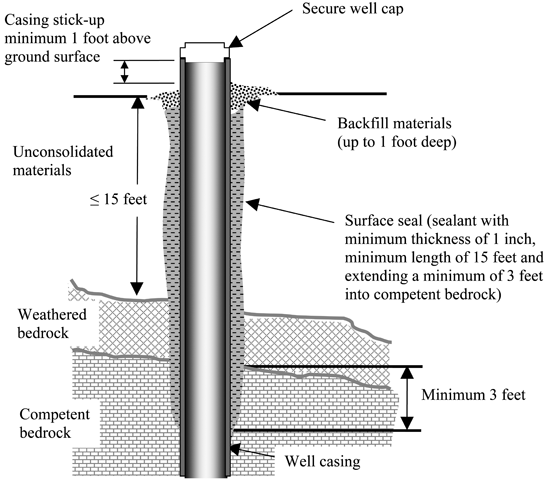
Figure 3. Minimum sealing requirements for drilled wells greater than 15 feet in depth used for water supply where bedrock is at or within 15 feet of ground surface.
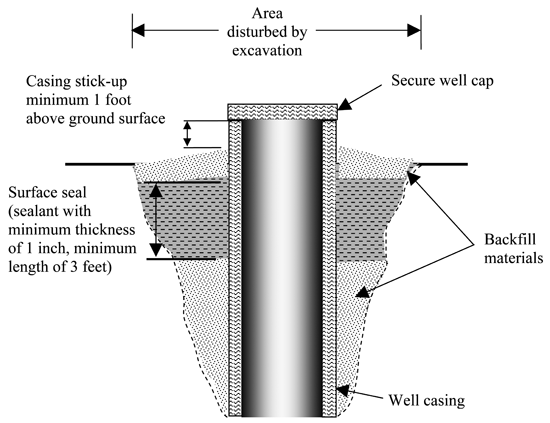
Figure 4. Minimum sealing requirements for excavated wells (for exceptions see Table 1).
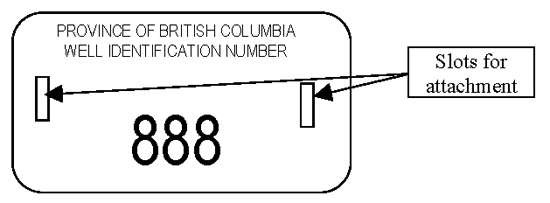
Figure 5. Example of a well identification plate, approximately 3 inch x 1.5 inch (7.5 cm x 4.0 cm) in size.
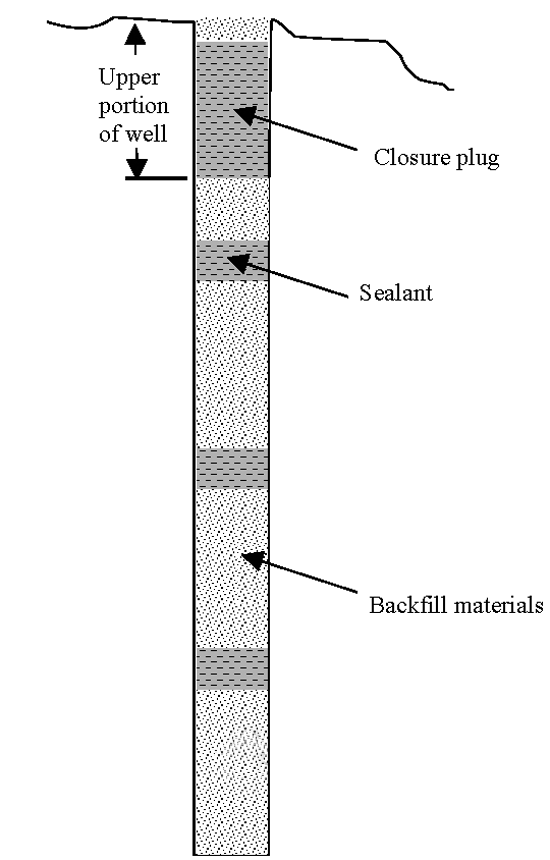
Figure 6. Well closure with sealants, backfill materials and closure plug.
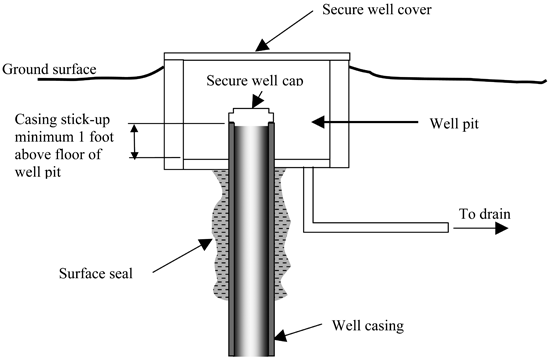
Figure 7. Minimum capping and covering requirements for all wells completed below ground surface (except drainage wells and geotechnical wells).
Reporting Requirements for Well Identification for a Well that is for the Purpose of Supplying a Water Supply System
1. Well Identification Plate Information
Date:................................................... Well Identification Number:.......................................................
Plate attached by:..........................................................................................................................................
Description of where plate is attached (usually attached to the well casing or well cap):.....................................
......................................................................................................................................................................
2. Water Well Information
Name for the Water Supply System Well (e.g., "Township of Langley # 8"):....................................................
Well location description or address:.....................................................................................................................................................................................................
............................................................................................................................................................................................................................................................
Latitude (degree/minutes/seconds):.........................................;
Longitude (degree/minutes/seconds):......................................, or
UTM Northing to within 33 feet (10 m):.....................................................
UTM Easting to within 33 feet (10 m):...........................................................
Source of Latitude/Longitude or UTM coordinates (check one):
GPS [ ] 1:20,000 map [ ] 1:50,000 map [ ] Other (please specify) [ ]
.....................................................................................................................................................................................................................................................
....................................................................................................................................................................................................................................................
| Legal Description of Well Location | ||
| Township:................................................................................ | Section:..................................................... | Plan:......................................................................... |
| District Lot:............................................................................. | Range:....................................................... | PID:.......................................................................... |
| Lot:......................................................................................... | Block:....................................................... | |
If well construction report is attached to this form, please check [ ]
3. Water Supply System Information
Water Supply System Name:............................................................................................................................................................................................
Owner Name:.................................................................................................................................................................................................................
Mailing Address:...........................................................................................................................................................................................................
City or Town:.............................................................................................................................. Postal Code:...........................................................
Phone Number:.................................................................... E-Mail:.....................................................................................................................
Requirements for Well Closure Reports that Must Be Submitted
1 For the purposes of section 6 (9) of this Code, the well closure report must provide all of the following information:
(a) name and mailing address of the well owner;
(b) site address, legal description or PID (parcel identifier) of the property on which the well is located;
(c) geographic coordinates (UTM or latitude and longitude) for the well recorded to a precision of within 33 feet (10 m);
(d) location map sketch or location description of the well on the property;
(f) well identification plate number if known;
(g) if applicable, an attached copy of the well construction report (well record);
(h) depth and diameter of the well;
(i) method of drilling well (for example, excavated, drilled or driven);
(j) diameter of well casing or liner and composition of material;
(l) if applicable, an attached copy of the written confirmation of any alternative specifications, and the alternative specifications, of the engineer or qualified professional;
(m) details of the closure describing the depths, types and amounts of sealant and backfill material;
(n) name, address and telephone number of the person completing the work;
(o) name, address and telephone number of the person supervising completion of the work;
(p) date of commencement and date of completion of the work.
Requirements for Well Closure Reports that Must Be Retained
1 For the purposes of section 6 (10) of this Code, the well closure report must provide all of the following information:
(a) name and mailing address of the well owner;
(b) site address, legal description or PID (parcel identifier) of the property on which the well is located;
(c) geographic coordinates (UTM or latitude and longitude) for the well recorded to a precision of within 33 feet (10 m);
(d) location map sketch or location description of the well on the property;
(f) if applicable, an attached a copy of the written confirmation of any alternative specifications, and the alternative specifications, of the engineer or qualified professional;
(g) details of the closure showing the depths, types and amounts of sealant and backfill material;
(h) name and address of person completing the work;
(i) name and address of the person supervising completion of the work;
(j) date of commencement and date of completion of the work.
Surface Sealing
| Column 1 | Column 2 | Column 3 | Column 4 | Column 5 | Column 6 | ||
| Class of well | Sub-class of well | Method of drilling | Orientation of well | Surface seal required? | Minimum length of surface seal required (in feet) | ||
| Hole depth <15 feet | Hole depth >15 feet | Hole depth <15 feet | Hole depth >15 feet | ||||
| Water supply | Domestic | Drilling | Vertical | Required | Required | 3 | 15 |
| Drilling | Horizontal | Optional | Required | Not specified | 15 | ||
| Driving | Vertical | Required | Required | 3 | 3 | ||
| Jetting | Vertical | Required | Required | 3 | 15 | ||
| Excavating | Vertical | Required | Required | 3 | 3 | ||
| Non-Domestic | Drilling | Vertical | Required | Required | 3 | 15 | |
| Drilling | Horizontal | Required | Required | 3 | 15 | ||
| Driving | Vertical | Required | Required | 3 | 3 | ||
| Jetting | Vertical | Required | Required | 3 | 15 | ||
| Excavating | Vertical | Required | Required | 3 | 3 | ||
| Monitoring | Temporary (< 90 days) | Drilling | Vertical | Optional | Required | Not specified | 3 V |
| Drilling | Horizontal | Optional | Required | Not specified | 3 V | ||
| Driving | Vertical | Optional | Required | Not specified | 3 V | ||
| Excavating | Vertical | Optional | Required | Not specified | 3 V | ||
| Permanent (> 90 days) | Drilling | Vertical | Optional | Required | Not specified | 3 V | |
| Drilling | Horizontal | Optional | Required | Not specified | 3 V | ||
| Driving | Vertical | Optional | Required | Not specified | 3 V | ||
| Excavating | Vertical | Optional | Required | Not specified | 3 V | ||
| Recharge or Injection | Drilling | Vertical | Required | Required | 3 V | 3 V | |
| Driving | Vertical | Required | Required | 3 V | 3 V | ||
| Excavating | Vertical | Required | Required | 3 V | 3 V | ||
| Dewatering or Drainage | Temporary (< 90 days) | Drilling | Vertical | Optional | Optional | Not specified | Not specified |
| Drilling | Horizontal | Optional | Optional | Not specified | Not specified | ||
| Driving | Vertical | Optional | Optional | Not specified | Not specified | ||
| Jetting | Vertical | Optional | Optional | Not specified | Not specified | ||
| Excavating | Vertical | Optional | Optional | Not specified | Not specified | ||
| Permanent (> 90 days) | Drilling | Vertical | Required | Required | 3 V | 3 V | |
| Drilling | Horizontal | Required | Required | 3 V | 3 V | ||
| Driving | Vertical | Required | Required | 3 V | 3 V | ||
| Jetting | Vertical | Required | Required | 3 V | 3 V | ||
| Excavating | Vertical | Required | Required | 3 V | 3 V | ||
| Remediation | Temporary (< 90 days) | Drilling | Vertical | Optional | Optional | Not specified | Not specified |
| Drilling | Horizontal | Optional | Optional | Not specified | Not specified | ||
| Driving | Vertical | Optional | Optional | Not specified | Not specified | ||
| Jetting | Vertical | Optional | Optional | Not specified | Not specified | ||
| Excavating | Vertical | Optional | Optional | Not specified | Not specified | ||
| Permanent (> 90 days) | Drilling | Vertical | Required | Required | 3 V | 3 V | |
| Drilling | Horizontal | Required | Required | 3 V | 3 V | ||
| Driving | Vertical | Required | Required | 3 V | 3 V | ||
| Jetting | Vertical | Required | Required | 3 V | 3 V | ||
| Excavating | Vertical | Required | Required | 3 V | 3 V | ||
| Geotechnical (does not involve water transfer) | Borehole | Drilling | Various | Optional | Optional | Not specified | Not specified |
| Test pit | Various | Various | Optional | Optional | Not specified | Not specified | |
| Special type of hole | Various | Various | Optional | Optional | Not specified | Not specified | |
| Closed loop geothermal | Drilling | Various | Required | Required | 3 V | 3 V | |
| Explanation | ||
| Optional | = | A surface seal is not required but is recommended in cases where there is a significant potential for contaminants to enter the well either at the time of drilling or at a later date. |
| 3 V | = | The length of the surface seal must be at least 3 feet, unless a qualified professional who has competency in the field of hydrogeology or geotechnical engineering or an engineer under the Water Act confirms in writing that a lesser length will not significantly increase the risk of a contaminant entering the well or aquifer. |
| Note: | If it is not desirable to have the sealant exposed at the ground surface, the sealant may extend to within 1 foot of the ground surface to allow for 1 foot of backfill materials but must still have a total length at least equal to that specified in the Table. | |
Well Identification Plate
| Column 1 | Column 2 | Column 3 | Column 4 | Column 5 | Column 6 | Column 7 |
| Class of well | Sub-class of well | Method of drilling | Orientation of well | Well ID plate required? | Is reporting of well identification number required? | Method of reporting the well identification number |
| Water Supply | Domestic | Drilling | Vertical | Yes | Yes | Existing well that is for the purpose of supplying a water supply system - Schedule 2; other water supply wells - in the well construction report |
| Drilling | Horizontal | Yes | Yes | Existing well that is for the purpose of supplying a water supply system - Schedule 2; other water supply wells - in the well construction report | ||
| Driving | Vertical | Yes | Yes | Existing well that is for the purpose of supplying a water supply system - Schedule 2; other water supply wells - in the well construction report | ||
| Jetting | Vertical | Yes | Yes | Existing well that is for the purpose of supplying a water supply system - Schedule 2; other water supply wells - in the well construction report | ||
| Excavating | Vertical | Yes | Yes | Existing well that is for the purpose of supplying a water supply system - Schedule 2; other water supply wells - in the well construction report | ||
| Non- Domestic | Drilling | Vertical | Yes | Yes | In the well construction report | |
| Drilling | Horizontal | Yes | Yes | In the well construction report | ||
| Driving | Vertical | Yes | Yes | In the well construction report | ||
| Jetting | Vertical | Yes | Yes | In the well construction report | ||
| Excavating | Vertical | Yes | Yes | In the well construction report | ||
| Monitoring | Temporary (< 90 days) | Drilling | Vertical | No | No | Not applicable |
| Drilling | Horizontal | No | No | Not applicable | ||
| Driving | Vertical | No | No | Not applicable | ||
| Excavating | Vertical | No | No | Not applicable | ||
| Permanent (> 90 days) | Drilling | Vertical | No | No | Not applicable | |
| Drilling | Horizontal | No | No | Not applicable | ||
| Driving | Vertical | No | No | Not applicable | ||
| Excavating | Vertical | No | No | Not applicable | ||
| Recharge or Injection | Drilling | Vertical | Yes | Yes | In the well construction report | |
| Driving | Vertical | No | No | Not applicable | ||
| Excavating | Vertical | No | No | Not applicable | ||
| Dewatering or Drainage | Temporary (< 90 days) | Drilling | Vertical | No | No | Not applicable |
| Drilling | Horizontal | No | No | Not applicable | ||
| Driving | Vertical | No | No | Not applicable | ||
| Jetting | Vertical | No | No | Not applicable | ||
| Excavating | Vertical | No | No | Not applicable | ||
| Permanent (> 90 days) | Drilling | Vertical | Yes - dewatering wells only | Yes - dewatering wells only | In the well construction report | |
| Drilling | Horizontal | No | No | Not applicable | ||
| Driving | Vertical | No | No | Not applicable | ||
| Jetting | Vertical | No | No | Not applicable | ||
| Excavating | Vertical | No | No | Not applicable | ||
| Remediation | Temporary (< 90 days) | Drilling | Vertical | No | No | Not applicable |
| Drilling | Horizontal | No | No | Not applicable | ||
| Driving | Vertical | No | No | Not applicable | ||
| Jetting | Vertical | No | No | Not applicable | ||
| Excavating | Vertical | No | No | Not applicable | ||
| Permanent (> 90 days) | Drilling | Vertical | No | No | Not applicable | |
| Drilling | Horizontal | No | No | Not applicable | ||
| Driving | Vertical | No | No | Not applicable | ||
| Jetting | Vertical | No | No | Not applicable | ||
| Excavating | Vertical | No | No | Not applicable | ||
| Geotechnical (does not involve water transfer) | Borehole | Drilling | Various | No | No | Not applicable |
| Test pit | Various | Various | No | No | Not applicable | |
| Special type of hole | Various | Various | No | No | Not applicable | |
| Closed loop geothermal | Drilling | Various | No | No | Not applicable |
Well Closure
| Column 1 | Column 2 | Column 3 | Column 4 | Column 5 | Column 6 | Column 7 | Column 8 | ||
| Class of well | Sub-class of well | Method of drilling | Orientation of well | Closure plug required? | Minimum length of closure plug required (in feet) | Does a well closure report need to be completed? | Does a well closure report need to be submitted or retained? | ||
| Hole depth < 15 feet | Hole depth > 15 feet | Hole depth < 15 feet | Hole depth > 15 feet | ||||||
| Water supply | Domestic | Drilling | Vertical | Required | Required | 3 V | 15 V | Yes - see Schedule 3 | Submit |
| Drilling | Horizontal | Optional | Required | Not specified | 15 V | Yes - see Schedule 3 | Submit | ||
| Driving | Vertical | Required | Required | 3 V | 3 V | Yes - see Schedule 3 | Submit | ||
| Jetting | Vertical | Required | Required | 3 V | 15 V | Yes - see Schedule 3 | Submit | ||
| Excavating | Vertical | Required | Required | 3 V | 3 V | Yes - see Schedule 3 | Submit | ||
| Non Domestic | Drilling | Vertical | Required | Required | 3 V | 15 V | Yes - see Schedule 3 | Submit | |
| Drilling | Horizontal | Required | Required | 3 V | 15 V | Yes - see Schedule 3 | Submit | ||
| Driving | Vertical | Required | Required | 3 V | 3 V | Yes - see Schedule 3 | Submit | ||
| Jetting | Vertical | Required | Required | 3 V | 15 V | Yes - see Schedule 3 | Submit | ||
| Excavating | Vertical | Required | Required | 3 V | 3 V | Yes - see Schedule 3 | Submit | ||
| Monitoring | Temporary (< 90 days) | Drilling | Vertical | Optional | Required | Not specified | 3 V | No | Not applicable |
| Drilling | Horizontal | Optional | Required | Not specified | 3 V | No | Not applicable | ||
| Driving | Vertical | Optional | Required | Not specified | 3 V | No | Not applicable | ||
| Excavating | Vertical | Optional | Required | Not specified | 3 V | No | Not applicable | ||
| Permanent (> 90 days) | Drilling | Vertical | Optional | Required | Not specified | 3 V | Yes - see Schedule 4 | Retain | |
| Drilling | Horizontal | Optional | Required | Not specified | 3 V | Yes - see Schedule 4 | Retain | ||
| Driving | Vertical | Optional | Required | Not specified | 3 V | Yes - see Schedule 4 | Retain | ||
| Excavating | Vertical | Optional | Required | Not specified | 3 V | Yes - see Schedule 4 | Retain | ||
| Recharge or Injection | Drilling | Vertical | Required | Required | 3 V | 3 V | Yes - see Schedule 3 | Submit | |
| Driving | Vertical | Required | Required | 3 V | 3 V | No | Not applicable | ||
| Excavating | Vertical | Required | Required | 3 V | 3 V | No | Not applicable | ||
| Dewatering or Drainage | Temporary (< 90 days) | Drilling | Vertical | Optional | Required | Not specified | 3 V | No | Not applicable |
| Drilling | Horizontal | Optional | Required | Not specified | 3 V | No | Not applicable | ||
| Driving | Vertical | Optional | Required | Not specified | 3 V | No | Not applicable | ||
| Jetting | Vertical | Optional | Required | Not specified | 3 V | No | Not applicable | ||
| Excavating | Vertical | Optional | Required | Not specified | 3 V | No | Not applicable | ||
| Permanent (> 90 days) | Drilling | Vertical | Required | Required | 3 V | 3 V | Yes - dewatering wells only - see Schedule 3 | Submit | |
| Drilling | Horizontal | Required | Required | 3 V | 3 V | Yes - dewatering wells only - see Schedule 4 | Retain | ||
| Driving | Vertical | Required | Required | 3 V | 3 V | Yes - dewatering wells only - see Schedule 4 | Retain | ||
| Jetting | Vertical | Required | Required | 3 V | 3 V | Yes - dewatering wells only - see Schedule 4 | Retain | ||
| Excavating | Vertical | Required | Required | 3 V | 3 V | Yes - dewatering wells only - see Schedule 4 | Retain | ||
| Remediation | Temporary (< 90 days) | Drilling | Vertical | Optional | Required | Not specified | 3 V | No | Not applicable |
| Drilling | Horizontal | Optional | Required | Not specified | 3 V | No | Not applicable | ||
| Driving | Vertical | Optional | Required | Not specified | 3 V | No | Not applicable | ||
| Jetting | Vertical | Optional | Required | Not specified | 3 V | No | Not applicable | ||
| Excavating | Vertical | Optional | Required | Not specified | 3 V | No | Not applicable | ||
| Permanent (> 90 days) | Drilling | Vertical | Required | Required | 3 V | 3 V | Yes - see Schedule 4 | Retain | |
| Drilling | Horizontal | Required | Required | 3 V | 3 V | Yes - see Schedule 4 | Retain | ||
| Driving | Vertical | Required | Required | 3 V | 3 V | Yes - see Schedule 4 | Retain | ||
| Jetting | Vertical | Required | Required | 3 V | 3 V | Yes - see Schedule 4 | Retain | ||
| Excavating | Vertical | Required | Required | 3 V | 3 V | Yes - see Schedule 4 | Retain | ||
| Geotechnical (does not involve water transfer) | Borehole | Drilling | Various | Optional | Required | Not specified | 3 V | Yes - see Schedule 4 | Retain |
| Test pit | Various | Various | Optional | Optional | Not specified | Not specified | No | Not applicable | |
| Special type of hole | Various | Various | Optional | Optional | Not specified | Not specified | No | Not applicable | |
| Closed loop geothermal | Drilling | Various | Required | Required | 3 V | 3 V | Yes - see Schedule 4 | Retain | |
| Explanation | ||
| Optional | = | A closure plug is not required, but is recommended in cases where there is a significant potential for contaminants to enter the well either at the time of construction or at a later date. |
| 3 V | = | The length of the closure plug must be at least 3 feet, unless a qualified professional who has competency in the field of hydrogeology or geotechnical engineering or an engineer under the Water Act confirms in writing that a lesser length will not significantly increase the risk of a contaminant entering the well or aquifer. In wells to be closed, the closure plug should extend a minimum 3 feet below the base of any excavation dug to remove the pitless adapter. |
| 15 V | = | The length of the closure plug must be at least 15 feet, unless a qualified professional who has competency in the field of hydrogeology or geotechnical engineering or an engineer under the Water Act confirms in writing that a lesser length will not significantly increase the risk of a contaminant entering the well or aquifer. |
| Retain | = | Keep a copy of the well closure report at least 5 years and make it available on request. |
| Submit | = | Submit the final well closure report to the Comptroller of Water Rights. |
| Note: | If it is not desirable to have the closure plug exposed at the ground surface, the closure plug may extend to within 1 foot of the ground surface to allow for 1 foot of backfill materials but must still have a total length at least equal to that specified in the Table. | |
Well Caps
| Column 1 | Column 2 | Column 3 | Column 4 | Column 5 |
| Class of well | Sub-class of well | Method of drilling | Orientation of well | Well cap required? |
| Water supply | Domestic | Drilling | Vertical | Yes |
| Drilling | Horizontal | Yes V | ||
| Driving | Vertical | Yes | ||
| Jetting | Vertical | Yes | ||
| Excavating | Vertical | Yes | ||
| Non Domestic | Drilling | Vertical | Yes | |
| Drilling | Horizontal | No | ||
| Driving | Vertical | Yes | ||
| Jetting | Vertical | Yes | ||
| Excavating | Vertical | Yes | ||
| Monitoring | Temporary (< 90 days) | Drilling | Vertical | Yes |
| Drilling | Horizontal | Yes V | ||
| Driving | Vertical | Yes | ||
| Excavating | Vertical | Yes | ||
| Permanent (> 90 days) | Drilling | Vertical | Yes | |
| Drilling | Horizontal | Yes V | ||
| Driving | Vertical | Yes | ||
| Excavating | Vertical | Yes | ||
| Recharge or Injection | Drilling | Vertical | Yes | |
| Driven | Vertical | Yes | ||
| Excavating | Vertical | Yes | ||
| Dewatering or Drainage | Temporary (< 90 days) | Drilling | Vertical | Yes - dewatering wells only |
| Drilling | Horizontal | Yes - dewatering wells only | ||
| Driving | Vertical | Yes - dewatering wells only | ||
| Jetting | Vertical | Yes - dewatering wells only | ||
| Excavating | Vertical | Yes - dewatering wells only | ||
| Dewatering or Drainage — continued | Permanent (> 90 days) | Drilling | Vertical | Yes - dewatering wells only |
| Drilling | Horizontal | Yes - dewatering wells only | ||
| Driving | Vertical | Yes - dewatering wells only | ||
| Jetting | Vertical | Yes - dewatering wells only | ||
| Excavating | Vertical | Yes - dewatering wells only | ||
| Remediation | Temporary (< 90 days) | Drilling | Vertical | Yes |
| Drilling | Horizontal | Yes | ||
| Driving | Vertical | Yes | ||
| Jetting | Vertical | Yes | ||
| Excavating | Vertical | Yes | ||
| Permanent (> 90 days) | Drilling | Vertical | Yes | |
| Drilling | Horizontal | Yes | ||
| Driving | Vertical | Yes | ||
| Jetting | Vertical | Yes | ||
| Excavating | Vertical | Yes | ||
| Geotechnical (does not involve water transfer) | Borehole | Drilling | Various | No |
| Test pit | Various | Various | No | |
| Special type of hole | Various | Various | No | |
| Closed loop geothermal | Drilling | Various | No |
| Explanation | ||
| Yes V | = | Well to be capped, unless a qualified professional who has competency in the field of hydrogeology or geotechnical engineering or an engineer under the Water Act confirms in writing that a well cap is not required. |
[Provisions of the Water Act, R.S.B.C. 1996, c. 483, relevant to the enactment of this regulation: section 101]