Note: This regulation has been placed in the Regulations Point in Time collection. This regulation is not repealed.
| B.C. Reg. 453/59 O.C. 2886/59; Certificate 10031 |
Railway Act
Part II: General Operating Regulations
Definitions
In these regulations, unless the context otherwise requires:
"Act" means the Railway Act of British Columbia;
"chief inspector" or "inspector" means an inspecting engineer, inspector or assistant inspector appointed under the provisions of the Act or of the Public Service Act;
"company" means a railway company incorporated under the Act, and includes every person and every company by Act of the Legislature authorized to construct, own or operate a railway within the Province;
"conductor" or "head brakeman" means any person in charge of a train whose duty it is to receive train orders and to conduct the operation of a train upon a railway;
"dispatcher" means any person whose duty it is to issue train orders and to direct the movement of trains upon a railway;
"freight trailer" means any railway conveyance other than standard railway equipment, or hand push cars, on which freight is transported and which is hauled by rail car motive power;
"hand car" means a railway vehicle self-propelled by muscular power and of such proportions that it can be removed from the rails by hand;
"locomotive", wherever mentioned in these regulations, is defined as any self-propelled vehicle operating on the tracks of a railway, equipped with air or mechanical brakes, or both, and the necessary standard equipment, such as automatic couplers, etc., by means of which it can be used for the handling of logging, passenger and freight cars of any standard railway equipment;
"locomotive engineer" means any person having charge of or operating a locomotive.
[am. B.C. Reg. 40/91, s. 2.]
Definitions
"common carrier railway" means a company engaged in the operation of a railway or tramway transportation service for hire which serves the public;
"current of traffic" means the movement of trains on a main track, in one direction, specified by the regulations;
"extra train" means a train not authorized by a timetable schedule, which may be designated as
(a) "work extra" for a work train,
(b) "passenger extra" for an extra passenger train,
(c) "extra" for any other extra train;
"fixed signal" means a signal of fixed location indicating a condition affecting the movement of a train;
"industrial railway" means a company engaged in the operation of a railway, tramway or aerial tramway transportation service which does not serve the public;
"locomotive crane" means any railway crane capable of movement under its own motive power and shall include steam shovels, ditchers, pile drivers and any other self-propelled work equipment;
"locomotive crane engineer" means any person having charge of or operating a locomotive crane;
"main track" means a track extending through yards and between stations, upon which trains are operated by train order, or the use of which is controlled by block signals;
"owner" means the person who is the registered owner in fee, and, subject to payment to the Crown of any unpaid purchase money, includes a purchaser of Crown lands and a pre-emptor of Crown lands;
"passenger trailer" means any railway conveyance in which passengers or workmen are transported and which is hauled by rail car motive power;
"pilot" means a person assigned to a train when the engineer or conductor, or both, are not fully acquainted with the physical characteristics or running rules of the road, or portion of the road, over which the train is to be moved;
"power car" or "rail car" means any railway conveyance in which passengers or workmen are transported and which is self-propelled by its own motive power;
"power car operator" means any person having charge of or operating a power car;
"railway" means any railway which the company is authorized to construct and operate, and includes all branches, sidings, stations, depots, wharves, rolling stock, equipment, works, property (real or personal) and works connected therewith, and also every railway bridge, tunnel or other structure connected with the railway and undertaking of the company;
"siding" means a track auxiliary to the main track for meeting or passing trains, limited to the distance between 2 adjoining telephone stations;
"single track" means a main track upon which trains are operated in both directions;
"speeder" means a 4 wheeled railway vehicle similar to a hand car but propelled by a motor, such as is generally used by section gangs or by officials for inspection purposes;
"station" means a place designated by a signboard by name, at which a train may stop for traffic, or to enter or leave the main track, or from which fixed signals are operated;
"superior train" means a train having precedence over another train;
"train" means a locomotive or power car, or more than one locomotive or power car coupled, with or without cars displaying markers;
"train of superior right" means a train given precedence in the direction specified by the company's rules;
"yard" means a system of tracks within limits defined by yard limit boards provided for the making up of trains, storing of cars and other purposes, over which movements may be made subject to prescribed signals and rules;
"yard engine" means an engine assigned to yard service and working within yard limits.
[am. B.C. Reg. 40/91, s. 2.]
Extent and Application of Regulations
Application of regulations and company rules
1 These regulations shall govern the operation of all railways operating under the jurisdiction of the government of British Columbia, except where the minister has approved special operating rules for a railway company operating as a common carrier. Otherwise, company operating rules approved by the minister shall be deemed to be in addition to the regulations as herein set forth except as otherwise provided in this Part.
[en. B.C. Reg. 488/74.]
Employees subject to regulations
2 Persons employed in any service on trains or speeders are subject to these regulations and must be conversant with them.
When employees doubt meaning of rule or regulation
3 Employees when in doubt as to the meaning of any rule or regulation must apply to the proper authority for an explanation.
Employees must have copies of rules
4 All employees whose duties are prescribed by rules shall be provided by the company with a copy of said rules, and a receipt taken for same and kept on file in the company's office.
Rules must be followed
6 Employees must render every assistance in their power in carrying out the rules. Any violation of the rules must be reported.
Intoxicants prohibited
7 The use of intoxicants by employees, while on duty, is prohibited. Their use, or the frequenting of places where they are sold, is sufficient cause for dismissal.
Conductor
8 (1) Except where special rules are approved by the minister respecting common carrier railways, no person, unless holding a certificate granted by the minister, shall be employed as conductor or head brakeman in charge of a train; provided, however, that in case of illness or other unavoidable cause the conductor in charge is absent from duty, without fault or collusion of the owners or of any person interested, and a conductor holding such certificate is not available, then such deficiency may be filled temporarily until a conductor holding such certificate can be obtained, and the chief inspector shall be immediately notified of the temporary change by the owner of the railway and by the person acting temporarily as conductor.
(2) Upon application in writing by the company, the chief inspector may issue a temporary permit to a sufficiently qualified applicant to act as conductor on the railway specified, such permit to be good only for one month from date of issue.
(3) Candidates for examination must fill out a form of application which can be obtained from the chief inspector and, when properly filled in, should be returned to him, together with the applicable fee prescribed in the Railway Fees Regulation.
(4) Candidates for examination as conductor must have at least 12 months service as trainman or brakeman and must enclose with their application testimonials to this effect from their former or present employers, together with a certificate as to their eyesight and hearing from a qualified doctor.
(5) Railway companies having operating rules approved by the minister must examine their employees as to their general ability and knowledge of such rules before giving them employment or promotion as conductors. They must also notify the chief inspector at least one month before such examinations take place, in order that an inspector appointed by the ministry may be in attendance, in which case employees passing such an examination satisfactory to the inspector shall not be required to be the holders of certificates of competency as conductors granted by the minister.
(6) If a conductor proves to the satisfaction of the chief inspector that he has lost his certificate, or that it has been destroyed, he may obtain a duplicate of the original upon payment of the applicable fee prescribed in the Railway Fees Regulation.
(7) A conductor must be at least 21 years of age and, except as otherwise provided in this Part, must hold a certificate granted by the minister.
[am. B.C. Regs. 172/87, s. 1 (a), (b); 2/99, App. 1, ss. 1-2.]
Locomotive engineers
9 Locomotive engineers must be at least 21 years of age and hold a certificate granted by the minister in accordance with Part III, Locomotives [B.C. Reg. 454/59].
Power car operators
10 Power car operators must be at least 18 years of age and hold a certificate granted by the minister in accordance with Part V, Power cars [B.C. Reg. 456/59].
Locomotive crane engineers
11 Locomotive crane engineers must be at least 18 years of age and hold a certificate granted by the minister in accordance with Part IX, Locomotive Cranes [B.C. Reg. 460/59].
Dispatcher
12 (1) Except where special rules are approved by the minister with respect to dispatching on common carrier railways, no person shall be employed as dispatcher, and no person shall act as dispatcher on a railway, except he is the holder of a certificate in that behalf granted by the minister; provided, however, that in case of illness or other unavoidable cause the dispatcher in charge is absent from duty, without fault or collusion of the owners or of any person interested, and a dispatcher holding such certificate is not available, then such deficiency may be filled temporarily until a dispatcher holding such certificate can be obtained, and the chief inspector shall be notified of the temporary change by the owner.
(2) Pursuant to the preceding subsection and upon application in writing by the company, the chief inspector may issue a temporary permit to a sufficiently qualified person to act as dispatcher on the railway specified, such permit to be valid only for a period of 30 days from date of issue.
(3) Candidates for examination as dispatchers must fill out a form of application which can be obtained from the chief inspector and, when properly filled in, shall be returned to him, together with the applicable fee prescribed in the Railway Fees Regulation.
(4) Candidates for examination as dispatcher must have at least 2 years service in the railway running trades, or 2 years experience in train service, or one year experience as dispatcher.
(5) Railway companies having operating rules approved by the minister must examine their employees as to their general ability and knowledge of such rules before giving them employment or promotion as dispatchers. They must also notify the chief inspector at least one month before such examinations take place, in order that an inspector appointed by the ministry may be in attendance, in which case employees passing such an examination satisfactory to the inspector shall not be required to be the holders of certificates of competency as dispatchers granted by the minister.
[am. B.C. Regs. 172/87, s. 1 (a); 2/99, App. 1, s. 3.]
Certificates May be Cancelled, Marked or Revoked
Term of certificate
14 Every certificate of competency, unless otherwise restricted, shall be granted for life, or during good conduct, but if it be proven to the minister the holder is guilty of negligence or has refused to comply with any of the provisions of the regulations, the minister may suspend, mark or revoke his certificate.
Locomotive movement
15 Locomotives shall not be moved, either on shop track or in roundhouse, without first making sure that there is no person or persons working around or under same.
Headlights
16 Headlights on the front of every locomotive shall be displayed at night. (NOTE — Operation of power cars used for conveying passengers or workmen or for hauling other cars is defined in Part V [B.C. Reg. 456/59].)
Spouts of standpipes and water tanks
17 The spout of standpipes, when not in use, shall be fastened parallel with the main track, and enginemen are required to see that this is done after using any such pipe. The spouts of water tanks shall be properly put back into clear position before proceeding.
Passengers on locomotives
18 Engineers shall not allow persons other than the train crew or authorized officials to ride on locomotives without a written order from manager or superintendent.
Safe riding on cars
19 Trainmen shall see that all persons ride in a safe position on cars. No persons, except the train crew, shall be allowed to ride on cars loaded with logs.
Trainmen's duties
20 (1) Trainmen shall not allow persons to get on or off trains while in motion.
(2) On skeleton logging cars where hand operated retainers are used, trainmen shall not set such retainers while the train is in motion.
Clear tracks before moving cars
21 Trainmen shall see that the tracks are clear where workmen are working before moving cars. Cars shall not be "kicked" on to tracks where cars are being loaded or unloaded or where there are boarding cars.
Protection of car left on main line
22 No car shall be left on any main line without being properly protected.
Passengers, baggage and goods
23 Attention is directed to section 185 (1) to (9) of the Railway Act respecting the carrying of passengers, baggage or goods.
No freight in car with passengers
24 No train shall have any freight, merchandise, lumber or logging car in the rear of any car carrying passengers or workmen.
Position and speed of locomotives
25 (1) Except as otherwise ordered in writing by the minister, all trains with cars carrying passengers or workmen shall be headed by locomotives, and no such car shall be pushed ahead of the locomotive except in case of switchbacks.
(2) With the exception of tank locomotives equipped with pilot on tender, no locomotive running tender first shall exceed a speed of 25 miles an hour.
Log haulage across tracks
26 When in yarding it is necessary to haul logs across a track, every train must be brought to a full stop within 200 feet of the point of crossing, unless or until given signals by flagmen to proceed. Warning signs shall be set and maintained 80 rods from each side of point of log haulage across any railway.
Application of B.C. Reg. 457/59
27 Part VI, Uniform Regulations Governing the Determination of Visual Acuity, Colour Perception, and Hearing of Railway Employees [B.C. Reg. 457/59], shall govern.
Train safety responsibility
29 Every conductor and engineman shall be responsible for the safety of his train and, under conditions not provided for by the regulations, take every precaution for the protection of his train.
Dispatching and Train Movements
Sections 31 to 51 apply
30 With reference to dispatching and train movements, every company shall observe and carry out, and shall cause its employees to observe and carry out, the provisions of sections 31 to 51, inclusive.
Dispatcher requirement
31 Every company shall have in its employment a properly qualified dispatcher as set forth in section 12, who shall observe and carry out the duties hereinafter imposed on a dispatcher.
Dispatcher qualifications
32 No company shall appoint any person as a dispatcher unless that person is at least 21 years of age, and is familiar with the line in respect to which he is to act as dispatcher, and has passed an examination on train rules and the rules of the company as set forth in section 12.
Dispatcher methods and records
33 The dispatcher must carry out train dispatching under methods approved by the ministry. All movements must be entered on dispatch sheets. Dispatch sheets must be of approved type and all entries shall be made in ink.
Train orders
34 No company shall permit the movement of any locomotive, train, motorcar, speeder or other equipment except pursuant to a train order made by the dispatcher. A train order may be given verbally by telephone or in writing. Orders shall be in writing on common carrier roads.
Use of assigned number in train order
35 When a dispatcher issues an order in relation to a motor, speeder or locomotive, he shall designate the motor, speeder or locomotive to which the order relates by using the number assigned to that motor, speeder or locomotive.
Verbal orders
36 When a dispatcher issues an order by telephone, he shall, before issuing the order, ascertain that the person receiving the message at the receiving telephone station is one of the following persons, namely: the head brakeman, the speederman, or, in the case of a light engine, the engineer of the equipment to which the order relates. The head brakeman, speederman or engineer receiving the order shall confirm the order by repeating it to dispatcher, who shall thereupon indicate whether or not the order has been correctly repeated.
Flagmen
37 In case of telephone failure or any other reason whereby communication with dispatcher is not obtainable, persons in charge of all trains and speeders shall cause them to be protected by flagmen on the portion of the line affected.
Entry onto main line
38 The person in charge of a train or speeder shall not permit the train or speeder to leave the initial point or to enter the main line at a junction without an appropriate order from the dispatcher, and then only in accordance with that order.
Arrival of train at destination
39 On the arrival of a train or speeder at its destination, the person in charge of the train or speeder shall immediately notify the dispatcher of the arrival.
Persons to be notified of proposed train movement
40 The head brakeman shall, before the movement in respect to which any order of a dispatcher relates, notify the trainmen, engineer and firemen of that order.
Which train takes siding
41 The persons in charge of trains at meeting points shall, in determining which train shall take the siding, be governed by the company's rules or by order issued by the dispatcher.
Speeder meeting train
42 In case a speeder meets a train, the speederman shall, unless otherwise ordered by the dispatcher, cause the speeder to take the siding.
Stopping of train at meeting point
43 At a meeting point the person in charge of every train or speeder shall bring the train to a stop, unless otherwise ordered by the dispatcher.
Stopping point to be clear of switch
44 At a meeting point the person in charge of a train or speeder shall stop his train or speeder clear of the switch to be used by the opposing train or speeder.
Movement past meeting point
45 The person in charge of a train or speeder shall not cause it to pass any meeting point until he is satisfied that the train or speeder met is the train or speeder mentioned in the order of the dispatcher.
Actions must be in accordance with order
46 With respect to the movement of any train to which any order of a dispatcher relates, all persons affected shall act only in accordance with that order.
Numbering of camps, junctions, etc.
47 To facilitate dispatching, it is recommended that every company cause every camp, junction and spur to be numbered and all passing tracks to be lettered.
Numbering of motors, speeders and locomotives
48 Every company shall assign to each motor, speeder and locomotive a distinctive number, and shall cause that number to be displayed in conspicuous figures on the motor, speeder or locomotive to which it has been assigned, and no company and no employee of a company shall operate a motor, speeder or locomotive unless a number has been assigned and displayed as required by this rule.
Distance between trains and speeders
49 The person in charge of a train or speeder following a train or speeder shall keep his train or speeder at a distance not less than 1 500 feet from the preceding train or speeder.
Protection of trains
50 Where an accident or delay to a train or car on a main or branch line is likely to endanger the safety of that or any other train or car, the head brakeman shall properly protect the train or car at both ends with flags or signals, so as to ensure that approaching trains come to a standstill at a sufficient distance to avoid accident.
If part of train detaches
51 If a train parts while in motion, the trainmen shall take every step to prevent damage to the detached portion and shall cause the signals prescribed by sections 105 (d) and 107 (f) to be given. No person shall cause the detached portion to be moved or passed until the front portion has returned to the detached portion.
Coupling Cars and Riding Footboards
No standing in front of moving engines or cars
52 Trainmen shall not be allowed to stand in front of moving engines or cars for the purpose of boarding same, whether engine or car is proceeding backward or forward.
No entering between cars when in motion
53 Trainmen must not enter between cars when in motion for the purpose of adjusting drawbars or knuckles, or raising locking blocks, or turning angle cock, or uncoupling air hose with either hand or foot.
No riding on footboards
54 Trainmen are prohibited from riding on footboards between engine and cars when cars are being pushed and on leading footboard while coupling engines to cars.
Warning before switching
55 When switching in yards or where men are working around the track, trainmen must give warning and see that workmen are clear before starting to switch cars.
Engine pushing car
56 Except in case of shifting and making up trains in yards where there are no highway crossings at rail level, the person in charge of an engine shall not cause that engine to push any car unless there is a flagman in a conspicuous position on the front of the leading car.
Train movement at level crossing
57 Whenever in any city, town or village any train is passing over or along a highway at rail level, and is not headed by an engine moving forward in the ordinary manner, the company shall station on that part of the train, or of the tender if that is in front, which is then foremost a person who shall warn persons standing on, or crossing, or about to cross the track of such railway.
Switch position responsibility
58 When a switch has been used by a train, the conductor of that train shall, after his train has passed over the switch, see that the switch is set in its proper position. Conductors are responsible for the position of the switches used by them and their trainmen, except where switch tenders are stationed.
Train standing at level crossing
59 Whenever any railway crosses any highway at rail level, the company shall not, nor shall its officers, agents or employees, wilfully permit any engine, tender or car or any portion thereof to stand on any part of such highway for a longer period than 5 minutes at one time, nor, in shunting, to obstruct public traffic for a period longer than 5 minutes at one time, nor, in the opinion of the minister, unnecessarily interfere therewith.
Open switch
60 No person shall leave a switch open for a following train, unless said switch is in charge of a trainman of such train.
Derails
61 It shall be the duty of every trainman to see that derails are properly put in operation to derail rolling stock left on spur tracks, sidings, loading works or tracks where down grade exists or where otherwise derailment is necessary for the protection of train movement on any railway.
Brake testing
62 Engineers must personally make a terminal test of the airbrakes when the locomotive is coupled to a train. The train brake system shall be fully charged. During the charging period, train brakes shall be examined by the conductor or trainman for leakage and the necessary adjustments made to reduce the leakage to a minimum. It must be known that all angle cocks throughout the train are open, brake pipe cut-out cocks open, release valves closed, retaining valve handles turned down, and hand brakes fully released unless required on grades. After the train brake system is charged to the required pressure, the engineer upon request or proper signal will make a service reduction of the brake pipe pressure of 20 pounds, leave the brake valve handle on lap position and note brake pipe leakage, which must not exceed 7 pounds in one minute. Conductors and trainmen shall examine the train brakes to see that the brakes are applied in service application on each car and that the piston travel is between 6 and 8 inches and that the brakeshoes are firmly against the wheels. When the release signal is given, the engineer must release the brakes through the engineer's brake valve and trainman must see that all brakes are released. Conductor or trainman must notify the engineer of the car or cars on which the brakes are not in proper working order.
Airbrakes
63 Engineers must assure themselves that airbrakes are working properly by making a running test of the brakes as soon as speed of train permits and before descending heavy grades. At least 85% of the number of cars in every train shall have airbrakes in good working order. The engineer of the leading engine, when more than one engine is attached to a train, shall control and operate the train.
Handbrakes
64 No train of cars shall be left standing without a locomotive until the handbrakes are set and the airbrakes bled. After recoupling, handbrakes must not be released until airbrakes are fully charged.
Retaining valves on grades
65 Retaining valves must be used when descending grades whenever required by the company's instructions, or whenever it is considered necessary for the safe operation of the train.
Load inspection
66 Head brakemen shall personally inspect all cars, especially loads with logs, before they are coupled to the engine, and shall satisfy themselves that all cars are properly and securely loaded and that the couplings and airbrakes are in good order; and if there is any doubt as to the safety of such loading or the efficiency of brakes or couplings of any car, the train shall proceed slowly to the nearest sidetrack and the head brakeman shall set out the said car before proceeding with his train.
Loads on common carrier railways
67 Where cars are loaded for transit on the railways of common carriers, all companies shall strictly conform to the regulations from time to time approved by the American Association of Railroads governing the loading of lumber, logs and stone upon open cars, and the loading and carrying of structural material, plates, rails and girders; and no material of any kind shall be carried on the roofs of cars.
Inspection of train before starting up
68 No conductor or trainman shall permit his train to start until he is satisfied that every car in the train is in good order. He shall, pursuant to section 62 of this Part, inspect them whenever he has an opportunity to do so, particularly when entering or leaving sidings or waiting for other trains. Brakemen must inspect with extra care all cars taken in their train at intermediate stations.
Bad order cars
69 Not more than 2 bad order cars shall be hauled on any one train, and if train line is out of order, bad order cars must be kept at the rear of the train and attached to train by safety straps or chains.
Cars with cut out brakes
70 When any cars with brakes cut out are in trains, not more than 2 of such cars shall be hauled together.
Boomsticks or double loads
71 Boomsticks or double loads will be carried at rear end of train and shall, in the event of the continuity of the train line not extending to the rear car, be equipped with an approved device which will set the emergency airbrakes in the train should the rear car of the split load slip or break away.
Explosives and Goods of Dangerous Nature
No dangerous goods on train carrying passengers
73 Explosives or goods of a dangerous nature must not be placed on locomotives or on cars carrying passengers or workmen, and no car carrying any such goods shall be attached to any train or car carrying passengers or workmen.
Winter equipment
74 (1) All locomotives shall be equipped with appliances for sanding the rail in front and back of wheels and shall have a sufficient supply of dry sand at all times.
(2) During the winter season, November 1 to April 30, front windows of locomotive cabs operating on common carrier railways shall be equipped with double windows, the same to be made airtight; or with an air jet defroster acting upon a single pane of glass, or such a device as may be approved by the ministry for the purpose of preventing the frosting over of front windows.
Engineer inspection of locomotive
75 Engineers must personally see that their locomotives are in good working order before putting them in service; special attention being given to handholds, footboards, automatic couplers and levers, airbrakes, sanding devices, gauge glasses and guards, test cocks, steam gauges, safety valves and steam leaks that obscure vision.
Cars used for carrying workmen
76 All cars used for carrying workmen must be equipped with an air emergency valve and handbrake so placed that trainmen can apply same when necessary, and on logging railways must be provided in addition with saw and axe racks. These must be maintained in proper condition at all times. Doors, when used, must not be more than 4 feet wide. Handholds must be placed on each side of door openings and will extend down to not less than 4 feet from the top of rail. Where double doors are used, stanchions or handrails shall be attached so that handrails will be not less than 4 feet apart. Handrails are to have free clearance of not less than 2 1/2 inches from body of car. Bottom step of car is to be not more than 14 inches from top of rail.
Hand brakes
78 Hand brakes on logging cars must be applied and released without the necessity of the employees having to let go of the brake handle. Cars equipped with brake mast handles with spare ends fitted to brake mast are prohibited. Hand brakes on logging cars must be of approved type as specified in Part IV, Regulations [B.C. Reg. 455/59].
Standards
79 All railway equipment is to be constructed in accordance with the Association of American Railroads' standards. (See Part IV, Regulations [B.C. Reg. 455/59].)
Car repair details
80 Car repairers must pay special attention to automatic couplers, operating levers and chains, air brakes, hand brakes, lever and ratchet. Any defect in these is dangerous and must be repaired before being put in use again.
Numbering of rolling stock
81 All rolling stock shall be designated by a number. Duplication of numbers must be avoided.
Cleaning dates marked on equipment
82 Cleaning dates of brake cylinders and triple valves shall be stencilled directly on such equipment with white paint. Chalk or other marking substitutes for this purpose will not be permitted.
Hand brakes on skeleton logging cars
83 All skeleton logging cars shall be maintained with an approved type of hand brake as set forth in Part IV, Regulations [B.C. Reg. 455/59]; such brake shall be kept in working order.
Footboards
84 (1) Footboards on motive power shall be maintained as set forth in Part IV [B.C. Reg. 455/59].
(2) Split footboards shall have end blocking properly maintained at inside ends of footboards.
Openings on logging cars
85 On logging cars all openings over draught gear must be covered over to comply with safety standards as set forth in Part IV, Regulations [B.C. Reg. 455/59], and such covering shall be maintained in good order.
Signals when moving locomotives
86 Locomotives shall not be moved at any time without sounding bell or whistle.
Signals when at crossings, etc.
87 The whistle must be blown when approaching highway crossings, yards and places where men are working at least 80 rods before reaching same. The bell must be kept ringing continuously at highway crossings or when passing through yards from the time of the sounding of the whistle until the engine is clear of such crossings or yards.
Unnecessary use of signals prohibited
88 The unnecessary use of either the whistle or the bell is prohibited. They will be used only as prescribed by rule or law or to prevent accident.
Signals when approaching trestles and bridges
89 On trestles and bridges the length of which exceeds 200 feet, approaching motive power shall blow warning whistles when not less than 1 500 feet distant.
Display of headlights on trains at night
90 The headlights will be displayed to the front of every train by night, but must be concealed when a train turns out to meet another and has stopped clear of main track, or is standing to meet trains at the end of double track or at junctions and switch properly set for approaching train.
Display of headlights on yard engines at night
91 Yard engines will display the headlight to the front and rear by night. When not provided with a headlight at the rear, 2 white lights must be displayed. Yard engines will not display markers. Under conditions not requiring display of markers, road engines without cars will display a white light on the rear of the tender by night.
Lights on cars
92 (1) When cars are pushed by an engine (except when shifting or making up trains in yards), a white light must be displayed on the front of the leading car by night.
(2) Marker lights must be displayed by night to indicate the rear end of every train when standing or being moved on any main track, branch track or passing track where traffic is moving or may be moving, as follows: When the rear car consists of a caboose, passenger coach or workmen's car, there shall be one marker light on each side of rear displaying green lights to the front and sides and red light to the rear if running with the current of traffic or standing on a main track or branch track; when the rear car of any train is other than a caboose, passenger coach or workmen's car, there shall be one marker light only on the rear centre displaying green light to the sides and red to the rear if running with the current of traffic or standing on a main track or branch track. If standing on passing track clear of the main track, all trains will display green to the rear. The lights displayed to the rear must be changed from green to red before a train fouls the main track when leaving a passing track, or returns to the main track with the current of traffic.
(3) By night, or in foggy or stormy weather, a red light must be placed on unattended cars or dead engines obstructing main tracks within yard limits.
Signals when workmen are near
93 A blue flag by day and a blue light by night, displayed at one or both ends of an engine, car or train, indicates that workmen are under or about it; when thus protected, it must not be coupled to or moved. Workmen will display the blue signals, and the same workmen are alone authorized to remove them. Other cars must not be placed on the same track so as to intercept the view of the blue signals, without first notifying the workmen.
Signals at road, street and highway crossings
94 (1) Watchmen stationed at public road and street crossings must use red signals only when necessary to stop trains.
(2) A hand signal by day and a signal by (clear white light) lantern at night will be used to protect the movements of vehicles over railways at highway crossings at which trainmen are required to give protection during the time trains are uncoupled at such crossings.
Emergency signals for defective track
95 In emergency cases when track is suddenly found defective, any employee shall, by the use of flags, lights or other signals, use every effort possible to stop trains in both directions.
"Slow" signals
96 A "slow" sign or a yellow flag placed beside the track on the same side as the engineer or motorman of an approaching train shall be used to mark a point where a slow order is in effect. Maintenance gangs shall display yellow flags at the side of the track 400 feet in each direction from the point where such gangs are working.
Signals for entering sidings
97 The person in charge of a train or speeder when entering a siding shall, if practicable, cause the train to pull into the siding; if necessary to back into the siding, he shall, before backing into the siding, cause the train to be protected by a flagman.
Imperfect or absent signal
98 A signal imperfectly displayed, or the absence of a signal at a place where a signal is usually shown, must be regarded as a stop signal, and the fact reported to the dispatcher.
Train start must await correct signal
99 The person in charge of a train shall not allow that train to start until after the proper signal has been given.
Appliances for signalling
100 Employees whose duties may require them to give signals must provide themselves with the proper appliances, keep them in good order and ready for immediate use.
Flags and lamps
101 Flags of the prescribed colour must be used by day, and lamps of the prescribed colour by night.
Use of night and day signals
102 Night signals are to be displayed from sunset to sunrise. When weather or other conditions obscure day signals, night signals must be used in addition.
Visible colour signals
| Colour | Indication | |
| (a) Red | Stop. | |
| (b) Green | Proceed, and for other uses prescribed by the regulations. | |
| (c) Yellow | Proceed with caution, and for other uses prescribed by the regulations. | |
| (d) Green and white | Flag stop. | |
| (e) Blue | See section 93. |
Fusee on or near track
104 A fusee on or near the track burning red must not be passed until burned out. When burning yellow, it is a caution signal.
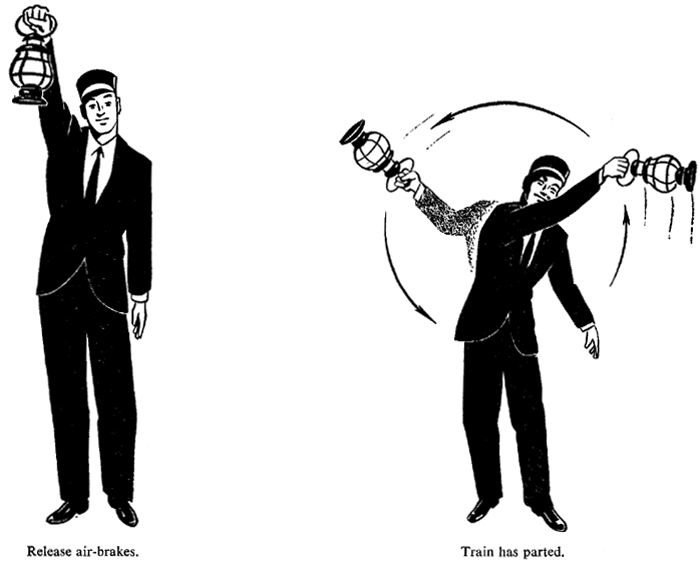
(Illustrated by diagrams)
Hand flag and lamp signals
| Manner of Using | Indication | ||
| (a) | Swung across the track | Stop. | |
| (b) | Raised and lowered vertically | Proceed. | |
| (c) | Swung vertically in a circle at half arm's length across the track when the train is standing | Back. | |
| (d) | Swung vertically in a circle at arm's length across the track when the train is running | Train has parted. | |
| (e) | Swung horizontally above the head when the train is standing | Apply air brakes. | |
| (f) | Held at arm's length above the head when the train is standing | Release air brakes. | |
Engine whistle signals
107 NOTE — The signals prescribed are illustrated by "o" for short sounds,"—" for long sounds. The sound of the whistle should be distinct, with intensity and duration proportionate to the distance signal is to be conveyed.
| Sound | Indication | |
| (a) o | Stop. Apply brakes. | |
| (b) — — | Release brakes, or ready to proceed. | |
| (c) — o o o | Flagman go out to protect rear of train. | |
| (d) — — — — | Flagman return from west or south. | |
| (e) — — — — — | Flagman return from east or north. | |
| (f) — — — | When running, train parted; to be repeated until answered by the signal prescribed by section 105 (d). Answer to 105 (d). | |
| (g) o o | Answer to any signal not otherwise provided for. | |
| (h) o o o | When train is standing, back. Answer to 105 (c) and 109 (c). When train is running, answer to 109 (d). | |
| (i) o o o o | Call for signals. | |
| (j) — o o | To call attention of extra trains and of trains of the same or inferior class or inferior right to signals displayed for a following section. | |
| (k) — — o — | Approaching public road crossings at grade and at whistle posts as prescribed in section 87. | |
| (l) ————— | Approaching stations, watering and fueling points, junctions, the end of double track, drawbridges, railway crossings at grade. To be blown when approaching at one mile distance. | |
| (m) o — | When double heading, air brakes have failed on leading engine and second engine is to take control of them. Answer to 107 (m); to be given by second engine as soon as it has control of air brakes. | |
| (n) o o — | Answer to 107 (j). |
A succession of short sounds of the whistle is an alarm for persons or animals on the track.
Signals by torpedo explosion
108 The explosion of one torpedo is a signal to stop, the explosion of 2 not more than 200 and not less than 100 feet apart is a signal to reduce speed and look out for a stop signal. Torpedoes must not be placed near stations or public crossings, nor where persons are liable to be injured by them.
Communicating signals
| Sound | Indication | ||
| (a) | Two | When train is standing, start. | |
| (b) | Two | When train is running, stop at once. | |
| (c) | Three | When train is standing, back. | |
| (d) | Three | When train is running, stop at next station. | |
| (e) | Four | When train is standing, apply or release air brakes. | |
| (f) | Four | When train is running, reduce speed. | |
| (g) | Five | When train is standing, call in flagman. | |
| (h) | Five | When train is running, increase speed. | |
| (i) | Six | When train is running, increase steam heat. | |
| (j) | Seven | When train is running, release air brakes, or sticking brake. | |
Demerit System on Industrial Railways
Demerit system
111 (1) All persons employed in train service on industrial railways shall be subject to an assessment of demerit marks by the ministry, and a record shall be kept accordingly in the office of the chief inspector. Demerit marks shall be assessed against the record of any employee for any infraction of the regulations made pursuant to the Railway Act or for a general disregard of safety to himself or his fellow employees.
(2) If, after full and proper investigation, it is proven to the satisfaction of an inspector that any person employed in train service has violated any of the regulations, such violation shall be immediately brought to the attention of the employee concerned.
(3) Anyone proved guilty of a violation as set forth in the preceding subsection shall be notified in writing within 30 days by the chief inspector setting forth the nature of the violation and the number of demerit marks imposed for such violation.
(4) The number of demerit marks imposed upon any person shall be doubled for a repetition of the same offence.
(5) A net accumulation of 60 demerit marks shall be cause for the minister to order an employee out of train service for a period of 12 calendar months.
(6) Twenty demerit marks shall be cancelled from the accumulated total for each 12 months' good behaviour.
(7) Any person who considers an injustice has been done to him, with respect to the imposition of demerit marks, may appeal to the minister, and after such appeal has been acted upon the person concerned shall be advised in writing as to the decision.
(8) The imposition of demerit marks shall not be misconstrued to exonerate the defaulter, upon summary conviction, from penalties as prescribed under section 275 of the British Columbia Railway Act.
Figure 1
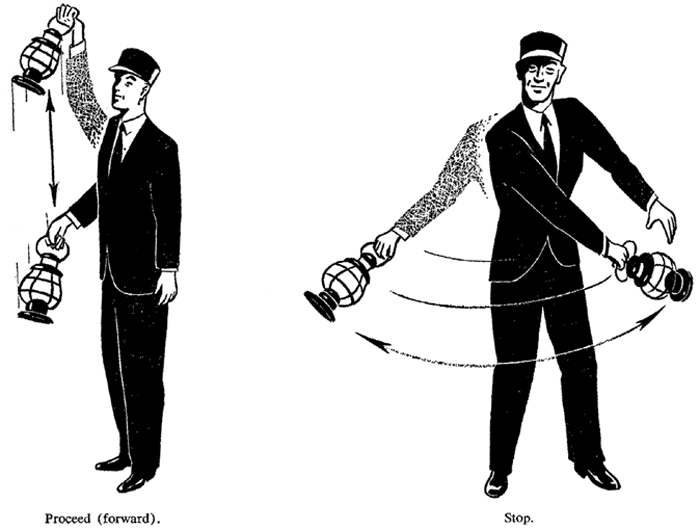
Figure 2
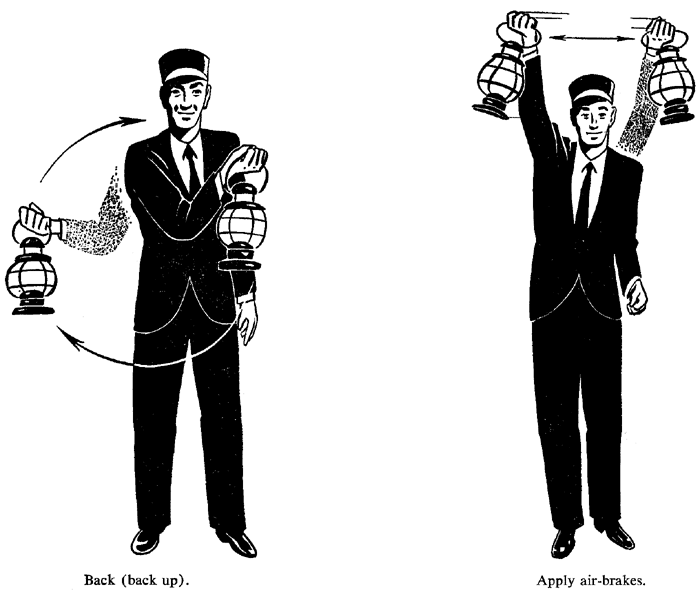
Figure 3
| 1. | Regulation originally made by authority of minister, by certificate, subject to approval of the Lieutenant Governor in Council (see R.S.B.C. 1948-285-7), since July 8, 1976, regulation made by authority of minister only. |
[Provisions of the Railway Act, R.S.B.C. 1996, c. 395, relevant to the enactment of these regulations: section 271]