Note: This regulation has been placed in the Regulations Point in Time collection. This regulation is not repealed.
| B.C. Reg. 455/59 O.C. 2886/59; Certificate 10031 |
Railway Act
Part IV: Railway Safety Appliance Standards Regulation
Extent and application of these regulations
These regulations shall apply to all railways owned and operated by companies within the legislative authority of the Province of British Columbia.
Division 1 - Box and Other House Cars
Handbrakes
1 (1) Number —Each box or other house car shall be equipped with an efficient handbrake which shall operate in harmony with the power brake thereon.
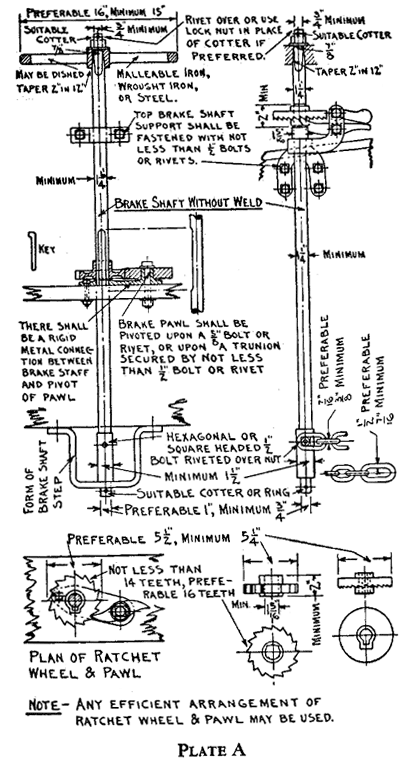
The handbrake may be of any efficient design, but must provide the same degree of safety as the design shown on Plate A.
(2) Dimensions — The brake shaft shall be not less than 1 1/4 inches in diameter, of wrought iron or steel without weld.
The brake wheel may be flat or dished, not less than 15, preferably 16, inches in diameter, of malleable iron, wrought iron or steel.
(3) Location — The handbrake shall be so located that it can be safely operated while car is in motion.
The brake shaft shall be located on end of car to the left of and not less than 17 nor more than 22 inches from centre.
(4) Manner of application — There shall be not less than 4 inches clearance around rim of brake wheel.
Outside edge of brake wheel shall be not less than 4 inches from a vertical plane parallel with end of car and passing through the inside face of knuckle when closed with coupler horn against the buffer block or end sill.
Top brake shaft support shall be fastened with not less than 1/2 inch bolts or rivets. (See Plate A)
A brake shaft step shall support the lower end of brake shaft. A brake shaft step which will permit the brake chain to drop under the brake shaft shall not be used. U-shaped form of brake shaft step is preferred. (See Plate A)
Brake shaft shall be arranged with a square fit at its upper end to secure the handbrake wheel; said square fit shall be not less than 7/8 of an inch square. Square fit taper; nominally 2 in 12 inches. (See Plate A)
Brake chain shall be of not less than 3/8, preferably 7/16, inch wrought iron or steel, with a link on the brake rod end of not less than 7/16, preferably 1/2, inch wrought iron or steel, and shall be secured to brake shaft drum by not less than 1/2 inch hexagon or square headed bolt. Nut on said bolt shall be secured by riveting end of bolt over nut. (See Plate A)
Lower end of brake shaft shall be provided with a trunnion of not less than 3/4, preferably one, inch in diameter extending through brake shaft step and held in operating position by a suitable cotter or ring. (See Plate A)
Brake shaft drum shall be not less than 1 1/2 inches in diameter. (See Plate A)
Brake ratchet wheel shall be secured to brake shaft by a key or square fit; said square fit shall be not less than 1 5/16 inches square. When ratchet wheel with square fit is used, provision shall be made to prevent ratchet wheel from rising on shaft to disengage brake pawl. (See Plate A)
Brake ratchet wheel shall be not less than 5 1/4 inches in diameter and shall have not less than 14, preferably 16, teeth. (See Plate A)
If brake ratchet wheel is more than 36 inches from brake wheel, a brake shaft support shall be provided to support this extended upper portion of brake shaft; said brake shaft support shall be fastened with not less than 1/2 inch bolts or rivets.
The brake pawl shall be pivoted upon a bolt or rivet not less than 5/8 of an inch in diameter or upon a trunnion secured by not less than 1/2 inch bolt or rivet and there shall be a rigid metal connection between brake shaft and pivot of pawl.
Brake wheel shall be held in position on brake shaft by a nut on a threaded extended end of brake shaft; said threaded portion shall be not less than 3/4 of an inch in diameter; said nut shall be secured by riveting over or by the use of a lock nut or suitable cotter.
Brake wheel shall be arranged with a square fit for brake shaft in hub of said wheel; taper of said fit, nominally 2 in 12 inches. (See Plate A)
Brake step
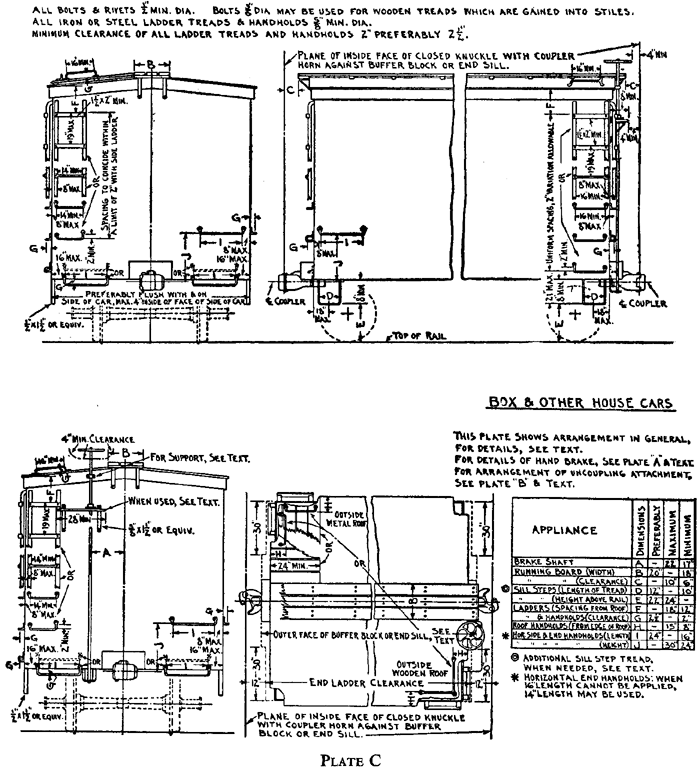
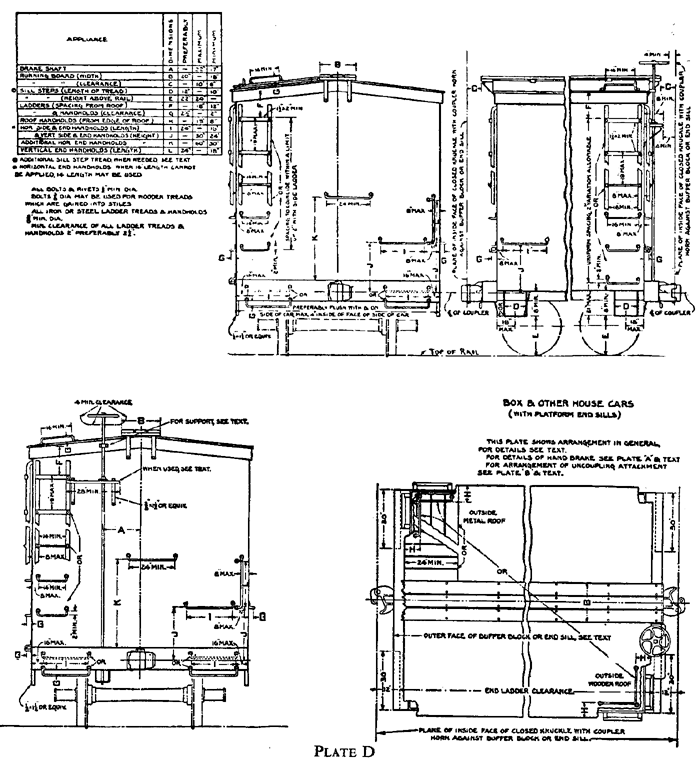
2 (1) If brake step is used, it shall be not less than 28 inches in length. Outside edge shall be not less than 8 inches from face of car and not less than 4 inches from a vertical plane parallel with end of car and passing through the inside face of knuckle when closed with coupler horn against the buffer block or end sill.
(2) Manner of application — Brake step shall be supported by not less than 2 metal braces having a minimum cross sectional area 3/8 by 1 1/2 inches or equivalent, which shall be securely fastened to body of car with not less than 1/2 inch bolts or rivets.
Running boards
3 (1) Number — One longitudinal running board.
On outside metal roof cars 2 latitudinal extensions.
(2) Dimensions — Longitudinal running board shall be not less than 18 and preferably 20 inches in width. Latitudinal extensions shall be not less than 24 inches in width. Wooden running boards or extensions hereafter installed shall be constructed of wood not less than 1 1/8 inches in thickness.
(3) Location — Full length of car, centre of roof.
On outside metal roof cars there shall be 2 latitudinal extensions from longitudinal running board to ladder locations, except on refrigerator cars where such latitudinal extensions cannot be applied on account of ice hatches.
(4) Manner of application — Running board shall be continuous from end to end and not cut or hinged at any point; provided that the length and width of running board may be made up of a number of pieces securely fastened to saddle blocks with screws, bolts or rivets. The ends of longitudinal running boards shall be not less than 6 nor more than 10 inches from a vertical plane parallel with end of car and passing through the inside face of knuckle when closed with coupler horn against the buffer block or end sill; and if more than 4 inches from edge of roof of car, shall be securely supported their full width by substantial metal braces. Running board shall be securely fastened to car and be made of wood or of material which provides the same as or greater degree of safety than wood of 1 1/8 inches thickness. When made of material other than wood the tread surface shall be of anti-skid design and constructed with sufficient open space to permit the elimination of snow and ice from the tread surface.
Sill steps
4 (1) Number — Six.
(2) Dimensions — Minimum cross sectional area 1/2 by 1 1/2 inches or equivalent of wrought iron or steel.
Minimum length of tread 10, preferably 12, inches.
Minimum clear depth, 8 inches.
(3) Location — One near each end of each side of car, so that there shall be not more than 18 inches from end of car to centre of tread of sill step. Also one at each end of car, centre of sill step to be as nearly central with the ladder as possible.
Outside edge of tread of step shall be not more than 4 inches inside of face of side of car, preferably flush with side of car.
Tread shall be not more than 24, preferably not more than 22, inches above the top of rail.
(4) Manner of application —Sill steps exceeding 21 inches in depth shall have an additional tread.
Sill steps shall be securely fastened with not less than 1/2 inch bolts with nuts outside (when possible) and riveted over or with not less than 1/2 inch rivets.
Ladders
5 (1) Number — Four.
(2) Dimensions — Minimum clear length of tread: Side ladders, 16 inches; end ladders, 14 inches.
Maximum spacing between ladder treads, 19 inches.
Top ladder tread shall be located not less than 12 nor more than 18 inches from roof at eaves.
Spacing of side ladder treads shall be uniform within a limit of 2 inches from top ladder tread to bottom tread of ladder.
Maximum distance from bottom tread of side ladder to top tread of sill step, 21 inches.
End ladder treads shall be spaced to coincide with treads of side ladders, a variation of 2 inches being allowed. Where construction of car will not permit the application of a tread of end ladder to coincide with bottom tread of side ladder, the bottom tread of end ladder must coincide with second tread from bottom of side ladder.
Hard wood treads, minimum dimensions 1 1/2 by 2 inches.
Iron or steel treads, minimum diameter 5/8 of an inch.
Minimum clearance of treads, 2, preferably 2 1/2, inches.
(3) Location — One on each side, not more than 8 inches from right end of car; one on each end, not more than 8 inches from left side of car; measured from inside edge of ladder stile or clearance of ladder treads to corner of car.
(4) Manner of application — Metal ladders without stiles near corners of cars shall have foot guards or upward projections not less than 2 inches in height near inside end of bottom treads.
Stiles of ladders, projecting 2 or more inches from face of car, will serve as foot guards.
Ladders shall be securely fastened with not less than 1/2 inch bolts with nuts outside (when possible) and riveted over, or with not less than 1/2 inch rivets. Three-eighths inch bolts may be used for wooden treads which are gained into stiles.
End ladder clearance
6 No part of car above end sills within 30 inches from side of car, except buffer block, brake shaft, brake wheel, brake step, running board or uncoupling lever, shall extend to within 12 inches of a vertical plane parallel with end of car and passing through the inside face of knuckle when closed with coupler horn against the buffer block or end sill, and no other part of end of car or fixtures on same above end sills, other than exceptions herein noted, shall extend beyond the outer face of buffer block.
Roof handholds
7 (1) Number — One over each ladder.
One right angle handhold may take the place of 2 adjacent specified roof handholds, provided the dimensions and locations coincide, and that an extra leg is securely fastened to car at point of angle.
(2) Dimensions — Minimum diameter, 5/8 of an inch, wrought iron or steel.
Minimum clear length, 16 inches.
Minimum clearance, 2, preferably 2 1/2, inches.
(3) Location — On roof of car: One parallel to treads of each ladder, not less than 8 nor more than 15 inches from edge of roof, except on refrigerator cars where ice hatches prevent, when location may be nearer edge of roof.
(4) Manner of application — Roof handholds shall be securely fastened with not less than 1/2 inch bolts with nuts outside (when possible) and riveted over, or with not less than 1/2 inch rivets.
Side handholds
8 (1) Number — Four.
(Tread of side ladder is a side handhold.)
(2) Dimensions — Minimum diameter, 5/8 of an inch, wrought iron or steel.
Minimum clear length, 16 inches, preferably 24 inches.
Minimum clearance, 2, preferably 2 1/2, inches.
(3) Location —Horizontal: One near each end on each side of car.
Side handholds shall be not less than 24 nor more than 30 inches above centre line of coupler, except as provided above, where tread of ladder is a handhold. Clearance of outer end of handhold shall be not more than 8 inches from end of car.
(4) Manner of application — Side handholds shall be securely fastened with not less than 1/2 inch bolts with nuts outside (when possible) and riveted over, or with not less than 1/2 inch rivets.
Horizontal end handholds
9 (1) Number — Eight or more. Four on each end of car.
(Tread of end ladder is an end handhold.)
(2) Dimensions — Minimum diameter, 5/8 of an inch, wrought iron or steel.
Minimum clear length, 16 inches, preferably 24 inches.
A handhold 14 inches in length may be used where it is impossible to use one 16 inches in length.
Minimum clearance, 2, preferably 2 1/2, inches.
(3) Location — One near each side on each end of car, not less than 24 nor more than 30 inches above centre line of coupler, except as provided above when tread of end ladder is an end handhold. Clearance of outer end of handhold shall be not more than 8 inches from side of car.
One near each side of each end of car on face of end sill or sheathing over end sill, projecting outward or downward. Clearance of outer end of handhold shall be not more than 16 inches from side of car.
On each end of cars with platform end sills 6 or more inches in width, measured from end post or siding and extending entirely across end of car, there shall be one additional end handhold not less than 24 inches in length, located near centre of car, not less than 30 nor more than 60 inches above platform end sill.
(4) Manner of application — Horizontal end handholds shall be securely fastened with not less than 1/2 inch bolts with nuts outside (when possible) and riveted over, or with not less than 1/2 inch rivets.
Vertical end handholds
10 (1) Number —Two on full width platform end sill cars as heretofore described.
(2) Dimensions — Minimum diameter, 5/8 of an inch, wrought iron or steel.
Minimum clear length, 18, preferably 24, inches.
Minimum clearance, 2, preferably 2 1/2, inches.
(3) Location — One on each end of car opposite ladder not more than 8 inches from side of car; clearance of bottom end of handhold shall be not less than 24 nor more than 30 inches above centre line of coupler.
(4) Manner of application — Vertical end handholds shall be securely fastened with not less than 1/2 inch bolts with nuts outside (when possible) and riveted over, or with not less than 1/2 inch rivets.
Uncoupling levers
11 (1) Number — Two.
Uncoupling levers may be either single or double and of any efficient design.
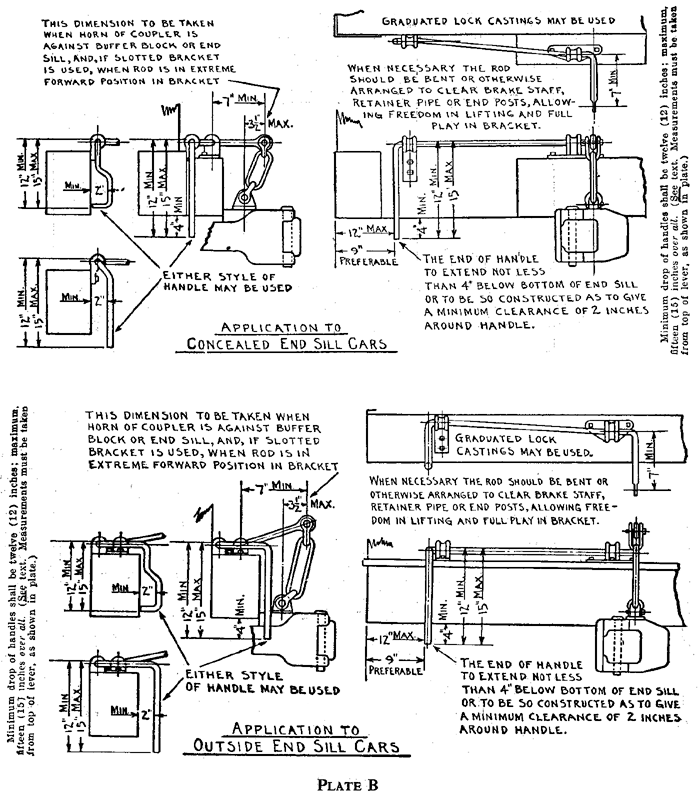
(2) Dimensions — Handles of uncoupling levers, except those shown on Plate B or of similar designs, shall be not more than 6 inches from sides of car.
Uncoupling levers of design shown on Plate B and of similar designs shall conform to the following prescribed limits:
(a) Handles shall be not more than 12, preferably 9, inches from sides of cars. Centre lift arms shall be not less than 7 inches long.
(b) Centre of eye at end of centre lift arm shall be not more than 3 1/2 inches beyond centre of eye of uncoupling pin of coupler when horn of coupler is against the buffer block or end sill. (See Plate B)
(c) Ends of handles shall extend not less than 4 inches below bottom of end sill or shall be so constructed as to give a minimum clearance of 2 inches around handle. Minimum drop of handles shall be 12 inches; maximum, 15 inches overall. (See Plate B)
(d) Handles of uncoupling levers of the "rocking" or "push-down" type shall be not less than 18 inches from the top of rail when lock block has released knuckle and a suitable stop shall be provided to prevent inside arm from flying up in case of breakage.
(3) Location — One on each end of car. When single lever is used, it shall be placed on left side of end of car.
Cars must be equipped with coupler operating lever connected direct with coupler lock or lock lift without use of links, clevises or chains.
Division 2 - Hopper Cars and High-side Gondolas with Fixed Ends
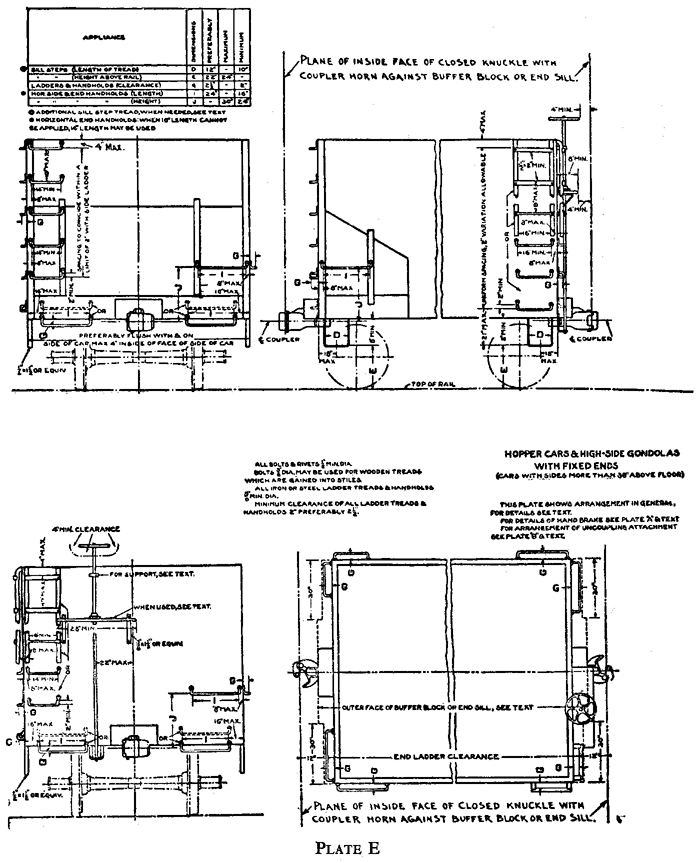
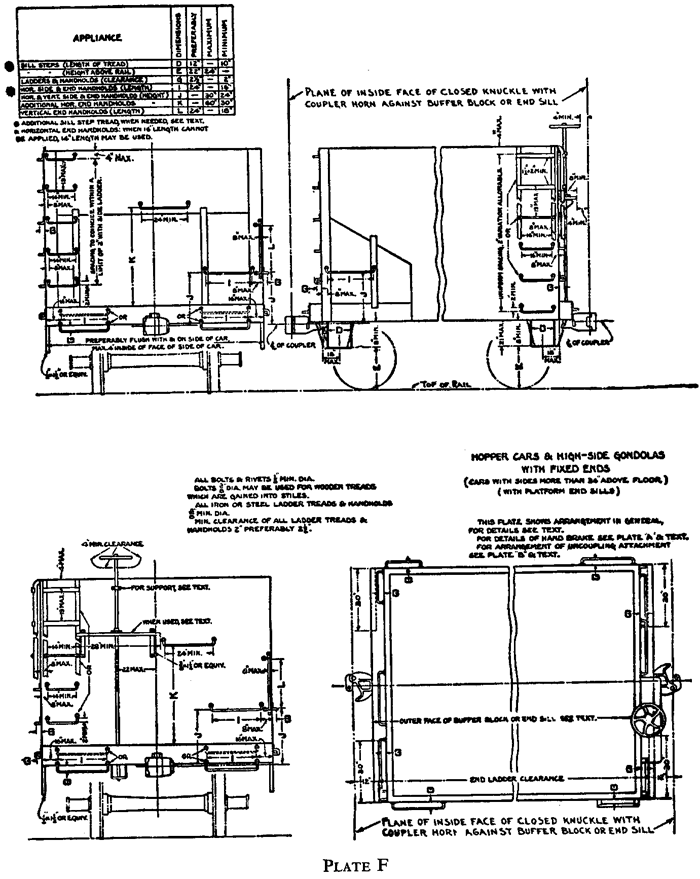
(Cars with sides more than 36 inches above the floor are high-side cars)
Handbrakes
12 (1) Number — Same as specified for "Box and Other House Cars" (Division 1).
(2) Dimensions — Same as specified for "Box and Other House Cars".
(3) Location — Each handbrake shall be so located that it can be safely operated while car is in motion.
The brake shaft shall be located on end of car to the left of and not more than 22 inches from centre.
(4) Manner of application — Same as specified for "Box and Other House Cars".
Sill steps
14 Same as specified for "Box and Other House Cars" (Division 1).
"End" sill steps as specified for "Box and Other House Cars" are required for box and other house cars only.
Ladders
15 (1) Number — Same as specified for "Box and Other House Cars" (Division 1).
(2) Dimensions — Same as specified for "Box and Other House Cars", except that top ladder tread shall be located not more than 4 inches from top of car.
(3) Location — Same as specified for "Box and Other House Cars".
(4) Manner of application — Same as specified for "Box and Other House Cars".
End ladder clearance
20 No part of car above end sills within 30 inches from side of car except buffer block, brake shaft, brake wheel, brake step or uncoupling lever shall extend to within 12 inches of a vertical plane parallel with end of car and passing through the inside face of knuckle when closed with coupler horn against the buffer block or end sill, and no other part of end of car or fixtures on same above end sills, other than exceptions herein noted, shall extend beyond the outer face of buffer block.
Division 3 - Drop-end High-side Gondola Cars
Handbrakes
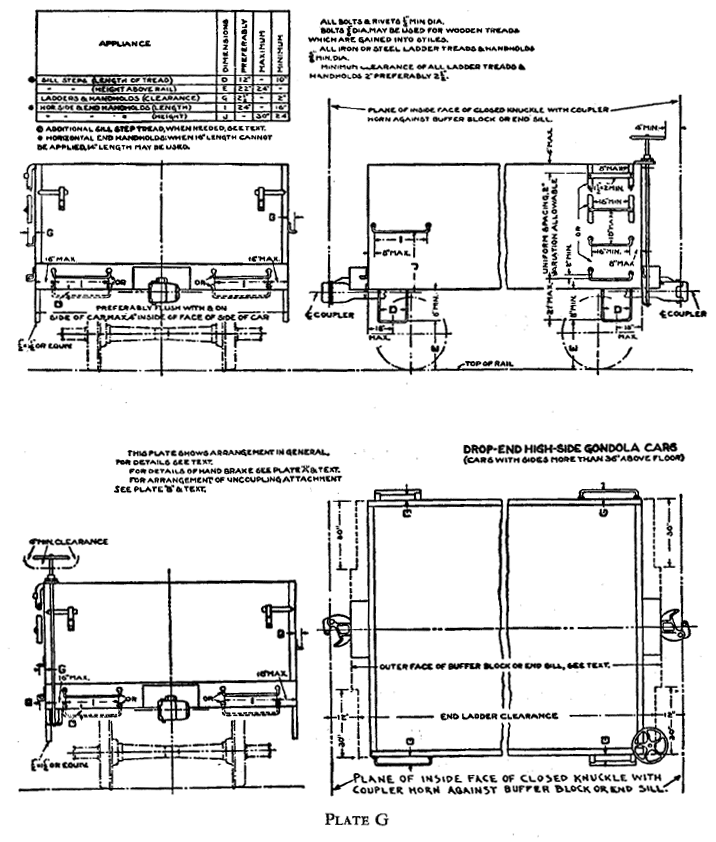
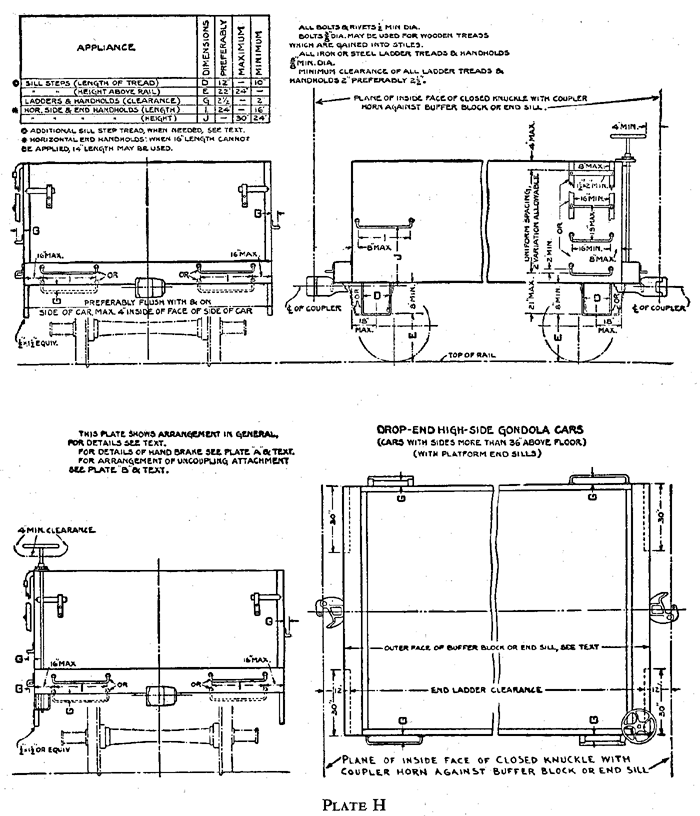
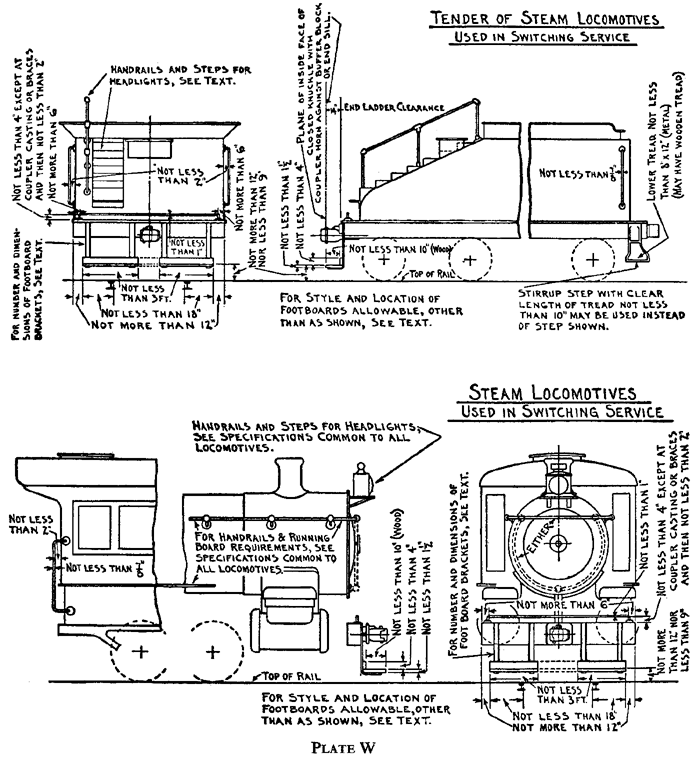
21 (1) Number — Same as specified for "Box and Other House Cars" (Division 1).
(2) Dimensions — Same as specified for "Box and Other House Cars".
(3) Location — Each handbrake shall be so located that it can be safely operated while car is in motion.
The brake shaft shall be located on end of car to the left of the centre.
(4) Manner of application — Same as specified for "Box and Other House Cars".
Sill steps
22 Same as specified for "Box and Other House Cars" (Division 1).
"End" sill steps, as specified for "Box and Other House Cars", are required for box and other house cars only.
Ladders
23 (1) Number — Two.
(2) Dimensions — Same as specified for "Box and Other House Cars" (Division 1), except that top ladder tread shall be located not more than 4 inches from top of car.
(3) Location — One on each side not more than 8 inches from right end of car, measured from inside edge of ladder stile or clearance of ladder treads to corner of car.
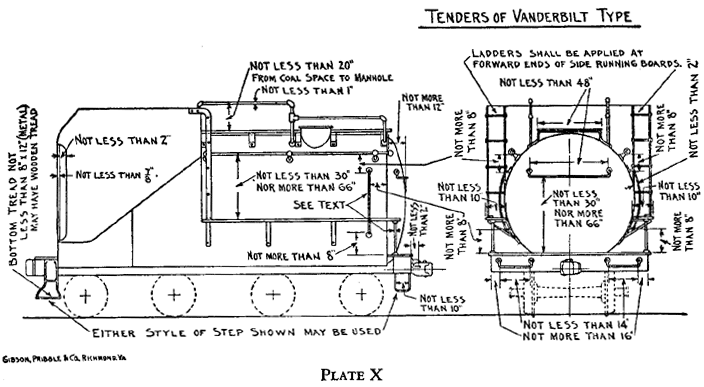
(4) Manner of application — Same as specified for "Box and Other House Cars".
Horizontal end handholds
25 (1) Number — Four.
(2) Dimensions — Same as specified for "Box and Other House Cars" (Division 1).
(3) Location — One near each side of each end of car on face of end sill. Clearance of outer end of handhold shall be not more than 16 inches from side of car.
(4) Manner of application — Same as specified for "Box and Other House Cars".
End ladder clearance
27 No part of car above end sills within 30 inches from side of car except buffer block, brake shaft, brake wheel or uncoupling lever, shall extend to within 12 inches of a vertical plane parallel with end of car and passing through the inside face of knuckle when closed with coupler horn against the buffer block or end sill and no other part of end of car or fixtures on same above end sills, other than exceptions herein noted, shall extend beyond the outer face of buffer block.
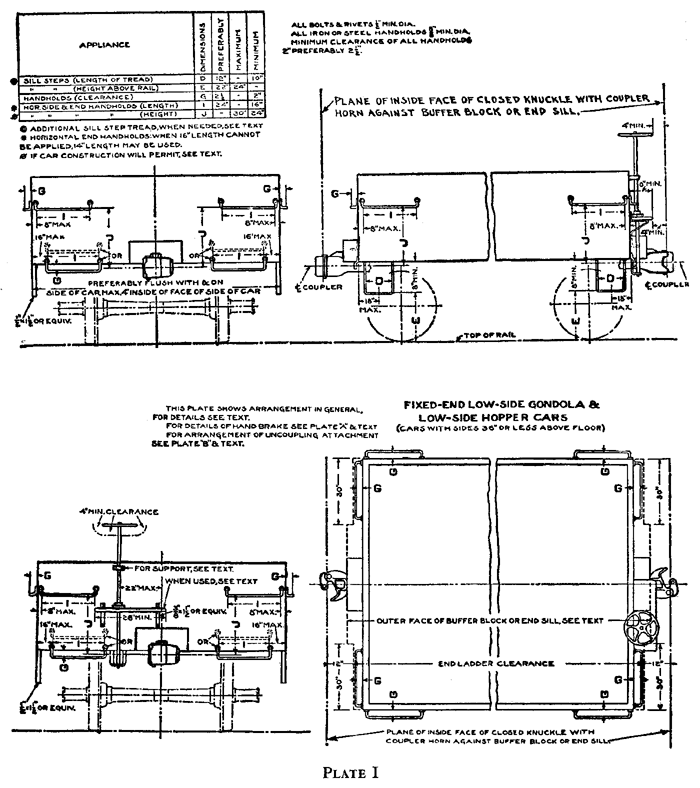
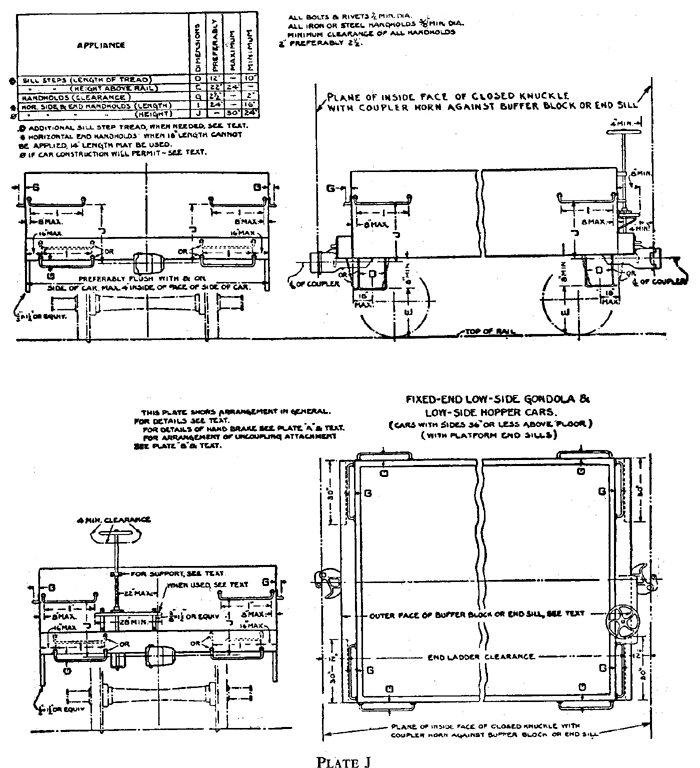
Division 4 - Fixed-end Low-side Gondola and Low-side Hopper Cars
(Cars with sides 36 inches or less above the floor are low-sided cars)
Handbrakes
28 (1) Number — Same as specified for "Box and Other House Cars" (Division 1).
(2) Dimensions — Same as specified for "Box and Other House Cars".
(3) Location — Each handbrake shall be so located that it can be safely operated while car is in motion.
The brake shaft shall be located on end of car, to the left of, and not more than 22 inches from, centre.
(4) Manner of application — Same as specified for "Box and Other House Cars".
Sill steps
30 Same as specified for "Box and Other House Cars" (Division 1).
"End" sill steps, as specified for "Box and Other House Cars", are required for box and other house cars only.
Side handholds
31 (1) Number — Same as specified for "Box and Other House Cars" (Division 1).
(2) Dimensions — Same as specified for "Box and Other House Cars".
(3) Location — Horizontal: One near each end on each side of car, not less than 24 nor more than 30 inches above centre line of coupler, if car construction will permit, but handhold shall not project above top of side. Clearance of outer end of handhold shall be not more than 8 inches from end of car.
(4) Manner of application — Same as specified for "Box and Other House Cars".
Horizontal end handholds
32 (1) Number — Same as specified for "Box and Other House Cars" (Division 1).
(2) Dimensions — Same as specified for "Box and Other House Cars".
(3) Location — One near each side of each end of car not less than 24 nor more than 30 inches above centre line of coupler, if car construction will permit. Clearance of outer end of handhold shall be not more than 8 inches from side of car.
One near each side of each end of car on face of end sill, projecting outward or downward. Clearance of outer end of handhold shall be not more than 16 inches from side of car.
(4) Manner of application — Same as specified for "Box and Other House Cars".
Uncoupling levers
33 No part of car above end sills within 30 inches from side of car, except buffer block, brake shaft, brake step, brake wheel or uncoupling lever, shall extend to within 12 inches of a vertical plane parallel with end of car and passing through the inside face of knuckle when closed with coupler horn against the buffer block or end sill, and no other part of end of car or fixtures on same above end sills, other than exceptions herein noted, shall extend beyond the outer face of buffer block.
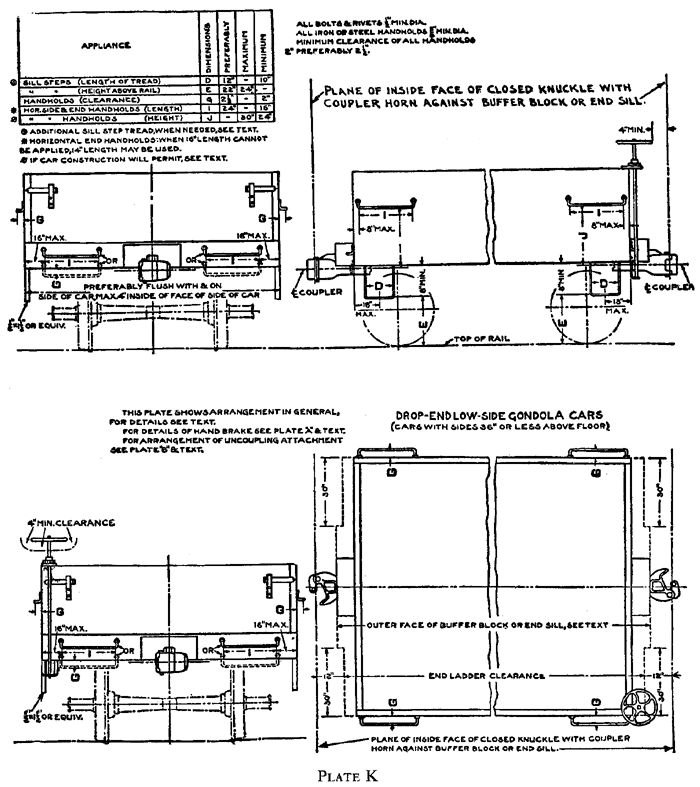
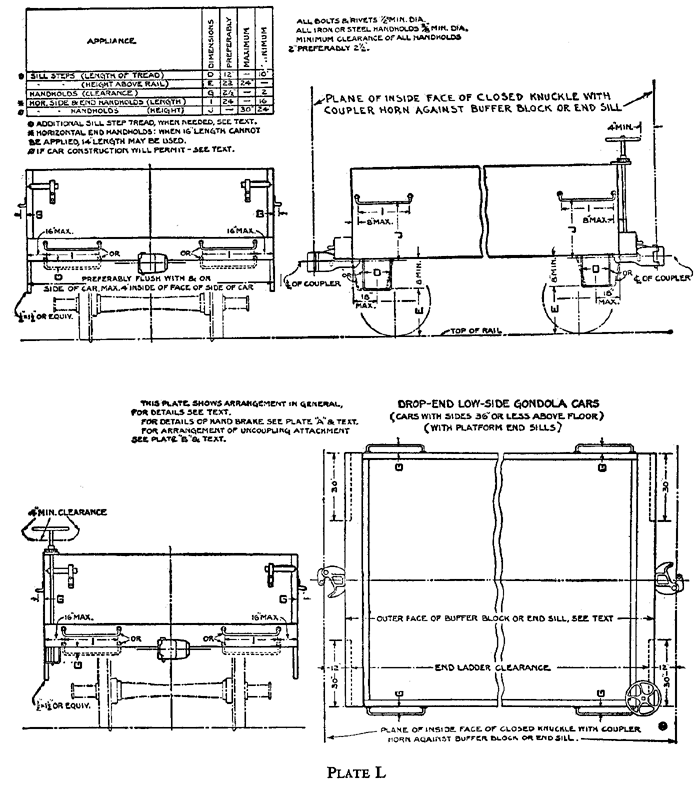
Division 5 - Drop-end Low-side Gondola Cars
Handbrakes
34 (1) Number — Same as specified for "Box and Other House Cars" (Division 1).
(2) Dimensions — Same as specified for "Box and Other House Cars".
(3) Location — Each hand-brake shall be so located that it can safely be operated while car is in motion.
The brake-shaft shall be located on end of car to the left of the centre.
(4) Manner of application — Same as specified for "Box and Other House Cars", provided that top brake shaft support may be omitted.
Sill steps
35 Same as specified for "Box and Other House Cars" (Division 1).
"End" sill steps as specified for "Box and Other House Cars" are required for box and other house cars only.
Side handholds
36 (1) Number — Same as specified for "Box and Other House Cars" (Division 1).
(2) Dimensions — Same as specified for "Box and Other House Cars".
(3) Location — Horizontal: One near each end on each side of car not less than 24 nor more than 30 inches above centre line of coupler, if car construction will permit, but handhold shall not project above top of side. Clearance of outer end of handhold shall be not more than 8 inches from end of car.
(4) Manner of application — Same as specified for "Box and Other House Cars".
End handholds
37 (1) Number — Four.
(2) Dimensions — Same as specified for "Box and Other House Cars" (Division 1).
(3) Location — Horizontal: One near each side of each end of car on face of end sill. Clearance of outer end of handhold shall be not more than 16 inches from side of car.
(4) Manner of application — Same as specified for "Box and Other House Cars".
End ladder clearance
39 No part of car above end sills within 30 inches from side of car, except buffer block, brake shaft, brake wheel or uncoupling lever, shall extend to within 12 inches of a vertical plane parallel with end of car passing through the inside face of knuckle when closed with coupler horn against the buffer block or end sill, and no other part of end of car or fixtures on same above end sills, other than exceptions herein noted, shall extend beyond the outer face of buffer block.
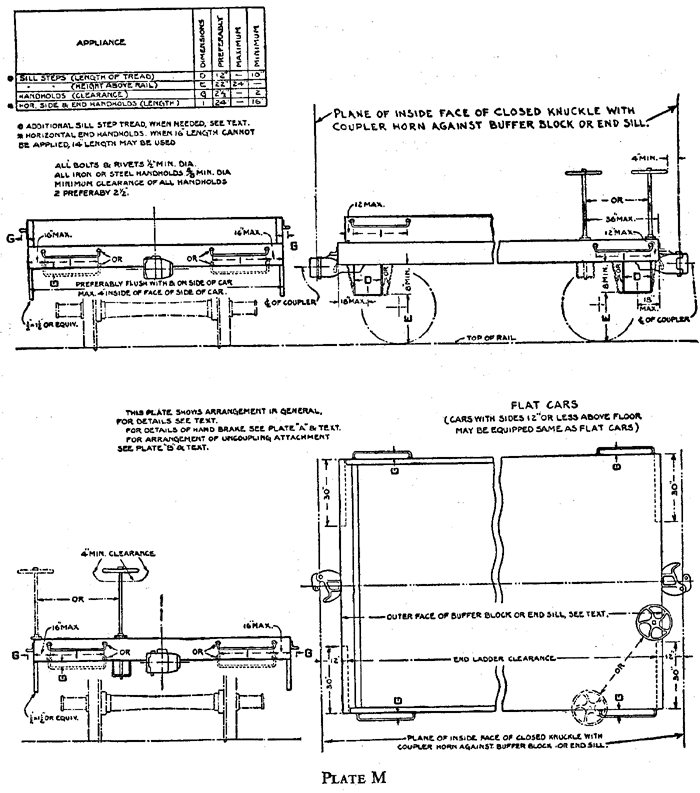
Division 6 - Flat Cars (Cars with sides 12 inches or less above the floor may be equipped the same as flat cars)
Handbrakes
40 (1) Number — Same as specified for "Box and Other House Cars" (Division 1).
(2) Dimensions — Same as specified for "Box and Other House Cars".
(3) Location — Each handbrake shall be so located that it can be safely operated while car is in motion.
The brake shaft shall be located on the end of car to the left of centre or on side of car not more than 36 inches from right hand end thereof.
(4) Manner of application — Same as specified for "Box and Other House Cars".
Sill steps
41 Same as specified for "Box and Other House Cars" (Division 1).
"End" sill steps as specified for "Box and Other House Cars" are required for box and other house cars only.
Side handholds
42 (1) Number — Same as specified for "Box and Other House Cars" (Division 1).
(2) Dimensions — Same as specified for "Box and Other House Cars".
(3) Location — Horizontal: One on face of each side sill near each end. Clearance of outer end of handhold shall be not more than 12 inches from end of car.
(4) Manner of application — Same as specified for "Box and Other House Cars".
End handholds
43 (1) Number — Four.
(2) Dimensions — Same as specified for "Box and Other House Cars" (Division 1).
(3) Location — Horizontal: One near each side of each end of car on face of end sill. Clearance of outer end of handhold shall be not more than 16 inches from side of car.
(4) Manner of application — Same as specified for "Box and Other House Cars".
End of car
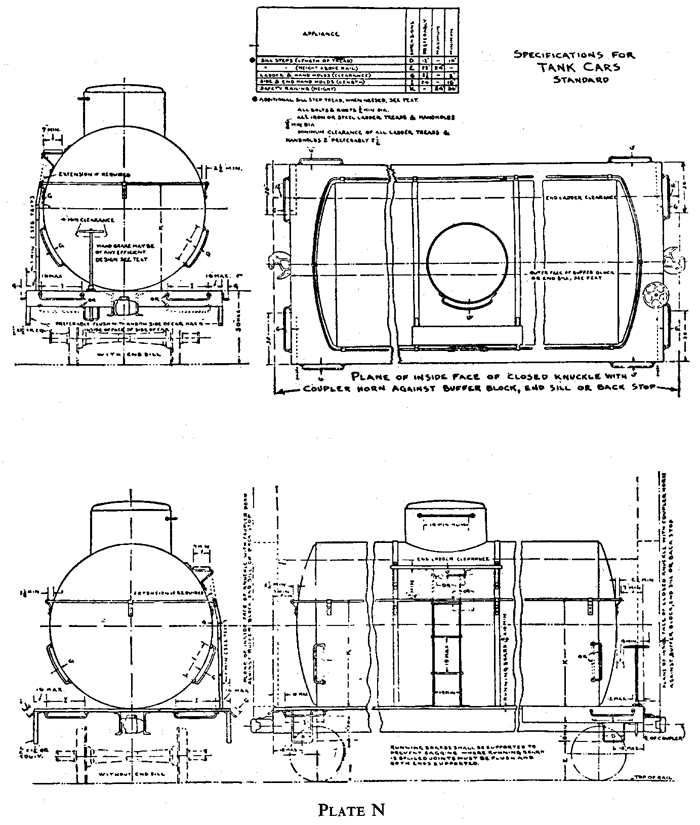
45 Shall be constructed with a platform similar to flat cars. Maximum height of platform from top of rail shall be 50 inches.
Handbrakes
46 (1) Number — Same as specified for "Box and Other House Cars" (Division 1).
(2) Dimensions — Same as specified for "Box and Other House Cars".
(3) Location — Each handbrake shall be so located that it can be safely operated while car is in motion. The brake shaft shall be located on end of car to the left of centre.
(4) Manner of application — Same as specified for "Box and Other House Cars".
Running boards
47 (1) Number — One continuous running board around sides and ends. End platform shall form continuation of side running board.
(2) Dimensions — Minimum thickness 1 3/4 inches. Minimum width on sides 10 inches.
(3) Location — Continuous around sides and ends of cars. End platform shall form continuation of side running board.
(4) Manner of application — Outside edge of side running board shall extend not less than 7 inches beyond bulge of tank, safety hand railing and dome ladder. In case of large tanks, where road limits will not permit the clearances specified, the outer edge of running boards shall extend not less than 7 inches beyond bulge of tank and the foot of ladder shall have a clearance of at least 7 inches from outer edge of running board.
Outside edge of end platform shall extend not less than 7 inches beyond bulge of tank head and safety hand railing.
Running boards shall be supported to prevent sagging. Where running boards are spliced, joints must be flush and both ends supported.
Running boards shall be securely fastened to platform and running board supports.
Sill steps
48 (1) Number — Same as specified for "Box and Other House Cars" (Division 1).
(2) Dimensions — Same as specified for "Box and Other House Cars".
(3) Location — When located on side sill: Same as specified for "Box and Other House Cars". When located on running board: One near each end of each side, flush with outside edge of running board, so that there shall be not more than 18 inches from end of car to centre of tread of sill step. Tread shall be not more than 24, preferably not more than 22, inches above the top of rail.
(4) Manner of application — When located on side sill: Same as specified for "Box and Other House Cars". When located on running board: Steps exceeding 18 inches in depth shall have an additional tread and be laterally braced. Sill steps shall be securely fastened with not less than 1/2 inch bolts with nuts outside (when possible) and riveted over, or with 1/2 inch rivets.
Side handholds
49 (1) Number — Eight.
(2) Dimensions — Same as specified for "Box and Other House Cars" (Division 1).
(3) Location — Four horizontal: One on face of each side sill near each end on tank cars with side sills; or one near each end on each side of car over sill step on running board, projecting downward or outward. Clearance of outer end of handhold shall be not more than 12 inches from end of car.
Four vertical: One as near as possible over each sill step, securely fastened to tank or tank band.
(4) Manner of application — Same as specified for "Box and Other House Cars".
End handholds
50 (1) Number — Four.
(2) Dimensions — Same as specified for "Box and Other House Cars" (Division 1).
(3) Location — Horizontal: One near each side of each end of car on face of end sill; or one near each side on each end of car on platform, projecting downward and outward. Clearance of outer end of handhold shall be not more than 16 inches from side of car.
(4) Manner of application — Same as specified for "Box and Other House Cars".
Safety railings
51 (1) Number — One continuous running around sides and ends of tank.
(2) Dimensions — Minimum diameter, 7/8 of an inch, wrought iron or steel rod or 1 1/4 inch pipe. Minimum clearance, 2 1/2 inches.
(3) Location — Running around sides and end of tank, not less than 36 nor more than 54 inches above platform or running board.
(4) Manner of application — Safety railings shall be securely fastened to tank or tank bands with a minimum of 4 brackets for each side of tank and one bracket on head at each end of tank and secured against end shifting.
(5) Uncoupling levers — Same as specified for "Box and Other House Cars" (Division 1).
(6) End ladder clearance — No part of car above end sills within 30 inches from side of car, except buffer block, brake shaft, brake shaft brackets, brake wheel, running boards or uncoupling lever, shall extend to within 12 inches of a vertical plane parallel with end of car and passing through the inside face of knuckle when closed with coupler horn against the buffer block or end sill, and no other part of end of car or fixtures on same above end sills, other than exceptions herein noted, shall extend beyond the outer face of buffer block.
Ladder, dome platform, dome platform handhold and dome handhold
52 (1) Number — One Ladder, one dome platform, one dome platform handhold and one dome handhold.
(2) Dimensions — Ladder: Ladder stiles 3/8 by 2 inches, or equivalent, wrought iron or steel.
Ladder treads, minimum diameter 5/8 of an inch, wrought iron or steel.
Minimum clear length of tread, 14 inches.
Maximum spacing of treads, 19 inches. Safety railing will be considered a ladder tread.
Minimum clearance of treads and ladder stiles, 2, preferably 2 1/2, inches.
(3) Dome platform — Minimum width, 7 inches; minimum thickness, 1 3/4 inches.
(4) Dome platform brackets — 3/8 by 1 1/2 inches, or equivalent, wrought iron or steel.
(5) Dome platform and dome handholds — Minimum diameter, 5/8 of an inch, wrought iron or steel.
Minimum clear length, 14, preferably 16, inches.
Minimum clearance, 2, preferably 2 1/2, inches.
(6) Location — On brake mast side of car leading to dome. When car is equipped with more than one dome, the step board shall be lengthened so that all dome covers will be accessible from same, or ladder, dome platform and handholds provided leading to each dome.
Dome platform handhold to be applied in line with ladder, not more than 2 inches back from outside edge of platform, projecting downward and outward, with horizontal portion of handhold flush with or extending one inch beyond edge of platform. Top ladder rung will be considered dome platform handhold if located within not less than 2 or more than 3 inches from bottom of dome platform. Dome handhold to be applied to dome over dome platform in line with ladder.
(7) Manner of application — Ladders shall be securely fastened at bottom to running board with not less than 1/2 inch bolts with nuts underneath and riveted over, or with not less than 1/2 inch rivets. Ladders shall be secured at top to safety railing or to underside of dome platform. If fastened to dome platform the stiles shall be secured with not less than 1/2 inch bolts riveted over nuts, or with 1/2 inch rivets.
The dome platform shall be supported by wrought iron or steel brackets which shall be securely fastened to tank or tank bands.
Dome platform handholds same as specified for "Box and Other House cars" (Division 1).
Dome handholds shall be securely fastened.
NOTE — In lieu of dome platform specified, any efficient design of platform encircling dome will be acceptable.
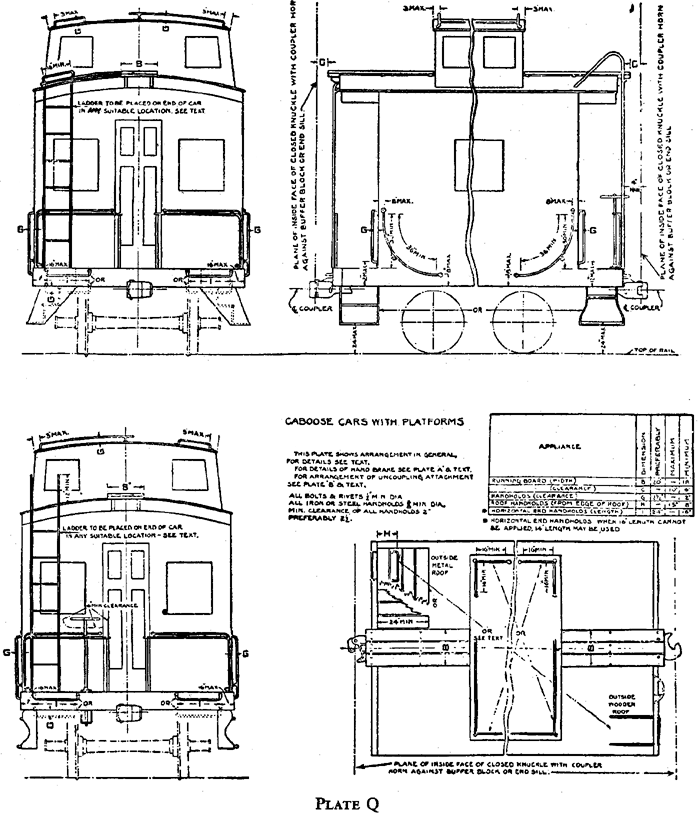
Division 8 - Caboose Cars with Platforms
Handbrakes
53 (1) Number — Each caboose car shall be equipped with an efficient handbrake which shall operate in harmony with the power brake thereon.
The handbrake may be of any efficient design but must provide the same degree of safety as the design shown on Plate A.
(2) Dimensions — Same as specified for "Box and Other House Cars" (Division 1).
(3) Location — Each handbrake shall be so located that it can be safely operated while car is in motion.
The brake shaft on caboose cars with platforms shall be located on platform to the left of centre.
(4) Manner of application — Same as specified for "Box and Other House Cars".
[am. B.C. Reg. 78/69.]
Running boards
54 (1) Number — One longitudinal running board.
(2) Dimensions — Same as specified for "Box and Other House Cars" (Division 1).
(3) Location — Full length of car, centre of roof. (On caboose cars with cupolas, longitudinal running board shall extend from cupola to ends of roof.)
Outside metal roof cars shall have latitudinal extensions leading to ladder locations.
(4) Manner of application — Same as specified for "Box and Other House Cars".
Ladders
55 (1) Number — Two.
(2) Dimensions — None specified.
(3) Location — One on each end.
(4) Manner of application — Same as specified for "Box and Other House Cars" (Division 1).
Roof handholds
56 (1) Number — One over each ladder.
Where stiles of ladders extend 12 inches or more above roof, no other roof handholds are required.
(2) Dimensions — Same as specified for "Box and Other House Cars" (Division 1).
(3) Location — On roof of caboose, in line with and running parallel to treads of ladder, not less than 8 nor more than 15 inches from edge of roof.
(4) Manner of application — Same as specified for "Box and Other House Cars".
Cupola handholds
57 (1) Number — One or more.
(2) Dimensions — Minimum diameter, 5/8 of an inch, wrought iron or steel. Minimum clearance, 2, preferably 2 1/2, inches.
(3) Location — One continuous handhold extending around top of cupola not more than 3 inches from edge of cupola roof.
Four right angle handholds, one at each corner, not less than 16 inches in clear length from point of angle, may take the place of the one continuous handhold specified, if locations coincide.
(4) Manner of application — Cupola handholds shall be securely fastened with not less than 1/2 inch bolts with nuts outside and riveted over, or with not less than 1/2 inch rivets.
Side handholds
58 (1) Number — Four.
(2) Dimensions — Minimum diameter, 5/8 of an inch, wrought iron or steel. Minimum clear length, 36 inches.
Minimum clearance, 2, preferably 2 1/2, inches.
(3) Location — One near each end on each side of car, curving downward toward centre of car from a point not less than 30 inches above platform to a point not more than 8 inches from bottom of car. Top end of handhold shall be not more than 8 inches from outside face of end sheathing.
(4) Manner of application — Same as specified for "Box and Other House Cars" (Division 1).
End handholds
59 (1) Number — Four.
(2) Dimensions — Same as specified for "Box and Other House Cars" (Division 1).
(3) Location — Horizontal: One near each side on each end of car on face of platform end sill. Clearance of outer end of handhold shall be not more than 16 inches from end of platform end sill.
(4) Manner of application — Same as specified for "Box and Other House Cars".
End platform handholds
60 (1) Number — Four.
(2) Dimensions — Minimum diameter, 5/8 of an inch, wrought iron or steel.
Minimum clearance, 2, preferably 2 1/2, inches.
(3) Location — One right angle handhold on each side of each end extending horizontally from doorpost to corner of car at approximate height of platform rail, then downward to within 12 inches of bottom of car.
(4) Manner of application — Handholds shall be securely fastened with bolts, screws or rivets.
Platform steps
61 Safe and suitable open or box steps leading to caboose platforms to be provided at each corner of caboose.
Where open steps are used, the bottom tread of said steps to be provided with a right and left foot stop at each end of tread, made of angle iron 3 1/2 by 2 1/2 by 1/4 inch; the 2 1/2 inch face of angle iron to be bolted to the step.
Uncoupling levers
62 Same as specified for "Box and Other House Cars" (Division 1).
Cabooses to be equipped with marker sockets in the lower position (the said lower position to be at such elevation as will permit of lamps and flags being placed therein from the platform or floor of the car without the use of steps).
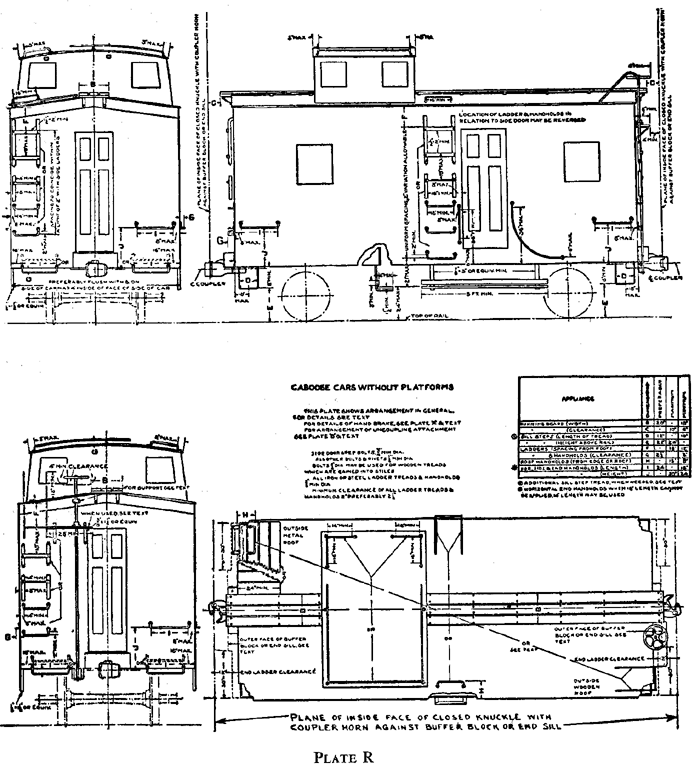
Division 9 - Caboose Cars without Platforms
Handbrakes
63 (1) Number — Same as specified for "Box and Other House Cars" (Division 1).
(2) Dimensions — Same as specified for "Box and Other House Cars".
(3) Location — Each handbrake shall be so located that it can be safely operated while car is in motion.
The brake shaft on caboose cars without platforms shall be located on end of car to the left of centre.
(4) Manner of application — Same as specified for "Box and Other House Cars".
Running boards
65 (1) Number — Same as specified for "Box and Other House Cars" (Division 1).
(2) Dimensions — Same as specified for "Box and Other House Cars".
(3) Location — Full length of car, centre of roof. (On caboose cars with cupolas, longitudinal running boards shall extend from cupola to ends of roof.)
Outside metal roof cars shall have latitudinal extensions leading to ladder locations.
(4) Manner of application — Same as specified for "Box and Other House Cars".
Sill steps
66 Same as specified for "Box and Other House Cars" (Division 1).
"End" sill steps, as specified for "Box and Other House Cars", are required for box and other house cars only.
Side door steps
67 (1) Number — Two (if caboose has side doors).
(2) Dimensions — Minimum length, 5 feet.
Minimum width, 6 inches.
Minimum thickness of tread, 1 1/2 inches.
Minimum height of back stop, 3 inches.
Maximum height from top of rail to top of tread, 24 inches.
(3) Location — One under each side door.
(4) Manner of application — Side door steps shall be supported by 2 iron brackets having a minimum cross sectional area 7/8 by 3 inches or equivalent, each of which shall be securely fastened to car by not less than two 3/4 inch bolts.
Ladders
68 (1) Number — Four.
(2) Dimensions — Same as specified for "Box and Other House Cars" (Division 1).
(3) Location — Same as specified for "Box and Other House Cars", except when caboose has side doors, then side ladders shall be located not more than 8 inches from doors.
(4) Manner of application — Same as specified for "Box and Other House Cars".
End of ladder clearance
69 No part of car above end sills within 30 inches from side of car, except buffer block, brake shaft, brake wheel, brake step, running board or uncoupling lever, shall extend to within 12 inches of a vertical plane parallel with end of car and passing through the inside face of knuckle when closed with coupler horn against the buffer block or end sill and no other part of end of cars or fixtures on same above end sills, other than exceptions herein noted, shall extend beyond the outer face of buffer block.
Roof handholds
70 (1) Number — Four.
(2) Dimensions — Same as specified for "Box and Other House Cars" (Division 1).
(3) Location — One over each ladder on roof in line with and running parallel to treads of ladder, not less than 8 nor more than 15 inches from edge of roof.
Where stiles of ladders extend 12 inches or more above roof, no other roof handholds are required.
(4) Manner of application — Roof handholds shall be securely fastened with not less than 1/2 inch bolts with nuts outside (when possible) and riveted over, or with not less than 1/2 inch rivets.
Cupola handholds
71 (1) Number — One or more.
(2) Dimensions — Minimum diameter, 5/8 of an inch, wrought iron or steel. Minimum clearance, 2, preferably 2 1/2, inches.
(3) Location — One continuous cupola handhold extending around top of cupola, not more than 3 inches from edge of cupola roof.
Four right angle handholds, one at each corner, not less than 16 inches in clear length from point of angle, may take the place of the one continuous handhold specified, if locations coincide.
(4) Manner of application — Cupola handholds shall be securely fastened with not less than 1/2 inch bolts with nuts outside and riveted over, or with not less than 1/2 inch rivets.
Side handholds
72 (1) Number — Four.
(2) Dimensions — Same as specified for "Box and Other House Cars" (Division 1).
(3) Location — Horizontal: One near each end on each side of car, not less than 24 nor more than 30 inches above centre line of coupler. Clearance of outer end of handhold shall be not more than 8 inches from end of car.
(4) Manner of application — Same as specified for "Box and Other House Cars".
Side door handholds
73 (1) Number — Four: 2 curved, 2 straight.
(2) Dimensions — Minimum diameter, 5/8 of an inch, wrought iron or steel. Minimum clearance, 2, preferably 2 1/2, inches.
(3) Location — One curved handhold from a point at side of each door opposite ladder, not less than 36 inches above bottom of car, curving away from door downward to a point not more than 6 inches above bottom of car.
One vertical handhold at ladder side of each door, from a point not less than 36 inches above bottom of car to a point not more than 6 inches above level of bottom of door.
(4) Manner of application — Side door handholds shall be securely fastened with not less than 1/2 inch bolts with nuts outside (when possible) and riveted over, or with not less than 1/2 inch rivets.
Horizontal end handholds
74 (1) Number — Same as specified for "Box and Other House Cars" (Division 1).
(2) Dimensions — Same as specified for "Box and Other House Cars".
(3) Location — Same as specified for "Box and Other House Cars", except that one additional end handhold shall be on each end of cars with platform end sills as heretofore described, unless car has door in centre of end. Said handhold shall be not less than 24 inches in length, located near centre of car, not less than 30 nor more than 60 inches above platform end sill.
(4) Manner of application — Same as specified for "Box and Other House Cars".
Uncoupling levers
76 Same as specified for "Box and Other House Cars" (Division 1).
Cabooses to be equipped with marker sockets in the lower position (the said lower position to be at such elevation as will permit of lamps and flags being placed therein from the platform or floor of the car without the use of steps).
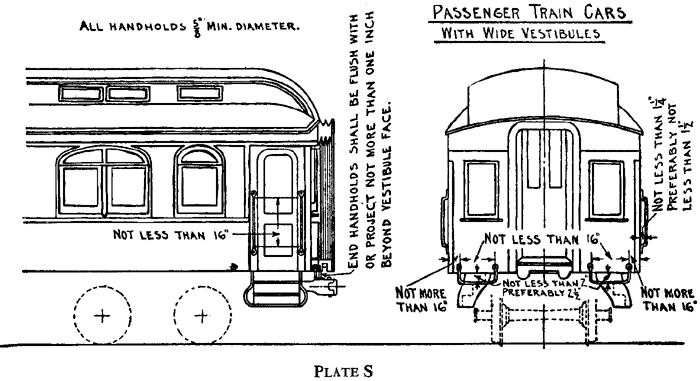
Division 10 - Passenger Train Cars with Wide Vestibules
Handbrakes
77 (1) Number — Each passenger train shall be equipped with an efficient handbrake, which shall operate in harmony with the power brake thereon.
(2) Location — Each handbrake shall be so located that it can be safely operated while car is in motion.
Side handholds
78 (1) Number — Eight.
(2) Dimensions — Minimum diameter, 5/8 of an inch, metal.
Minimum clear length, 16 inches.
Minimum clearance, 1 1/4, preferably 1 1/2, inches.
(3) Location — Vertical: One on each vestibule door post.
(4) Manner of Application — Side handholds shall be securely fastened with bolts, rivets or screws.
End handholds
79 (1) Number — Four.
(2) Dimensions — Minimum diameter, 5/8 of an inch, wrought iron or steel.
Minimum clear length, 16 inches.
Minimum clearance, 2, preferably 2 1/2, inches.
Handholds shall be flush with or project not more than one inch beyond vestibule face.
(3) Location — Horizontal: One near each side on each end, projecting downward from face of vestibule end sill. Clearance of outer end of handhold shall be not more than 16 inches from side of car.
(4) Manner of Application — End handholds shall be securely fastened with bolts or rivets.
Passenger cars to be equipped with marker sockets in the lower position (the said lower position to be at such elevation as will permit of lamps and flags being placed therein from the platform or floor of the car without use of steps).
Uncoupling levers
80 Uncoupling attachments shall be applied so they can be operated by a person standing on the ground.
Minimum length of ground uncoupling attachment, 42 inches, measured from centre line of end of car to handle of attachment.
On passenger train cars used in freight or mixed train service the uncoupling attachments shall be so applied that the coupler can be operated from left side of car.
Division 11 - Passenger Train Cars with Open End Platforms
Handbrakes
81 (1) Number — Each passenger train car shall be equipped with an efficient handbrake, which shall operate in harmony with the power brake thereon.
(2) Location — Each handbrake shall be so located that it can be safely operated while car is in motion.
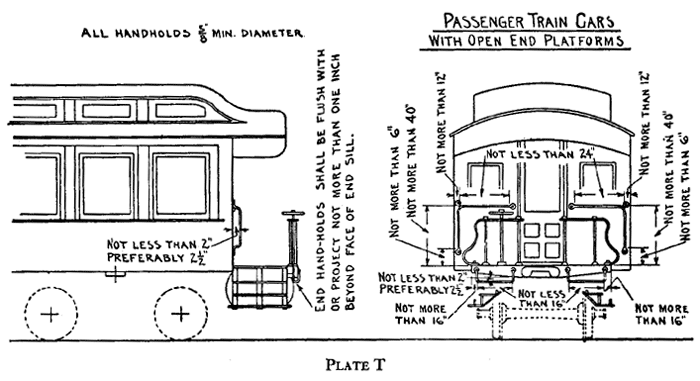
End handholds
82 (1) Number — Four.
(2) Dimensions — Minimum diameter, 5/8 of an inch, wrought iron or steel.
Minimum clear length, 16 inches
Minimum clearance, 2, preferably 2 1/2, inches.
Handholds shall be flush with or project not more than one inch beyond face of end sill.
(3) Location — Horizontal: One near each side of each end on face of platform end sill, projecting downward. Clearance of outer end of handhold shall be not more than 16 inches from end of end sill.
(4) Manner of application — End handholds shall be securely fastened with bolts or rivets.
End platform handholds
83 (1) Number — Four (cars equipped with safety gates do not require end platform handholds).
(2) Dimensions — Minimum clearance, 2, preferably 2 1/2, inches, metal.
(3) Location — Horizontal from or near door post to a point not more than 12 inches from corner of car, then approximately vertical to a point not more than 6 inches from top of platform. Horizontal portion shall be not less than 24 inches in length nor more than 40 inches above platform.
(4) Manner of application — End platform handholds shall be securely fastened with bolts, rivets or screws.
Passenger cars to be equipped with marker sockets in the lower position (the said lower position to be at such elevation as will permit of lamps and flags being placed therein from the platform or floor of the car without the use of steps).
Uncoupling levers
84 Uncoupling attachments shall be applied so they can be operated by a person standing on the ground.
Minimum length of ground uncoupling attachment, 42 inches, measured from centre line of end of car to handle of attachment.
On passenger train cars used in freight or mixed train service the uncoupling attachments shall be so applied that the coupler can be operated from left side of car.
Division 12 - Passenger Train Cars without End Platforms
Handbrakes
85 (1) Number — Each passenger train car shall be equipped with an efficient handbrake which shall operate in harmony with the power brake thereon.
(2) Location — Each handbrake shall be so located that it can be safely operated while car is in motion.
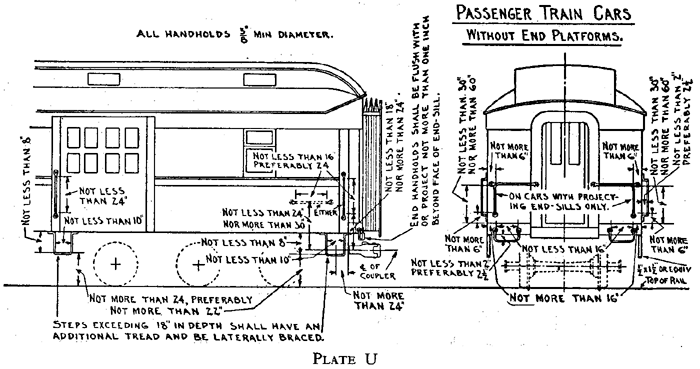
Sill steps
86 (1) Number — Four.
(2) Dimensions — Minimum length of tread, 10, preferably 12, inches.
Minimum cross sectional area, 1/2 by 1 1/2 inches or equivalent, wrought iron or steel.
Minimum clear depth, 8 inches.
(3) Location — One near each end on each side, not more than 24 inches from corner of car to centre of tread of sill step.
Outside edge of tread of step shall be not more than 2 inches inside of face of side of car.
Tread shall be not more than 24, preferably not more than 22, inches above the top of rail.
(4) Manner of application — Steps exceeding 18 inches in depth shall have an additional tread and be laterally braced.
Sill steps shall be securely fastened with not less than 1/2 inch bolts with nuts outside (when possible) and riveted over, or with not less than 1/2 inch rivets.
Side handholds
87 (1) Number — Four.
(2) Dimensions — Minimum diameter, 5/8 of an inch, wrought iron or steel.
Minimum clear length, 16, preferably 24, inches.
Minimum clearance, 2, preferably 2 1/2, inches.
(3) Location — Horizontal or vertical: One near each end on each side of car over sill step.
If horizontal, not less than 24 nor more than 30 inches above centre line of coupler.
If vertical, lower end not less than 18 nor more than 24 inches above centre line of coupler.
(4) Manner of application — Side handholds shall be securely fastened with bolts, rivets or screws.
End handholds
88 (1) Number — Four.
(2) Dimensions — Minimum diameter, 5/8 of an inch, wrought iron or steel.
Minimum clear length, 16 inches.
Minimum clearance, 2, preferably 2 1/2, inches.
(3) Location — Horizontal: One near each side on each end, projecting downward from face of end sill or sheathing. Clearance of outer end of handhold shall be not more than 16 inches from side of car.
(4) Manner of application — Handholds shall be flush with or project not more than one inch beyond face of end sill.
End handholds shall be securely fastened with bolts or rivets.
When marker sockets or brackets are located so that they cannot be conveniently reached from platforms, suitable steps and handholds shall be provided for men to reach such sockets or brackets.
Passenger cars to be equipped with marker sockets in the lower position (the said lower position to be at such elevation as will permit of lamps and flags being placed therein from the platform or floor of the car without the use of steps).
End handrails (on cars with projecting end sills)
89 (1) Number — Four.
(2) Dimensions — Minimum diameter, 5/8 of an inch, wrought iron or steel.
Minimum clearance, 2, preferably 2 1/2, inches.
(3) Location — One on each side of each end, extending horizontally from door post or vestibule frame to a point not more than 6 inches from corner of car, then approximately vertical to a point not more than 6 inches from top of platform end sill; horizontal portion shall be not less than 30 nor more than 60 inches above platform end sill.
(4) Manner of application — End handrails shall be securely fastened with bolts, rivets or screws.
Side door steps
90 (1) Number — One under each door.
(2) Dimensions — Minimum length of tread, 10, preferably 12, inches.
Minimum cross-sectional area, 1/2 by 1 1/2 inches or equivalent, wrought iron or steel.
Minimum clear depth, 8 inches.
(3) Location — Outside edge of tread of step, not more than 2 inches inside of face of side of car.
Tread not more than 24, preferably not more than 22, inches above the top of rail.
(4) Manner of application — Steps exceeding 18 inches in depth shall have an additional tread and be laterally braced.
Side door steps shall be securely fastened with not less than 1/2 inch bolts with nuts outside (when possible) and riveted over, or with not less than 1/2 inch rivets.
A vertical handhold not less than 24 inches in clear length shall be applied above each side door step on door post.
Uncoupling levers
91 Uncoupling attachments shall be applied so they can be operated by a person standing on the ground.
Minimum length of ground uncoupling attachments, 42 inches, measured from centre line of end of car to handle of attachment.
Running boards
94 Location — Full length of car, centre of roof. Outside metal roof cars shall have latitudinal extensions leading to ladder locations.
Side door steps
97 (1) Number — Two.
(2) Dimensions — Standard side sill step, as specified for "Box and Other House Cars" (Division 1).
(3) Location — One under each side door.
(4) Manner of application — Same as specified for "Box and Other House Cars".
Side door handholds
101 (1) Number — Four: 2 straight on each side of car each side of door.
(2) Dimensions — Minimum diameter, 5/8 of an inch, wrought iron or steel. Minimum clearance, 2, preferably 2 1/2, inches.
(3) Location — One vertical handhold at each side of door, from a point not less than 36 inches above bottom of car to a point not more than 6 inches above level of bottom of door.
(4) Manner of application — Side door handholds shall be securely fastened with not less than 1/2 inch bolts with nuts outside and riveted over, or with not less than 1/2 inch rivets.
Horizontal end handholds
102 Same as specified for "Box and Other House Cars" (Division 1), except that one additional end handhold shall be on each end of cars with platform end sills, as heretofore described, unless car has door in centre of end. Said handhold shall be not less than 24 inches in length, located near centre of car, not less than 30 nor more than 60 inches above platform end sill.
Vertical end handholds
103 Same as specified for "Box and Other House Cars" (Division 1), except where boarding car has door in centre of end, without platform, there shall be one handhold on each side of door on door post, from a point not less than 36 inches above bottom of door to point not more than 15 inches above level of bottom of door.
End doors
104 Boarding cars equipped with end doors will have the words "DANGER, NO PLATFORM" stencilled on panel inside of end door.
Boarding cars with platforms
106 Safety appliances on boarding cars equipped with platforms will coincide with safety appliances for caboose car with platform or original design of car as equipped.
Division 14 - Crew Cars (In Which Employees are Transported)
Handbrakes
107 Same as specified for "Box and Other House Cars" (Division 1), except that there shall be a handbrake operative from inside the car.
Running boards
109 Location — Full length of car, centre of roof. Outside metal roof cars shall have latitudinal extensions leading to ladder locations.
Side doors
111 (1) Number — All crew cars without end platforms must have 2 side doors.
(2) Location — One on each side of car.
(3) Manner of application — Doors shall be applied so that when shut they will completely cover the opening. Doors shall be securely hung and fitted with a substantial locking device.
(4) Dimensions — Door openings shall be in height not less than 72 inches measured from deck of car to top of opening and in width not less than 36 inches.
Side door steps
112 (1) Number — Two stirrup or box type may be used.
(2) Location — One under each side door. Outside edge of bottom tread shall be flush with side of car.
(3) Dimensions — Steps shall be full width of door openings. Tread of lower step shall be not more than 14 inches above top of rail. Maximum spacing of treads, 19 inches. If stirrup steps are used they shall have minimum cross sectional area 1/2 by 1 1/2 inches or equivalent, of wrought iron or steel.
(4) Manner of application — Steps shall be secured with bolts or rivets. If box type steps are used they shall be suitably boxed in and treads may be of wood, non-skid metal plate or covered with double or single crimped wire netting square mesh not less than 2 by 2 per inch nor more than 3 by 3 per inch of No. 14 B.W.G. wire. Door step openings (if any) in deck inside car when doors are closed shall be closed by substantial covering.
Side door handholds
113 (1) Number — Four.
(2) Dimensions — Minimum diameter, 5/8 inch, wrought iron or steel. Minimum free clearance, 2 1/2 inches from car body. Maximum distance between handrails, 48 inches. When double doors are used, stanchions or handrails shall be attached so that handrails will be not more than 48 inches apart.
(3) Location — One vertical handhold on each side of each door, from a point not less than 48 inches above deck of car to a point not more than 36 inches above the top of rail.
(4) Manner of application — Side door handholds shall be securely fastened with not less than 1/2 inch bolts with nuts outside and riveted over, or with not less than 1/2 inch rivets.
Crew cars with end platforms
121 Safety appliances on crew cars equipped with end platforms will coincide with safety appliances for caboose car with platform, except that tread of lower step shall be not more than 14 inches above top of rail, or for original design of car as equipped.
Emergency valve
122 All crew cars shall be equipped with conductor's emergency valve operative from within the body of the car.
Division 15 - Steam Locomotives Used in Road Service
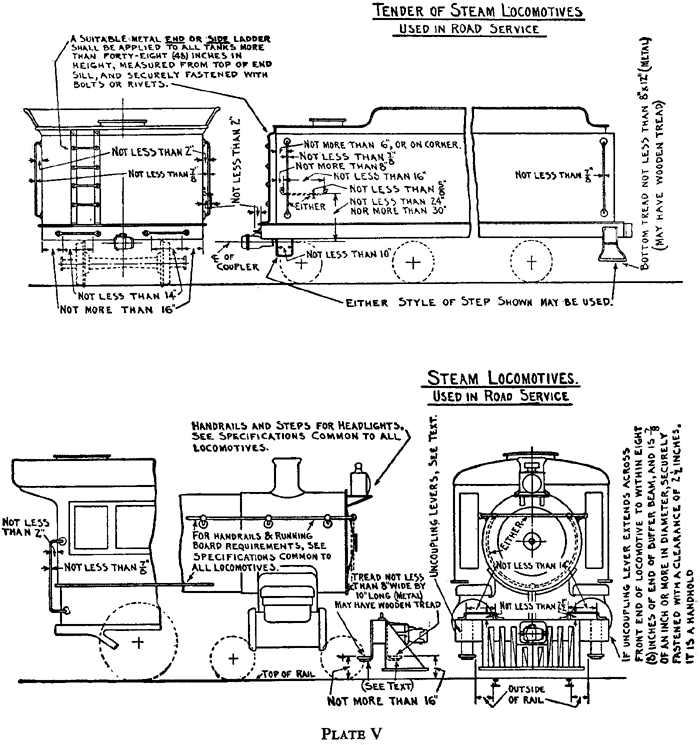
Tender sill steps
123 (1) Number — Four on tender.
(2) Dimensions — Bottom tread not less than 8 by 12 inches, metal. (May have wooden treads.)
If stirrup steps are used, clear length of tread shall be not less than 10, preferably 12, inches.
(3) Location — One near each corner of tender on sides.
(4) Manner of application — Tender sill steps shall be securely fastened with bolts or rivets.
Pilot sill steps
124 (1) Number — Two.
(2) Location — Foot rests shall be provided on the pilot of every such engine, sufficient in width for a man to stand on.
(3) Manner of application — Pilot sill steps shall be securely fastened with bolts or rivets.
Pilot beam handholds
125 (1) Number — Two.
(2) Dimensions — Minimum diameter, 5/8 of an inch, wrought iron or steel.
Minimum clear length, 14, preferably 16, inches.
Minimum clearance, 2 1/2 inches.
(3) Location — One on each end of buffer beam. (If uncoupling lever extends across front end of locomotive to within 8 inches of end of buffer beam, and is 7/8 of an inch or more in diameter, securely fastened, with a clearance of 2 1/2 inches, it is a handhold.)
(4) Manner of application — Pilot beam handholds shall be securely fastened with bolts or rivets.
Side handholds
126 (1) Number — Six.
(2) Dimensions — Minimum diameter, if horizontal, 5/8 of an inch; if vertical, 7/8 of an inch, wrought iron or steel.
Horizontal minimum clear length, 16 inches.
Vertical clear length equal to approximate height of tank.
Minimum clearance, 2, preferably 2 1/2, inches.
(3) Location — Horizontal or vertical: If vertical, one on each side of tender within 6 inches of rear or on corner; if horizontal, same as specified for "Box and Other House Cars" (Division 1).
One on each side of tender near gangway; one on each side of locomotive at gangway; applied vertically.
(4) Manner of application — Side handholds shall be securely fastened with not less than 1/2 inch bolts or rivets.
Rear end handholds
127 (1) Number — Two.
(2) Dimensions — Minimum diameter, 5/8 of an inch, wrought iron or steel.
Minimum clear length, 14 inches.
Minimum clearance, 2 preferably 2 1/2, inches.
(3) Location — Horizontal: One near each side of rear end of tender on face of end sill. Clearance of outer end of handhold shall be not more than 16 inches from side of tender.
(4) Manner of application — Rear end handholds shall be securely fastened with not less than 1/2 inch bolts or rivets.
Ladders
128 (1) Number — One on all tanks more than 48 inches in height measured from top of end sill.
(2) Dimensions — Minimum clear length of tread, 16 inches.
Maximum spacing between ladder treads, 19 inches.
Iron or steel treads, minimum diameter 5/8 of an inch.
Minimum clearance of 2, preferably 2 1/2, inches.
(3) Location — On back of tender.
(4) Manner of application — Metal ladders without stiles shall have foot guards or upward projections not less than 2 inches in height at both ends of tread. Stiles of ladders projecting 2 or more inches from face of tank will serve as footguards. Ladders shall be securely fastened with not less than 1/2 inch bolts with nuts outside (when possible) and riveted over, or with not less than 1/2 inch rivets.
Uncoupling levers
129 (1) Number — Two double levers, operative from either side.
(2) Dimensions — Rear end levers shall extend across end of tender, with handles not more than 12, preferably 9, inches from side of tender, with a guard bent on handle to give not less than 2 inches clearance around handle.
(3) Location — One on rear end of tender and one on front end of locomotive.
Handles of front end levers shall be not more than 12, preferably 9, inches from ends of buffer beam, and shall be so constructed as to give a minimum clearance of 2 inches around handle.
(4) Manner of application — Uncoupling levers shall be securely fastened with bolts or rivets.
Couplers
130 Locomotives shall be equipped with automatic couplers at rear of tender and front of locomotive.
Division 16 - Steam Locomotives Used in Switching Service
Footboards
131 (1) Number — Two or more.
(2) Dimensions — Minimum width of tread, 10 inches. Minimum height of back stop, 4 inches above tread. Height from top of rail to top of tread, not more than 12 nor less than 9 inches.
If made of wood, minimum thickness of tread shall be 1 1/2, preferably 2, inches. Footboards may be made of material other than wood which provides the same as or a greater degree of safety than wood of 1 1/2 inches thickness. When made of material other than wood, the tread surface shall be of anti-skid design and constructed with sufficient open space to permit the elimination of snow and ice from the tread surface.
(3) Location — Ends or sides.
If on ends, they shall extend not less than 18 inches outside of gauge of straight track and shall be not more than 12 inches shorter than buffer beam at each end.
(4) Manner of application — End footboards may be constructed in 2 sections, provided that practically all space on each side of coupler is filled and inner ends are protected with guard of same height as backstop; each section shall be not less than 3 feet in length.
Footboards shall be securely bolted to two 1 by 4 inch metal brackets, provided footboard is not cut or notched at any point.
If footboard is cut or notched or in 2 sections, not less than four 1 by 3 inch metal brackets shall be used, 2 located on each side of coupler. Each bracket shall be securely bolted to buffer beam, end sill or tank frame by not less than two 7/8 inch bolts.
If side footboards are used, a substantial handhold or rail shall be applied not less than 30 inches nor more than 60 inches above tread of footboard.
All locomotives used in yard, joint yard and transfer service must be equipped with footboards, as prescribed above.
Sill steps
132 (1) Number — Two or more.
(2) Dimensions — Lower tread of step shall be not less than 8 by 12 inches, metal. (May have wooden treads.)
If stirrup steps are used, clear length of tread shall be not less than 10, preferably 12, inches.
(3) Location — One or more on each side at gangway secured to locomotive or tender.
(4) Manner of application — Sill steps shall be securely fastened with bolts or rivets.
End handholds
133 (1) Number — Two.
(2) Dimensions — Minimum diameter, one inch, wrought iron or steel. Minimum clearance, 4 inches, except at coupler casting or braces, when minimum clearance shall be 2 inches.
(3) Location — One on pilot buffer beam; one on rear end of tender, extending across front end of locomotive and rear end of tender. Ends of handholds shall be not more than 6 inches from ends of buffer beam or end sill, securely fastened at ends. If the uncoupling levers meet all specified requirements for end handholds, it is a handhold.
(4) Manner of application — End handholds shall be securely fastened with bolts or rivets.
Side handholds
134 (1) Number — Four.
(2) Dimensions — Minimum diameter, 7/8 inch, wrought iron or steel.
Clear length equal to approximate height of tank.
Minimum clearance, 2, preferably 2 1/2, inches.
(3) Location — Vertical: One on each side of tender near front corner; one on each side of locomotive gangway.
(4) Manner of application — Side handholds shall be securely fastened with bolts or rivets.
Uncoupling levers
135 (1) Number — Two double levers, operative from either side.
(2) Dimensions — Handles of front end levers shall be not more than 12, preferably 9, inches from ends of buffer beam and shall be so constructed as to give a minimum clearance of 2 inches around handle.
Rear end levers shall extend across end of tender, with handles not more than 12, preferably 9, inches from side of tender, with a guard bent on handle to give not less than 2 inches clearance around handle.
(3) Location — One on rear end of tender and one on front end of locomotive.
Handrails and steps for headlights
136 Switching locomotives with sloping tenders with manhole or headlight located on sloping portion of tender shall be equipped with secure steps and handrail or with platform and handrail leading to such manhole or headlight.
Ladders
137 (1) Number — One on all tanks more than 48 inches in height measured from top of end sill.
(2) Dimensions — Minimum clear length of tread, 16 inches. Maximum spacing between ladder treads, 19 inches. Iron or steel treads, minimum diameter 5/8 of an inch. Minimum clearance of 2, preferably 2 1/2, inches.
(3) Location — On back of tender.
(4) Manner of application — Metal ladders without stiles shall have footguards or upward projections not less than 2 inches in height at both ends of tread. Stiles of ladders projecting 2 or more inches from face of tank will serve as footguards. Ladders shall be securely fastened with not less than 1/2 inch bolts with nuts outside (when possible) and riveted over, or with not less than 1/2 inch rivets.
End ladder clearance
138 No part of locomotive or tender, except draught rigging, coupler and attachments, safety chains, buffer block, footboard, brake pipe, signal pipe, steam heat pipe or arms of uncoupling lever shall extend to within 14 inches of a vertical plane passing through the inside face of knuckle when closed with horn of coupler against buffer block or end sill.
Couplers
139 Locomotives shall be equipped with automatic couplers at rear of tender and front of locomotive.
Division 17 - Specifications Common to All Steam Locomotives
Handbrakes
140 Handbrakes will not be required on locomotives nor on tenders when attached to locomotives.
If tenders are detached from locomotives and used in special service, they shall be equipped with efficient handbrakes.
Running boards
141 (1) Number — Two.
(2) Dimensions — Not less than 10 inches wide. If of wood, not less than 1 1/2 inches in thickness; if of metal, not less than 3/16 of an inch, properly supported. Providing that in the case of locomotives of such dimensions in the diameter of that portion of the boiler between the front of cab and the forward end of the course adjoining the fire box a 10 inch width cannot be obtained without extending beyond the side clearance allowable, the width of running board may be reduced to a minimum of 5 1/2 inches, widening to 10 inches as the reducing diameter of the boiler permits. Pipes or other appurtenances must be so located as will provide for not less than the minimum widths of running board above prescribed.
(3) Location — One on each side of boiler, extending from cab to front end near pilot beam. Running boards may be in sections, where necessary, to provide for the location of air compressors, water pumps or heaters, reservoirs or other appurtenances. (Flat top steam chests may form section of running board.) Where necessary, section shall be placed over the top of the power reverse gear or similar devices located on or projecting through running boards; all sections to provide the minimum widths prescribed. Where the difference in elevation between sections is 20 inches or more, an auxiliary step shall be provided.
(4) Manner of application — Running boards shall be securely fastened with bolts, rivets or studs.
Locomotives having Wootten type boilers with cab located on top of boiler more than 12 inches forward from boiler head shall have suitable running boards running from cab to rear of locomotive, with handrailing not less than 20 and not more than 48 inches above the outside edge of running boards, securely fastened with bolts, rivets or studs.
Handrails
142 (1) Number — Two or more.
(2) Dimensions — Not less than one inch in diameter, wrought iron or steel.
(3) Location — One on each side of boiler extending from near cab to near front end of boiler, and extending across front end of boiler, not less than 24 nor more than 66 inches above running board.
(4) Manner of application — Handrails shall be securely fastened to boiler.
1 All locomotives of 100 000 pounds or over, or where exit cannot be made through front cab window, shall be equipped with handrails on the sides of the cabs above the windows, near the top of the cab, and running the entire length of the same and to continue across the front of the cab. Where it is not practicable to extend the railing across the front of the cab, suitable handholds shall be provided; the rails to have a clearance of 2 inches between the inner side of the rail and the outside wall of the cab, and to be supported by columns to make them secure.
2 Where the running boards do not project beyond the side of the cab, an additional piece be added to project not less than one inch from the side of the cab and running the full length of same.
(a) All locomotive tenders of the coal hopper type, equipped with hoppers 24 inches and over, shall have a handrailing on both sides of the coal hopper, to run the full length of the same and across the back end, the same to have a clearance of not less than 2 inches between the inner side of the rail and the outside wall of the fuel well and to be located near the top, but not to project above. Hoppers less than 24 inches high shall be equipped with a railing on both sides and across the back, on the top of the hopper, to measure 8 inches over all from top of hopper, back walls sloping toward the front of hoppers excepted.
(b) Coal hoppers must be designed so as to provide a sidewalk the full length of the hopper, with a minimum width of 8 inches.
(c) All locomotive tenders of the open top type shall be equipped with a railing on both sides, on top of the coping, to measure 8 inches over all from top of coping, the said rails to run the full length of the fuel storage well, or clear of the back coal wall, on the tender.
(d) On the spaces back of the coal wall, where the water manhole is located, a railing shall be provided projecting 8 inches above the top of the tank and running around both sides and back of the tank. Where tenders of engines are equipped with a coping 8 inches high, on the space back of the coal wall, the coping will be accepted as a railing.
(e) The said railings, (c) and (d), if made of round iron, shall be not less than one inch in diameter, supported by columns.
3 The top of the tender behind the fuel space and the running boards on the coal hopper type shall be kept clean; that suitable covers be provided for the filling holes; and that, where a coping is in use behind the fuel space, means must be provided to carry off waste water.
Tenders of Vanderbilt type
143 (1) Tenders known as the Vanderbilt type shall be equipped with running boards; one on each side of tender not less than 10 inches in width and one on top of tender not less than 48 inches in width, extending from coal space to rear of tender.
(2) There shall be a handrail on each side of top running board, extending from coal space to rear of tank, not less then one inch in diameter and not less than 20 inches in height above running board from coal space to manhole.
(3) On tenders of the Vanderbilt type, with 3 filling holes, there shall be a handrail 4 inches above the level of the top running board not less than one inch in diameter, extending from the present handrail, which extends from the coal space to within 20 inches of the first filling hole, to the rear end of the tender at each side of the top running board.
(4) There shall be a handrail extending from coal space to within 12 inches of rear of tank, attached to each side of tank above side running board, not less than 30 nor more than 66 inches above running board.
(5) There shall be one vertical end handhold on each side of Vanderbilt type of tender, located within 8 inches of rear of tank, extending from within 8 inches on top of end sill to 8 inches of side handrail. Post supporting rear end of side running board, if not more than 2 inches in diameter and properly located, may form section of handhold.
(6) An additional horizontal end handhold shall be applied on rear end of all Vanberbilt type of tenders which are not equipped with vestibules. Handhold to be located not less than 30 nor more than 66 inches above top of end sill. Clear length of handhold to be not less than 48 inches.
(7) Ladders shall be applied at forward ends of side running boards.
Handrails and steps for headlights
144 (1) Locomotives having headlights which cannot be safely and conveniently reached from pilot beam or steam chests shall be equipped with secure handrails and steps suitable for the use of men in getting to and from such headlights and headlight equipment.
(2) A suitable metal end or side ladder shall be applied to all tanks more than 48 inches in height, measured from the top of end sill, and securely fastened with bolts or rivets.
Couplers
145 Locomotives shall be equipped with automatic couplers at rear of tender and front of locomotive.
Division 18 - Locomotives with Vestibule Cabs
Steps, handholds and ladders
146 (1) Sill steps are not required on either side at the front of the tender.
(2) Vertical side handholds are not required on either side at the front of the tender.
(3) In addition to the ladder on rear of tender there shall be a ladder on the right side close to the front corner, or, where corner of tender is rounded or bevelled, the ladder must be placed on the corner, with the treads having the same form as the corner. The ladder to extend full height of tank. A handhold must be placed on fuel bunker or tank over and in line with treads of ladder.
(4) Vestibule cabs on locomotives shall have one door on each side of cab not less than 24 inches in width nor less than 72 inches in height. There shall be steps directly under and in line with each side door not less than 10, preferably 12, inches in width and height of tread of bottom steps above top of rail not more than 24 inches. Steps shall be suitably enclosed behind treads, but distance from back plate of enclosure to outside edge of tread shall be not less than 4 inches. Maximum spacing of treads, 19 inches. There shall be one vertical handhold on each side of each door, extending from top of door opening to a point not more than 48 inches above top of rail; minimum diameter, 7/8 inch; clearance, 2 inches, preferably 2 1/2 inches.
Division 19 - Locomotive Cranes
Handbrakes
147 (1) Number — Same as specified for "Box and Other House Cars" (Division 1).
(2) Dimensions — Same as specified for "Box and Other House Cars".
(3) Location — The brake shaft shall be located on the end of car to left of centre, or on side of car not more than 36 inches from right hand end thereof.
(4) Manner of application — Same as specified for "Box and Other House Cars".
Sill steps
148 For locomotive cranes in transit, same as specified for "Box and Other House Cars" (Division 1), except end sill steps not required.
For locomotive cranes in service, sill steps are not permitted.
Side handholds
149 For locomotive cranes in transit, same as specified for "Flat Cars" (Division 6).
For locomotive cranes in service, side handholds are not permitted.
End handholds
150 For locomotive cranes in transit or in service without footboards, same as specified for "Flat Cars" (Division 6).
For locomotive cranes in service with footboards, same as specified for "Locomotives Used in Switching" (Division 16).
Footboards (where used)
152 Same as specified for "Locomotives Used in Switching Service" (Division 16).
Ladders
153 (1) Number — One.
(2) Dimensions — Same as specified for "Box and Other House Cars" (Division 1).
(3) Location — Front, rear or side of cab, providing same is readily accessible from deck of cab or car.
(4) Manner of application — Same as specified for "Box and Other House Cars".
Roof handholds
154 (1) Number — One over each ladder.
Where stiles of ladders extend 12 inches or more above roof, no other roof handholds are required.
(2) Dimensions — Same as specified for "Box and Other House Cars" (Division 1).
(3) Location — On roof of cab in line with and running parallel to treads of ladder, not less than 8 nor more than 15 inches from edge of roof.
(4) Manner of application — Same as specified for "Box and Other House Cars".
Cab doors
155 (1) Number — One or more.
(2) Location — At least one door shall be at the front or side of the cab on the same side as the operator and readily accessible from the operator's position without obstruction.
Door handholds
156 (1) Number — Two straight at each door.
(2) Dimensions — Minimum diameter, 5/8 of an inch, wrought iron or steel. Minimum clearance 2, preferably 2 1/2, inches.
(3) Location — One vertical handhold at each side of door, from a point not less than 48 inches above deck of cab to a point not more than 6 inches above deck of cab.
(4) Manner of application — Same as specified for handholds for "Box and Other House Cars" (Division 1).
Door steps
157 (1) Number — One for each door when height of cab deck above car deck exceeds 14 inches.
(2) Dimensions — Standard sill step as specified for "Box and Other House Cars" (Division 1).
(3) Location — One under each door.
(4) Manner of application — Same as specified for "Box and Other House Cars".
Where possible, when distance from top of rail to deck of car exceeds 24 inches, a standard sill step is to be applied to the side sill of car in line with each cab door. Dimensions and manner of application same as for "Box and Other House Cars".
The deck of car must be completely and substantially covered, including draught gear.
The cab must be substantially constructed and completely enclose the boiler and machinery and provide protection for the operator with reasonable opening at the front for boom and cables. There must be sufficient window space to provide the operator with a clear view of the hook and entire boom at all times.
End ladder clearance
158 No part of crane car or back of cab, except draught rigging, coupler and attachments, buffer block, footboard, brake pipe or arm of uncoupling lever, shall extend to within 14 inches of a vertical plane passing through the inside face of knuckle when closed with horn of coupler against buffer block or end sill.
Couplers
159 Locomotive cranes used for switching other cars shall be equipped with automatic couplers at both ends of car and when automatic couplers are not used, trailer cars shall be permanently attached to the crane car by a substantial draw bar.
Division 20 - Skeleton Logging Cars (Connected Trucks)
Handbrakes
160 (1) Number — Each skeleton logging car shall be equipped with an efficient handbrake which shall operate in harmony with the power brake thereon.
The brake may be of any efficient design but must provide the same degree of safety as the design shown on Plate Z. The brake handle shall be free to oscillate on the brake shaft. Handbrakes shall be applied and released without the necessity of letting go the brake handle.
(2) Location — The handbrake shall be located on the centre sill on the left hand side of B. end. The brake handle shall rotate in a vertical plane parallel to the length of the car and shall be located at a distance not less than 22 inches from the centre of the car. The brake shaft shall be located horizontally at right angles to the length of the car, not less than 28 nor more than 34 inches above the rail and not less than 22 nor more than 28 inches from a vertical plane parallel with end of car and passing through the inside face of knuckle when closed with coupler horn against the buffer block or end sill.
(3) Manner of application — The brake shaft bracket shall be of wrought iron or steel not less than 1/2 inch thick by 6 inches wide or equivalent casting and secured to the sill by at least 4 bolts or rivets not less than 3/4 inch diameter.
(4) Dimensions — Brake chain shall be of not less than 3/8, preferably 7/16, inch wrought iron or steel with a link on the brake rod of not less than 7/16, preferably 1/2, inch wrought iron or steel and shall be secured to brake shaft drum by not less than 1/2 inch hexagon or square headed bolt. Nut on said bolt shall be secured by riveting end of bolt over nut. Brake shaft shall be wrought iron or steel without weld. Brake shaft drum shall be not less than 1 1/2 inches in diameter and held in operating position by cotter not less than 3/8 inch diameter. Ratchet wheel shall be not less than 5 1/4 inches diameter with not less than 18 teeth and shall have a square fit on the brake shaft not less than 1 1/8 inches square. Brake handle shall have trunnion bearing on the brake shaft not less than 1 1/8 inches diameter and be retained on brake shaft by washer and bolt or cotter 1/4 inch minimum diameter. Brake handle shall be not less than 20 nor more than 22 inches from centre of trunnion to end, having a minimum cross sectional area of one square inch. The brake handle pawl shall be pivoted upon a bolt, rivet or pin not less than 5/8 inch diameter. The locking pawl shall be pivoted upon a bolt, rivet or pin not less than 5/8 inch diameter and there shall be a rigid metal connection between brake shaft and pivot of locking pawl.
Log bunks
163 (1) Number — Two.
(2) Location — In line with centre of truck.
(3) Manner of application — Securely fastened to body bolster.
(4) Type — Log bunks employing chains for locking of "cheese or chock blocks" are not permitted, except for special loads. Chock blocks shall be locked independently by cam or other device similar to "Rainier" or "Seattle" type bunks and unlatched from opposite side of car.
Uncoupling levers
164 (1) Number — Two.
Uncoupling levers shall be similar to either of the designs shown on Plate Z1.
(2) Location — One on each end placed on left side of car.
(3) Dimensions — Where "lift lock" type is used, handles of uncoupling levers shall be not less than 19 inches from centre of car.
Handles of uncoupling levers of the "rocking" type shall be not less than 19 inches from centre of car, and end of handle shall be not less than 18 inches from top of rail in vertical position. When "pull chain" uncoupling attachment is used, the free end of chain shall be not less than 19 inches from centre of car. Uncoupling devices shall conform to dimensions shown on Plate Z1.
Draught gear
165 The space above the draught gear between the sills must be covered by wood securely fastened to the sills or by netting secured to the sills by staples. Netting for this purpose shall be double or single crimped square mesh not less than 2 by 2 per inch nor more than 3 by 3 per inch of No. 14 B.W.G. wire.
Side friction bearings
166 (1) Number — Eight.
(2) Location — One on each side of each truck on the bolsters inside the truck side frame. One on each side of each truck on the bolsters outside the truck side frame.
(3) Clearance — Inside side friction bearing clearance to be maintained at 3/8 inch total per truck or 3/16 inch clearance for each inside bearing.
Log cars shall be kept free of loose bark and debris.
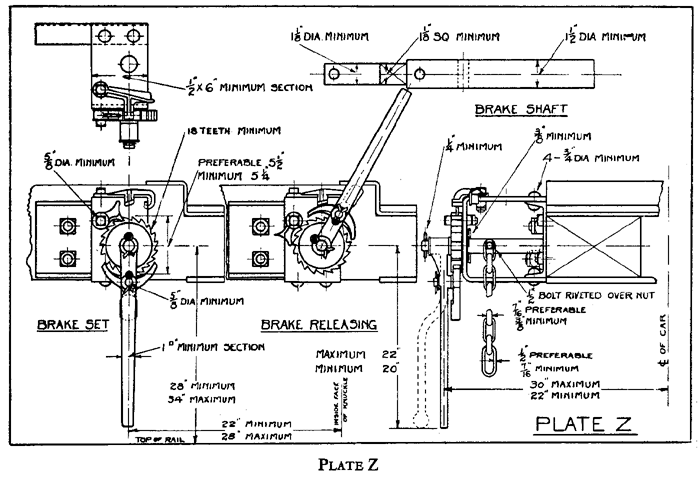
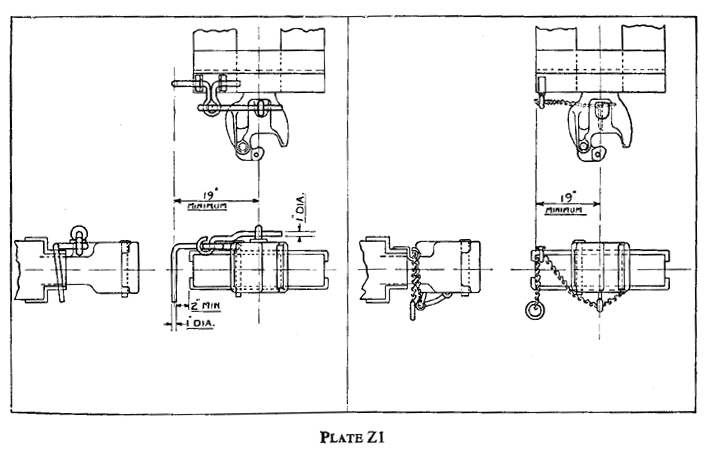
Division 21 - Rail Power Cars and Trailers (Passenger)
Power brakes
167 Power cars for carrying passengers or workmen must have an efficient brake acting on all wheels of the unit. Power cars equipped to haul trailers must have an efficient automatic air brake that can be operated by the operator of the power vehicle to all cars to which it is attached.
Handbrakes
168 (1) Number — Each power car shall be equipped with an efficient handbrake which shall operate in harmony with the power brake thereon. The handbrake may be of any efficient design but shall be sufficient when fully set to prevent movement of the car on 10% grade.
(2) Location — The handbrake shall be so located that it can be safely operated from inside the car.
Side doors (on rail cars without end platforms)
169 (1) Number — Two.
(2) Location — One near centre of each side.
(3) Manner of application — Doors shall be applied so that when shut they will completely cover the opening. Doors shall be securely hung and fitted with a substantial locking device.
(4) Dimensions — Door openings shall be in height not less than 60 inches, measured from deck of car to top of opening, and in width not less than 36 inches.
Side door steps
170 (1) Number — Two. Stirrup or box type may be used.
(2) Location — One under each side door. Outside edge of bottom tread shall be flush with side of car.
(3) Dimensions — Steps shall be the full width of the door opening. Lower tread of step shall be not more than 14 inches above top of rail. If stirrup steps are used they shall have minimum cross sectional area 1/2 by 1 1/2 inches, or equivalent, of wrought iron or steel.
(4) Manner of application — Steps shall be secured with bolts or rivets. If box type steps are used they shall be suitably boxed in and treads may be of wood, non-skid metal plate, or covered with double or single crimped wire netting square mesh not less than 2 by 2 per inch nor more than 3 by 3 per inch of No. 14 B.W.G. wire. Door step opening (if any) in deck inside car when doors are closed shall be closed by substantial covering.
Side door handholds
171 (1) Number — Four.
(2) Dimensions — Minimum diameter, 5/8 inch, wrought iron or steel. Minimum free clearance, 2 1/2 inches from car body. Maximum distance between handrails, 48 inches. When double doors are used, stanchions or handrails shall be attached so that handrails will be not more than 48 inches apart.
(3) Location — One vertical handhold on each side of each door, from a point not less than 48 inches above deck of car to a point not more than 36 inches above rail.
(4) Manner of application — Sidedoor handholds shall be securely fastened with not less than 1/2 inch bolts with nuts outside and riveted over, or with not less than 1/2 inch rivets.
Couplers
172 Power cars used for hauling trailers or cars shall be equipped with couplers at each end. Automatic couplers are preferred. Link and pin type couplers may or may not be used. (See Part V (B.C. Reg. 456/59), sections 33-36.)
Uncoupling levers (if automatic couplers are used)
173 (1) Number — Two double levers operative from either side.
(2) Dimensions — Levers shall extend across end of car with handles not more than 12, preferably 9, inches from side of car, and shall be so constructed as to give a minimum clearance of 2 inches around handle.
Pull chain type uncouplers may be used but lever type preferred. If pull chain type used, free end of chain shall hang not more than 12, preferably 9, inches from side of car.
Headlights
174 (1) Number — Two.
(2) Location — One near top at centre of each end of car.
(3) Dimensions — See Part V (B.C. Reg. 456/59), section 42.
Whistle or horn
176 (1) Number — One whistle or diaphragm horn of approved type.
(2) Location — On top of car, acoustically unobstructed.
Sanders
177 (1) Number — Four air operated sanders.
(2) Location — One in front of each wheel of leading pair at both ends of car.
(3) Manner of application — Sanders shall be applied so that they may be controlled from the operator's position and sanders on one end applied independently of sanders on other end.
Fuel tanks
178 Location — Whenever possible, outside body of car, preferably under the deck. Filler nozzles shall be located outside body of car.
Saw racks
179 Location — When saws are carried, saw racks shall be provided and shall be located outside the body of the car.
Seats
180 (1) Dimensions — Minimum width, 14 inches. Minimum space per person, 18 inches.
(2) Manner of application — Seats shall be securely fastened to the body of the car.
Windshield wipers
181 (1) Number — Two, power operated.
(2) Location — One on window at each end of car (or cupola, if any) through which operator views the track.
Window and position of operator shall be so disposed that operator has clear view of track and when switching may see signals.
Power cars and trailers used for conveying passengers or workmen must be housed in completely.
Trailers used for conveying passengers or workmen shall have an automatic power brake and emergency valve and shall conform to the safety appliance specifications for power cars with respect to handbrakes, side doors, side door handholds, side door steps, couplers, uncoupling levers, saw racks and seats.
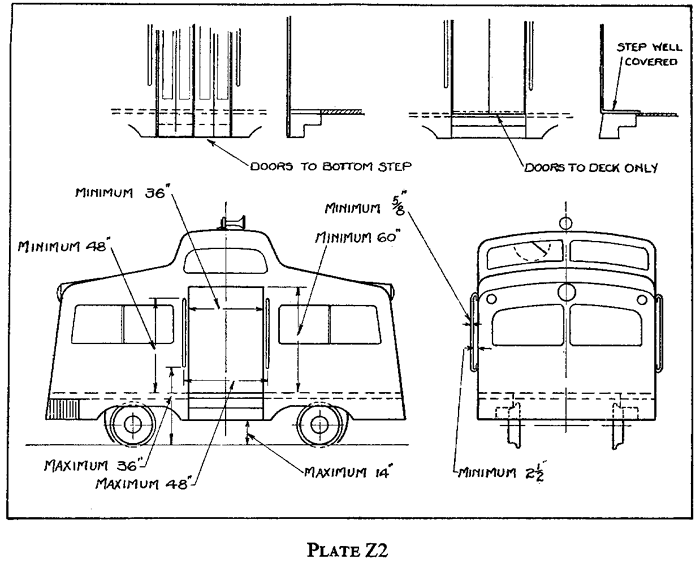
Steps, handholds, handbrakes, etc.
182 (1) Cars or locomotives of construction not covered specifically in the foregoing sections, relative to handholds, sill steps, ladders, handbrakes, footboards and running boards, may be considered as of special construction, but shall have, as nearly as possible, the same complement of handholds, sill steps, ladders, handbrakes, footboards, and running boards as are required for cars or locomotives of the nearest approximate type.
(2) When referring to cars, "right" or "left" refers to side of person when facing end or side of car from ground.
(3) When referring to locomotives, "right" or "left" refers to side of person when facing in forward direction of locomotive.
(4) To provide for the usual inaccuracies of manufacturing and for wear, where sizes of metal are specified, a total variation of 5% below size given is permitted.
Division 23 - Automatic Couplers
Couplers and drawbars
183 (1) All standard railway equipment shall be equipped with couplers coupling automatically by impact and which can be uncoupled without the necessity of men going between the ends of the cars.
(2) The prescribed standard height of drawbars on standard railway equipment shall be maximum 34 1/2 inches, minimum 31 1/2 inches, measured in a vertical line from top of rail to centre of knuckle.
Division 24 - Diesel Road Locomotives of the "A" or "Lead Unit" Type
Handbrake
184 (1) Number — Each locomotive shall be equipped with an approved type handbrake device which shall operate in harmony with the power brake thereon.
(2) Location — Each handbrake device shall be so located that it can be safely operated while the locomotive is in motion.
Pilots
185 (1) Number — One.
(2) Location — Front end of locomotive.
(3) Pilot toe steps — Optional, but if provided steps shall be of sufficient width and depth for a man to stand on, and for each such toe step there shall also be provided in an appropriate location a grab iron or handhold not less than 4 feet nor more than 5 feet above such toe step. Handholds shall be 5/8 of an inch or more in diameter, securely fastened, with a clearance of 2 1/2 inches.
(4) Type of pilot — Pilots shall be of the general lines as shown on Plate Z2 and shall be made of steel plate, securely fastened to the body of the locomotive, the lines of shear being such as to prevent large animals or other obstructions when struck from entering under the front of an advancing locomotive. In order to improve the shear in the last respect, and with particular consideration to motor vehicles, the front coupler may be arranged to fold into the shear board, in which case uncoupling levers shall not be required.
Door handholds
187 (1) Door handholds — There shall be one vertical handhold on each side of each door, extending from the top of the floor opening to a point not more than 48 inches above the top of rail; minimum diameter, 7/8 inch; clearance, 2 inches, preferably 2 1/2 inches. Maximum distance between handholds, 48 inches.
(2) Cab side steps — There shall be steps directly under and in line with each side door not less than 10, preferably 12, inches in width, and height of tread of bottom steps above top of rail not more than 24 inches. Steps shall be suitably enclosed behind treads, but distance from back plate of enclosure to outside edge of tread shall be not less than 4 inches. Maximum spacing of treads, 19 inches.
Cab appurtenances
188 (1) Cab end door — On "A" units as shown in Plate Z3 there shall be a bulkhead and a door between the engine compartment and the cab, and such bulkhead and door shall be substantially constructed to prevent the passage of engine fumes from the engine compartment into the cab. It shall be securely hung on hinges, opening out from the cab, and shall have a secure fastener to hold the door closed. Suitable steps and handrails shall be provided where the height of the door sill exceeds 14 inches above either floor.
(2) Ventilation — The cab and the engine compartment shall be properly ventilated to prevent the accumulation of noxious fumes.
(3) Windshields — Windshields shall be of shatter proof heavy gauge glass. No obstructions which impair vision shall be permitted on any front windshield, other than sun visors or windshield wipers.
(4) Windshield wipers — A power operated windshield wiper shall be maintained on each side of the front windshield and located on the right side in the operator's line of vision, and on the left side so as to enable a head end brakeman, engineer's helper or fireman to see the track and signals during adverse weather conditions.
(5) Windshield heaters and fans — Means of a thermo-mechanical or thermo-pneumatic nature shall be provided to keep front windshields free from frost and fogging.
(6) Sun visors — Two adjustable sun visors shall be maintained in appropriate locations, one on each side of the cab.
(7) Cab seats — Cab seats shall be provided for each operator or person required by law to ride the cab of the locomotive. Such seats shall be appropriately located and securely fastened down by bolts.
[am. B.C. Reg. 111/91.]
Engine compartment
189 (1) Machinery guards — All exposed moving parts of machinery within normal reach and access shall be properly guarded, and likewise all hot steam pipes, exhaust pipes and other excessively hot surfaces shall be guarded or properly lagged.
(2) Crank case explosion — Appropriate venting shall be provided in all engine compartments and provision shall be made to prevent crank case explosion in all diesel engines.
(3) Grab irons and railings — Adequate grab irons, railings, ladders, steps, etc., shall be provided throughout all engine compartments to assure the safety of personnel.
(4) Doors — Two minimum, one of which may lead to the cab.
Access between coupled units
190 In the absence of end diaphragms and step plates as shown in Plate U and Plate Z2 herein, provision shall be provided so that persons may safely pass from an "A" type lead unit into a "B" type unit, passenger train equipment, or other power unit coupled to the rear end of any "A" unit. Such provision may be by means of folding platforms over the coupler not less than 20 inches wide with hand chains connected between the units on both sides of the said platforms, and the height of the lowest of such chains shall be not less than 3 feet from the platform level, and platforms shall be of non-slip or checkered material.
Fuel supply
191 (1) Fuel tanks — Fuel tanks shall be properly constructed as such with sufficient baffles and braces, and shall be securely fastened by bolts to the frame of the locomotive.
(2) Vents and flame traps — Each fuel tank shall be vented to the atmosphere by means of a vertical return loop or loops, the outlet or outlets of which shall be not more than 24 inches above the top of the rail. The combined capacity or size of the venting system shall be such that in the case of overflow, while filling, the full capacity of any filling means on the railway may pass through the said vent pipes without raising the static pressure in the fuel tank or tanks connected therewith by more than 5 pounds per square inch, gauge. Each vent pipe shall be provided with an approved type of flame trap.
(3) Filler plugs — There shall be provided, on each side of the outside of the locomotive, means for filling the fuel tanks, and such means shall securely fasten to prevent spillage or leakage while filling, and caps shall be provided which fasten and lock securely to prevent any leakage.
(4) Fuel level gauges — There shall be a fuel level indicator on each side of the locomotive, adjacent to each filling nozzle, which will indicate visually or audibly, while filling, when fuel tanks are filled to capacity.
(5) Emergency shut off — There shall be a rod or handle in a conspicuous place on each side of the outside of the locomotive adjacent to which shall be marked in both places "EMERGENCY FUEL SHUT OFF", and the said rods or handles shall be connected to an emergency fuel shut off valve in a suitable manner so that when the rods or handles are manipulated the supply of fuel from the fuel tank to the diesel engine or engines shall be positively shut off.
Illuminated numbers
193 (1) Number — Every locomotive shall be equipped and maintained with at least 2 illuminated number panels having at least 6 inch translucent figures.
(2) Location — On the front corners of the cab and on an appropriate angle so that they can be read from the front end or either side of the locomotive.
Headlights
194 Road engines shall be equipped with headlights and other lights in accordance with Part III, Locomotive Regulations.
Sill steps and handholds
195 (1) Number — Two or more.
(2) Dimensions — Stirrup steps shall have a clear length of tread of not less than 10, preferably 12, inches.
(3) Location — At rear end of locomotive on each side and under any side doors not otherwise specified. Where sill steps are located, sufficient grab irons or vertical rails shall be installed appropriately with the location of the sill steps, and the bottom end of any vertical rail or the lowest horizontal grab iron installed in conjunction with any sill step shall be not more than 48 inches above the rail. They shall be at least 5/8 inch in diameter, with a minimum clearance of 2, preferably 2 1/2, inches.
(4) Manner of application — Side handholds and grab irons shall be securely fastened with bolts or rivets.
Uncoupling levers
196 (1) Number — One, operative from either side at rear of locomotive.
(2) Dimensions — Rear end levers shall extend across rear end of locomotive with handles not more than 12, preferably 9, inches from the side of locomotive and so arranged to give at least 2 inches clearance around the handle.
Couplers
198 Locomotives shall be equipped with automatic couplers at the rear and front of the locomotive.
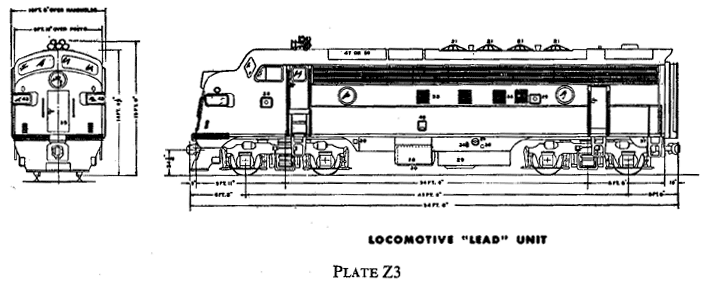
Division 25 - Diesel Road Locomotives of the Road Switcher Type
Handbrake
199 (1) Number — Each locomotive shall be equipped with an approved type handbrake device which shall operate in harmony with the power brake thereon.
(2) Location — Each handbrake device shall be so located that it can be safely operated while the locomotive is in motion.
Road pilots
200 (1) Number — Two.
(2) Location — Front and back end of locomotive.
(3) Design — As shown in Plate Z5 herein.
(4) Snowplough pilots — Snowplough pilots as shown on Plate Z5, Revision A (M.L.W. Drawing No. 997Q912600), may be used in lieu of the pilot as shown on Plate Z5.
[am. B.C. Reg. 24/67.]
Footboards
201 (1) Number — Two or more.
(2) Dimensions — Minimum width of tread, 10 inches. Minimum height of back stop, 4 inches above tread. Height from top of rail to top of tread, not more than 12 nor less than 9 inches. If made of wood, minimum thickness of tread shall be 1 1/2, preferably 2, inches. Footboards may be made of material other than wood which provides the same as or a greater degree of safety than wood of 1 1/2 inches thickness. When made of material other than wood, the tread surface shall be of anti-skid design and constructed with sufficient open space to permit the elimination of snow and ice from the tread surface.
(3) Location — Ends or sides.
If on ends, they shall extend not less than 18 inches outside the gauge of straight track, and shall be not more than 12 inches shorter than buffer beam at each end.
(4) Manner of application — End footboards may be constructed in 2 sections, provided that practically all space on each side of coupler is filled and inner ends are protected with guards of same height as back stop; each section shall be not less than 3 feet in length.
Footboards shall be securely bolted to two 1 by 4 inch metal brackets, provided footboard is not cut or notched at any point.
If footboard is cut or notched or in 2 sections, not less than four 1 by 3 inch metal brackets shall be used, 2 located on each side of coupler. Each bracket shall be securely bolted to buffer beam, end sill or tank frame by not less than two 7/8 inch bolts.
If side footboards are used, a substantial handhold or rail shall be applied not less than 30 inches nor more 60 inches above tread of footboard.
All locomotives used in yard, joint yard and transfer service must be equipped with footboards, as prescribed above.
End platforms
202 Where used, end platforms shall conform to the general arrangement shown herein on Plate Z4. End handrails shall be not less than one inch in diameter, with a minimum height of 3 feet from the platforms. Where end platforms are used, side steps and handrails shall be provided on each side of the locomotive. The steps shall be of material other than wood, and the tread surface shall be of anti-skid design and constructed with sufficient open space to permit the elimination of snow and ice from the tread surface. Handrails shall exist on both sides of steps at appropriate heights and of the general design as shown herein on Plate Z4.
Handrails and steps for headlights, etc.
203 (1) Locomotives having headlights which cannot be safely and conveniently reached from pilot beam shall be equipped with secure handrails and steps suitable for the use of men in getting to and from such headlights and headlight equipment.
(2) A suitable metal end or side ladder shall be applied to all compartments more than 48 inches in height, measured from the top of end sill, and securely fastened with bolts or rivets.
Running boards
204 (1) Number — One each side of locomotive and arranged in a manner that by passing through the cab a person may traverse from one end sill to the other end sill of the locomotive.
(2) Dimensions — Not less than 18 inches wide.
(3) General — Running boards shall be constructed and maintained with a non-skid surface and steps shall be provided where any rise is in excess of 14 inches.
Running board handrails
205 On road switcher type locomotives all handrails in conjunction with running boards shall be on the outside of each running board and shall be continuous from the end step railing to the cab on both sides and shall be constructed in a secure manner, using bolts or rivets. Stanchions shall be not more than 60 inches, centre to centre, and the handrail and stanchions shall be a minimum size of one inch in diameter. Where rises or steps occur, handrails shall rise accordingly by means of easy bends. The height of outside running board handrails above the running boards they serve shall be not less than 36 inches and not more than 42 inches (unless more than one rail is used).
End access between locomotives
206 Where locomotives are operated as multiple units or where locomotives are coupled in road service directly to baggage, mail, express or passenger coaches, or similar equipment, the end platforms of every road switcher locomotive so coupled shall be equipped and maintained with a folding or collapsible platform which may be let down above the coupler to allow persons to pass with reasonable safety between locomotives and such equipment when so coupled. The minimum width of such platforms shall be 20 inches and chains shall be provided with each platform which may be extended to act as handrails between locomotives or other equipment.
Door handholds if side doors used
208 (1) Door handholds — If side doors are used there shall be one vertical handhold on each side of each door, extending from the top of the door opening to a point not more than 48 inches above the top of rail; minimum diameter, 7/8 of an inch; clearance 2, preferably 2 1/2, inches. Maximum distance between handholds, 48 inches.
(2) Cab side steps — If side doors are used there shall be steps directly under and in line with each side door not less than 10 inches, preferably 12 inches, in width, and height of tread of bottom steps above top of rail not more than 24 inches. Steps shall be suitably enclosed behind treads, but distance from back plate of enclosure to outside edge of tread shall be not less than 4 inches. Maximum spacing of treads, 19 inches.
Cab appurtenances
209 (1) Cab end door — On road switcher units where boilers are installed, there shall be a bulkhead and a door between the boiler compartment and the cab, and such bulkhead and door shall be substantially constructed to prevent the passage of boiler fumes from the boiler compartment into the cab. It shall be securely hung on hinges, opening out from the cab, and shall have a secure fastener to hold the door closed. Suitable steps and handrails shall be provided where the height of the door sill exceeds 14 inches above either floor.
(2) Ventilation — The cab and the engine compartment (and boiler compartment, if used) shall be properly ventilated to prevent the accumulation of noxious fumes.
(3) Windshields — Windshields shall be of shatter proof heavy gauge glass. No obstructions which impair vision shall be permitted on any front windshield, other than sun visors or windshield wipers.
(4) Windshield wipers — A sufficient number of power operated windshield wipers shall be maintained on each side of the front windshields and located in the operator's line of vision and on the other side so as to enable a head end brakeman, engineer's helper or fireman to see the track and signals ahead of the locomotive during adverse weather conditions.
(5) Windshield heaters and fans — Means of a thermo-mechanical or thermo-pneumatic nature shall be provided to keep all windshields free from frost and fogging.
(6) Sun visors — Sufficient adjustable sun visors shall be maintained in appropriate locations on each side of the cab.
(7) Cab seats — Cab seats shall be provided for each operator or person required by law to ride the cab of the locomotive. Such seats shall be appropriately located and securely fastened down by bolts.
[am. B.C. Reg. 111/91.]
Engine compartment
210 (1) Machinery guards — All exposed moving parts of machinery within normal reach and access shall be properly guarded and likewise all hot steam pipes, exhaust pipes and other excessively hot surfaces shall be guarded or properly lagged.
(2) Crank case explosion — Appropriate venting shall be provided in all engine compartments and provision shall be made to prevent crank case explosion in all diesel engines.
Fuel supply
211 (1) Fuel tanks — Fuel tanks shall be properly constructed as such with sufficient baffles and braces and shall be securely fastened by bolts to the frame of the locomotive.
(2) Vents and flame traps — Each fuel tank shall be vented to the atmosphere by means of a vertical return loop or loops, the outlet or outlets of which shall be not more than 24 inches above the top of the rail. The combined capacity or size of the venting system shall be such that in the case of overflow, while filling, the full capacity of any filling means on the railway may pass through the said vent pipes without raising the static pressure in the fuel tank or tanks connected therewith by more than 5 pounds per square inch, gauge. Each vent pipe shall be provided with an approved type of flame trap.
(3) Filler plugs — There shall be provided, on each side of the outside of the locomotive, means for filling the fuel tanks and such means shall securely fasten to prevent spillage or leakage while filling, and caps shall be provided which fasten and lock securely to prevent any leakage.
(4) Fuel level gauges — There shall be a fuel level indicator on each side of the locomotive, adjacent to each filling nozzle, which will indicate visually or audibly, while filling, when fuel tanks are filled to capacity.
(5) Emergency shut off — There shall be a rod or handle in a conspicuous place on each side of the outside of the locomotive adjacent to which shall be marked in both places "EMERGENCY FUEL SHUT OFF", and the said rods or handles shall be connected to an emergency fuel shut off valve in a suitable manner so that when the rods or handles are manipulated the supply of fuel from the fuel tank to the diesel engine or engines shall be positively shut off.
Illuminated numbers
213 (1) Every locomotive of the road switcher type shall be equipped and maintained with at least 2 illuminated number panels having at least 6 inch translucent figures.
(2) Location — On each front (with regard to the direction of travel) corner of the locomotive as high as practicable and on an appropriate angle so that they can be read from the front end (with regard to the direction of travel) or either side of the locomotive.
Headlights
214 Road switcher engines shall be equipped with headlights and other lights in accordance with Part III (B.C. Reg. 454/59), Locomotive Regulations.
Uncoupling levers
215 (1) Number — Two, operative from either side at front and rear of locomotive.
(2) Dimensions — Uncoupling levers shall extend across the end of locomotive, with handles not more than 12 inches, preferably 9 inches, from the side of locomotive and so arranged to give at least 2 inches clearance around the handle.
Couplers
217 Locomotives shall be equipped with automatic couplers at the rear and front of the locomotive.
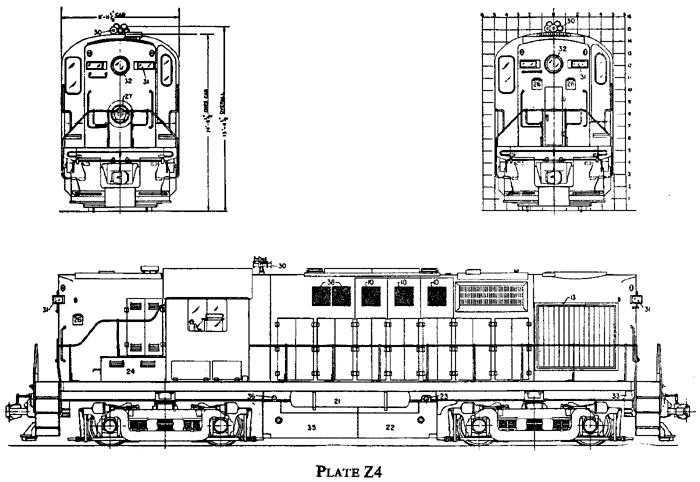
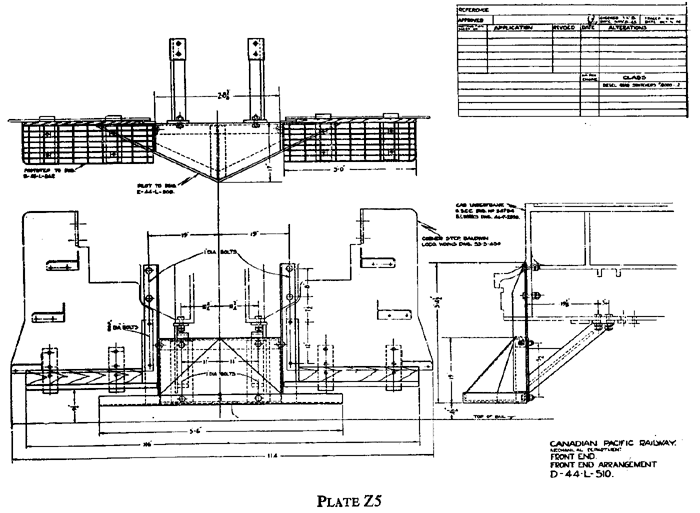
Division 26 - Diesel Yard Switcher Locomotives
Handbrake
218 (1) Number — Each locomotive shall be equipped with an approved type handbrake device which shall operate in harmony with the power brake thereon.
(2) Location — Each handbrake device shall be so located that it can be safely operated while the locomotive is in motion.
Footboards
219 (1) Number — Two or more.
(2) Dimensions — Minimum width of tread, 10 inches. Minimum height of back stop, 4 inches above tread. Height from top of rail to top of tread, not more than 12 nor less than 9 inches. If made of wood, minimum thickness of tread shall be 1 1/2, preferably 2, inches. Footboards may be made of material other than wood which provides the same as or a greater degree of safety than wood of 1 1/2 inches thickness. When made of material other than wood, the tread surface shall be of anti-skid design and constructed with sufficient open space to permit the elimination of snow and ice from the tread surface.
(3) Location — Ends or sides.
If on ends, they shall extend not less than 18 inches outside of gauge of straight track and shall be not more than 12 inches shorter than buffer beam at each end.
(4) Manner of application — End footboards may be constructed in 2 sections, provided that practically all space on each side of coupler is filled and inner ends are protected with guard of same height as back stop; each section shall be not less than 3 feet in length.
Footboards shall be securely bolted to two 1 by 4 inch metal brackets, provided footboard is not cut or notched at any point.
If footboard is cut or notched or in 2 sections, not less than four 1 by 3 inch metal brackets shall be used, 2 located on each side of coupler. Each bracket shall be securely bolted to buffer beam, end sill or tank frame by not less than two 7/8 inch bolts.
If side footboards are used, a substantial handhold or rail shall be applied not less than 30 inches nor more than 60 inches above tread of footboard.
All locomotives used in yard, joint yard and transfer service must be equipped with footboards as prescribed above.
End platforms
220 Where used, end platforms shall conform to the general arrangement shown herein on Plate Z6. End handrails shall be not less than one inch in diameter, with a minimum height of 3 feet from the platforms. Where end platforms are used, side steps and handrails shall be provided on each side of the locomotive. The steps shall be of material other than wood and the tread surface shall be of anti-skid design and constructed with sufficient open space to permit the elimination of snow and ice from the tread surface. Handrails shall exist on both sides of steps at appropriate heights and of the general design as shown herein on Plate Z6.
Handrails and steps for headlights, etc.
221 (1) Locomotives having headlights which cannot be safely and conveniently reached from pilot beam shall be equipped with secure handrails and steps suitable for the use of men in getting to and from such headlights and headlight equipment.
(2) A suitable metal end or side ladder shall be applied to all compartments more than 48 inches in height, measured from the top of end sill and securely fastened with bolts or rivets.
Running boards
222 (1) Number — One each side of locomotive and arranged in a manner that by passing through the cab a person may traverse from one end sill to the other end sill of the locomotive.
(2) Dimensions — Not less than 18 inches wide.
(3) General — Running boards shall be constructed and maintained with a non-skid surface and steps shall be provided where any rise is in excess of 14 inches.
Running board handrails
223 On switcher type locomotives where handrails in conjunction with running boards are not on the outside of each running board and continuous from the end step railing to the cab on both sides as specified for diesel locomotives of the road switcher type and illustrated in Plate Z4 herein, handrails in lieu thereof may be securely fastened to each side of the outside of the engine compartment, situated above the outside access doors but not less than 48 inches nor more than 66 inches above the running boards they serve. Such handrails shall be continuous for any portion of the running board where outside handrails are not installed. They shall have a minimum diameter of one inch and a hand clearance of at least 2, preferably 2 1/2, inches.
Door handholds if side doors used
225 (1) Door handholds — If side doors are used there shall be one vertical handhold on each side of each door, extending from the top of the door opening to a point not more than 48 inches above the top of rail; minimum diameter, 7/8 of an inch; clearance 2, preferably 2 1/2, inches. Maximum distance between handholds, 48 inches.
(2) Cab side steps — If side doors are used there shall be steps directly under and in line with each side door not less than 10 inches, preferably 12 inches, in width, and height of tread of bottom steps above top of rail not more than 24 inches. Steps shall be suitably enclosed behind treads, but distance from back plate of enclosure to outside edge of tread shall be not less than 4 inches. Maximum spacing of treads, 19 inches.
Cab appurtenances
226 (1) Ventilation — The cab and the engine compartment shall be properly ventilated to prevent the accumulation of noxious fumes.
(2) Windshields — Windshields shall be of shatterproof heavy gauge glass. No obstructions which impair vision shall be permitted on any front windshield, other than sun visors or windshield wipers.
(3) Windshield wipers — A sufficient number of power operated windshield wipers shall be maintained on each side of the front windshields and located in the operator's line of vision.
(4) Windshield heaters and fans — Means of a thermo-mechanical or thermo-pneumatic nature shall be provided to keep all windshields free from frost and fogging.
(5) Sun visors — Sufficient adjustable sun visors shall be maintained in appropriate locations on each side of the cab.
(6) Cab seats — Cab seats shall be provided for each operator or person required by law to ride the cab of the locomotive. Such seats shall be appropriately located and securely fastened down by bolts.
Engine compartment
227 (1) Machinery guards — All exposed moving parts of machinery within normal reach and access shall be properly guarded, and likewise all hot steam pipes, exhaust pipes and other excessively hot surfaces shall be guarded or properly lagged.
(2) Crank case explosion — Appropriate venting shall be provided in all engine compartments, and provision shall be made to prevent crank case explosion in all diesel engines.
Fuel supply
228 (1) Fuel tanks — Fuel tanks shall be properly constructed as such with sufficient baffles and braces and shall be securely fastened by bolts to the frame of the locomotive.
(2) Vents and flame traps — Each fuel tank shall be vented to the atmosphere by means of a vertical return loop or loops, the outlet or outlets of which shall be not more than 24 inches above the top of the rail. The combined capacity or size of the venting system shall be such that in the case of overflow, while filling, the full capacity of any filling means on the railway may pass through the said vent pipes without raising the static pressure in the fuel tank or tanks connected therewith by more than 5 pounds per square inch, gauge. Each vent pipe shall be provided with an approved type of flame trap.
(3) Filler Plugs — There shall be provided, on each side of the outside of the locomotive, means for filling the fuel tanks, and such means shall securely fasten to prevent spillage or leakage while filling and caps shall be provided which fasten and lock securely to prevent any leakage.
(4) Fuel level gauges — There shall be a fuel level indicator on each side of the locomotive, adjacent to each filling nozzle, which will indicate visually or audibly, while filling, when fuel tanks are filled to capacity.
(5) Emergency shut off — There shall be a rod or handle in a conspicuous place on each side of the outside of the locomotive adjacent to which shall be marked in both places "EMERGENCY FUEL SHUT OFF", and the said rods or handles shall be connected to an emergency fuel shut off valve in a suitable manner so that when the rods or handles are manipulated the supply of fuel from the fuel tank to the diesel engine or engines shall be positively shut off.
Illuminated numbers
230 (1) Every locomotive of the yard switcher type shall be equipped and maintained with at least 2 illuminated number panels having at least 4 inch translucent figures.
(2) Location — On each end of the locomotive, as high as practicable, and on an appropriate angle so that they can be read from either side of the locomotive.
Headlights
231 Yard switcher engines shall be equipped with headlights and other lights in accordance with Part III (B.C. Reg. 454/59), Locomotive Regulations.
Uncoupling levers
232 (1) Number — Two, operative from either side at front and rear of locomotive.
(2) Dimensions — Uncoupling levers shall extend across the end of locomotive, with handles not more than 12, preferably 9, inches from the side of locomotive and so arranged to give at least 2 inches clearance around the handle.
Couplers
234 Locomotives shall be equipped with automatic couplers at the rear and front of the locomotive.
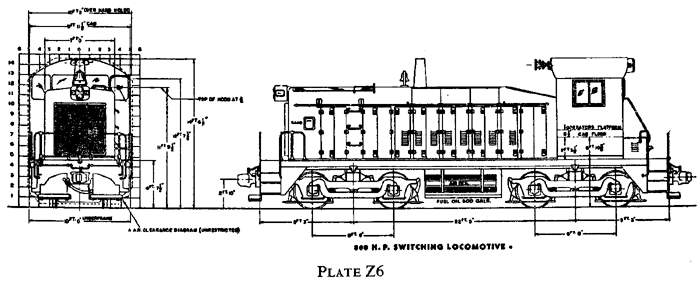
Division 27 - Passenger Train Cars of the (Budd) R.D.C. Type
Handbrakes
235 (1) Number — Each passenger train car shall be equipped with 2 efficient handbrake devices of an approved type which shall operate in harmony with the power brake thereon.
(2) Location — A handbrake shall be located in each vestibule, adjacent to the operator's position at each end of the car.
Power brakes
236 (1) The power brakes of each unit shall be operative from the operator's position in each vestibule at each end of the car, and so arranged with suitable cut-out cocks and removable operator's handles that any controls when not in use may be rendered approximately inoperative.
(2) Power brakes shall be continuous in operation from car to car when cars are coupled together and operated as a train, and arranged in such a manner that all brakes in the train are under the control of the operator driving the train, and shall be so constructed and arranged that should the continuity of the brake pipe be broken the brakes on the entire train shall apply automatically.
Emergency stop
237 Each passenger train car shall be equipped and maintained with a manually operated means which, when pulled, shall immediately apply the brakes in emergency on the entire train. Its function shall be plainly marked with operating instructions.
Communication between cars
238 There shall be a communication system between the conductor and the driver of each R.D.C. car when operated singly or when 2 or more such cars are coupled together and operated as a train.
Headlights
239 The headlights and classification lights on all R.D.C. cars shall be the same as those specified in Part III (B.C. Reg. 454/59) for road locomotives. Nothing in any regulation, however, shall be misconstrued to prevent the application of extra lights in the general interest of safety.
Windshields, wipers, visors and defrosting
240 The same as the specifications set forth herein for diesel road engines (Divisions 24 and 25).
Operators' seats
241 The same as the specifications set forth herein for diesel road engines (Divisions 24 and 25).
Side door steps
242 The same as the specifications set forth herein for "Side door steps" on "Passenger Train Cars Without End Platforms" (Division 12).
Uncoupling levers
243 The same as specified for "Passenger Train Cars With Wide Vestibules" (Division 10).
End vestibule side steps, doors and railings for the use of passengers
245 All end vestibules, vestibule doors, windows, floors, floor trap doors, fasteners, railings, steps, step treads, grab irons and all appurtenances with respect to the boarding and detraining of passengers and the accommodation of passengers with respect to passageway and access between passenger coaches coupled together shall be in accordance with A.A.R. standards for passenger train cars with wide vestibules (Division 10).
Pilots
246 (1) Number — Two.
(2) Location — One on each end of car.
(3) Type of pilot — Pilots shall be made of steel plate, securely fastened to the body of the rail car, the lines of shear being such as to prevent large animals or other obstructions, when struck, from entering under the front of an advancing rail car.
(4) Pilot toe steps — Optional, but, if provided, steps shall be of sufficient width and depth for a man to stand on and for each such toe step there shall also be provided in an appropriate location a grab iron or handhold not less than 4 feet nor more than 5 feet above such toe step. Handholds (if used) shall be 5/8 of an inch or more in diameter, securely fastened, with a clearance of 2 1/2 inches.
Roof ladder
247 (1) Number — One.
(2) Location — At side of rail car, accessible from vestibule door.
(3) Dimensions and manner of application — The same as the specifications set forth herein for "Box and Other House Cars" (Division 1).
Couplers
248 Rail passenger cars shall be equipped with automatic couplers at each end, the same to be compatible and standard with the couplers and draw gears used on locomotives, passenger coaches and freight equipment.
Fuel supply
249 Fuel tanks, vents, flame traps, filler plugs, fuel level gauges and emergency shut offs shall be the same as specified herein for "Diesel Road Locomotives of the Road Switcher Type" (Division 25).
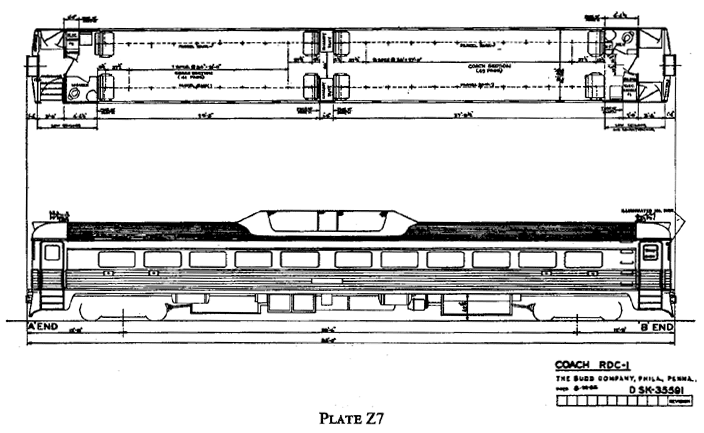
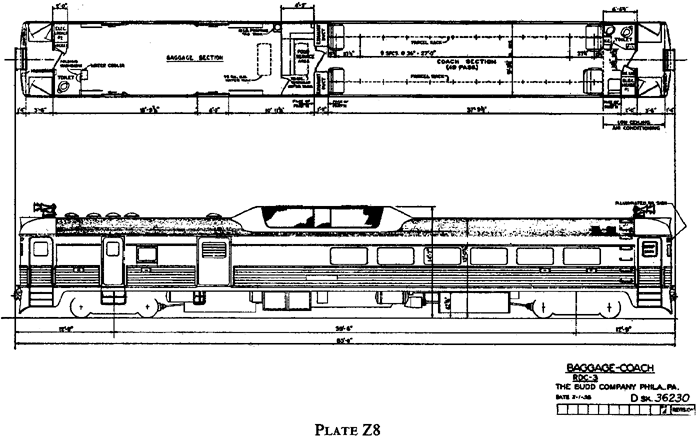
| 1. | Regulation originally made by authority of minister, by certificate, subject to approval of the Lieutenant Governor in Council (see R.S.B.C. 1948-285-7), since July 8, 1976, regulation made by authority of minister only. |
[Provisions of the Railway Act R.S.B.C. 1996, c. 395, relevant to the enactment of these regulations: section 271]