Note: This regulation has been placed in the Regulations Point in Time collection. This regulation is not repealed.
| B.C. Reg. 456/59 O.C. 2886/59; Certificate 10031 |
Railway Act
Part V: Power Cars and Rail Cars Regulations
Definitions
In these regulations, unless the context otherwise requires:
"Act" means the Railway Act of British Columbia;
"chief inspector" or "inspector" means an inspecting engineer, inspector or assistant inspector appointed under the provisions of the Act or of the Public Service Act;
"certificate" means a certificate of inspection made by an inspector;
"power car" or "rail car" means any railway conveyance in which passengers or workmen are transported and which is self-propelled by its own motive power, and shall include any self-propelled motive equipment not considered to be a locomotive but which is equipped to haul or switch railway rolling stock by its own motive power;
"passenger trailer" means any railway conveyance in which passengers or workmen are transported and which is hauled by rail car motive power, and shall include all apparatus and things attached to and connected therewith or used in reference thereto;
"freight trailer" means any railway conveyance other than standard railway equipment, or hand push cars, on which freight is transported and which is hauled by rail car motive power;
"push car" means a 4 wheeled railway vehicle of such proportions that it can be pushed along or removed from the rails by hand;
"hand car" means a railway vehicle self-propelled by muscular power and of such proportions that it can be removed from the rails by hand;
"speeder" means a 4 wheeled railway vehicle similar to a hand car but propelled by a motor, such as is generally used by section gangs or by officials for inspection purposes;
"passenger" for the purpose of this Part, "passenger" or "passengers" means any person or persons, including workmen, other than those in line of duty, being transported by rail car or trailer;
"owner" means any person, firm or corporation in possession of or operating a power car or rail car equipment, and includes the manager or other chief officer of such firm or corporation;
"operator" means any person having charge of or operating a power car.
[am. B.C. Regs. 167/65, s. (a); 40/91, s. 4.]
Extent and Application of Regulations
Application
1 These regulations shall apply to all railways operating under the jurisdiction of the Government of British Columbia.
Railway responsibility
2 Every railway will be held responsible for the general condition of all power cars and rail car equipment under its control. The mechanical officer in charge at each point where repairs are done will be held responsible for the inspection and repair of all rail cars and appurtenances under his jurisdiction. He must know that all defects disclosed by any inspection are properly repaired before the equipment is returned to service. The safe working pressure of all pressure parts shall be fixed by the chief inspector of the ministry after full consideration has been given to design workmanship, age and condition.
Portions of Boiler Code applicable
3 That portion of the regulations known as Part III of the "British Columbia Railway Department Boiler Code", adopted by order in council under the Railways Act on January 21, 1947, shall govern the design, registration and construction of all pressure parts used on rail cars.
Inspection frequency
4 Every rail car shall be inspected before being put into service and at least every 12 months thereafter by an inspector of the ministry. Inspectors shall have the right, at all reasonable hours, to examine rail cars, and may refuse to grant a certificate for any rail car found defective according to the provisions of these regulations. They may order out of service any rail car which for any cause they consider unfit and dangerous to operate.
Reporting of defects
5 It is the duty of every power car operator to inform the inspector of any defects known or believed to exist in the rail car under his charge. The permit to operate power cars of any rail car operator refusing or refraining from doing so may be revoked by the inspector.
Approval for new rail car equipment
6 No company shall install or operate any new rail car equipment without first obtaining approval thereof from the chief inspector. Every company shall submit with each application for approval designs and specifications of said equipment.
[am. B.C. Reg. 2/99, App. 3, s. 1.]
Other approval
7 No company shall install or operate any equipment without first applying to the chief inspector for, and obtaining from him, his approval of such equipment.
Requirements for approval
8 The chief inspector shall not grant his approval pursuant to sections 6 and 7 of this Part unless there is compliance with the following provisions:
(a) all equipment must comply with the ministry's Safety Appliance Standards, as set forth in Part IV of the regulations made pursuant to the Railway Act (B.C. Reg. 455/59);
(b) all equipment shall comply with Part V of the regulations made pursuant to the Railway Act (B.C. Reg. 456/59) governing power cars and rail cars used for conveying passengers and workmen or for hauling other cars as herein set forth;
(c) all rail car equipment used for carrying passengers or workmen must be housed in so that passengers or workmen will not be exposed to the weather;
(d) the seating capacity on equipment used for conveying passengers or workmen shall be based on 18 inches per passenger, and the seats shall be securely fastened to the body of the car;
(e) all rail car equipment (power cars, trailers or other cars) shall be equipped with hand brakes or power brakes complying with the regulations hereinafter set forth in this Part under "Brakes";
(f) the position of the operator of power cars shall be so arranged that he can have a clear view of the tracks and see signals. In particular the requirements shall be as follows: On single end power cars travelling in one direction, the operator shall be located in the front of the car with unobstructed forward vision; on power cars in excess of 16 feet overall body length, intended to travel in either direction, the operator and controls shall be located in a cupola with unobstructed vision in all directions, or the car shall be equipped with controls on each end of the car and unobstructed vision in whichever direction the car may be travelling;
(g) power units with trailers attached used for hauling logs and operated as a unit must have the trailer securely fastened, and must be equipped with a hand brake and an air brake that will apply brakes to all wheels of the unit. A clearance of 6 feet must be maintained between the ends of the logs and the operator;
(h) the wheels of all rail car equipment must comply with the A.A.R. standard flanges and wheel tread.
Issuance and display of certificate
9 A certificate shall be issued by the inspector for every power car found, after inspection and testing, to be in satisfactory working condition. Such certificate, showing date of last inspection, the horsepower and the number of passengers for which the car is approved, shall be placed under glass in the cab of every such power car.
Period of certificate
10 Certificates shall be issued covering a period of 12 months, but should the inspector consider it advisable he may issue a certificate for a lesser period.
Suspension of certificate
11 Inspectors finding defects in any power car having an unexpired certificate may suspend such certificate until repairs are made or necessary fittings supplied.
Self starters on internal combustion engines
16 Internal combustion engines of all power cars shall be fitted with self starters.
Controls of power cars
17 The controls of power cars shall be arranged so that the operator has complete control of the car from the operator's position and all operating levers shall actuate with a minimum amount of manual effort.
Axles on large capacity rail cars
18 Every rail car with a capacity in excess of 50 passengers (or 24 feet overall body length) shall be equipped with swivel type trucks under each end of the car, having at least 2 axles in each truck; provided, however, when 4 wheel power cars are fitted with axle housings having a differential drive on each axle, the wheelbase may be extended to 16 feet with an overall body length not exceeding 30 feet, in which case the approved capacity of each such car shall not exceed 55 passengers.
Chain drives to axles
19 Chain drives to the axles of power cars shall be arranged so as to cause a minimum of bending movement in the axles which they drive. The driven sprockets shall be located as near to the axle journals as possible. The drives are to be arranged so that the chain tension will not be altered due to the deflection of the springs, and the drive chains are to be sufficiently heavy that in case of a chain breakage the full horsepower can be transmitted without undue stretching or straining of the remaining chains.
Physical requirements of axles
20 For the purpose of this Part, "axle" means a rotating axle subject to a bending movement due to supporting the weight of the rail car, and shall not mean a housing or axle subject to torque only.
Axles must be made from new material and of such quality as to withstand shock. The size of axles in proportion to passenger capacity, body length and wheelbase of 4 wheel rail cars shall be not less than those shown in the following table:
| FOUR WHEEL RAIL CAR PROPORTIONS | |||
| Approved | Overall | Wheelbase | Minimum Axle |
| Capacity | Body Length | (4 wheel) | Diameter in Inches |
| 50 passengers | 24' | 12' 6" | 3 3/4" |
| 45 passengers | 22' | 12' | 3 1/2" |
| 40 passengers | 20' | 11' | 3 1/4" |
| 35 passengers | 18' | 10' | 3" |
| 30 passengers | 16' | 9' | 2 3/4" |
| 25 passengers | 14' | 8' | 2 1/2" |
| 20 passengers | 12' | 7' | 2 1/4" |
| 15 passengers | 10' | 6' | 2" |
The foregoing table shows the minimum size of axles when journals are placed between the wheels. When journals are placed outside the wheels, sizes of axles are to be increased by 1/4 inch in diameter. The minimum size of axle on any passenger carrying rail car shall be 2 inches.
Springs on rail cars
21 Every rail car shall have springs so arranged that the weight of the chassis and body structure is spring slung from the trucks or axles. Springs shall be of such proportions that from empty to full load of the car their deflection or compression will not exceed 2 1/2 inches. On 4 wheel rail cars where the wheel base exceeds 8 feet, it is recommended that 3 point suspension, using a cross equalizing bar, be applied to the springs of one axle.
Transmission and reverse gear boxes
22 Transmission and reverse gear boxes shall be designed to transmit the full horsepower of the engine under all operating conditions of the power car.
Brakes
23 Every power car shall be equipped with air brake, vacuum booster or an efficient hand brake, determined by the capacity and size of the power car; in particular the requirements shall be as follows:
(a) every power car equipped or intended to haul trailers or other cars shall be fitted with automatic air brakes. Such system of brakes shall be continuous, instantaneous in action, and capable of being applied at will by the operator, and the brakes must be self applying in the event of any failure in the continuity of their action;
(b) every power car in excess of 16 feet overall body length shall be equipped with air brakes acting through brake shoes to all wheels. Power cars not equipped or intended to haul trailers or other cars need not have automatic air brakes but may be equipped with straight air;
(c) power cars in excess of 12 feet up to and including 16 feet overall body length shall be equipped with either air brakes or vacuum booster augmenting an efficient hand brake;
(d) power cars up to and including 12 feet overall body length shall be equipped with either air, vacuum booster or efficient hand brake;
(e) every power car shall be equipped with emergency hand brake capable of holding the car on any grade up to 10%;
(f) every passenger trailer shall be equipped with a hand brake, automatic air brake and emergency valve;
(g) every freight trailer shall be equipped with a hand brake and automatic air brake;
(h) the braking power of rail car equipment equipped with air brakes shall be designed so that the sum and total force of all the brake shoes acting on the wheels is equal to at least 50% of the loaded weight of the car.
Air horns, bells and gongs
24 Every power car shall be equipped with an approved type air horn, and, in addition, power cars intended or used to switch standard railway equipment shall be fitted with a bell or gong.
Windshield wipers
25 Every power car shall be fitted with power operated windshield wipers on the windows through which the operator views the track.
Sanders
26 All air equipped power cars shall be fitted with air operated sanders, one ahead of each wheel of the leading pair at both ends of the car. Sanders shall be applied so that they may be controlled from the operator's position, and sanders on one end operated independently of the other.
Fuel tanks
27 Fuel tanks shall be located, whenever possible, outside the body of the car, preferably under the deck. Filler nozzle shall be located outside the body of the car.
Doors
29 No rail car without end platform shall have end doors for passengers. Doors shall be arranged so that passengers board and unload from both sides of the car, and shall be placed so that an injured person on a stretcher may be passed through the doors. The minimum width of passenger side door openings shall be 36 inches, and where doors exceed 48 inches in width, stanchions or handrails shall be attached so that handrails will not be more than 48 inches apart. It is recommended that passenger side doors be of the folding type. Doors shall be so constructed that step wells are not open to the right of way.
Road numbers
30 Every rail car shall be designated by a road number. Road numbers shall be at least 6 inches in size and painted or securely fastened to the sides and ends of the car. Road numbers shall be of a series apart from steam motive power; the series ranging from 100 to 199 is recommended.
Exhaust
31 The exhaust gases from internal combustion engines shall be piped to exhaust above the top of power car, and shall be so arranged that exhaust fumes do not drift into the cab so they may be breathed by the operator or passengers.
Ventilation of cabs
32 Cabs of rail cars shall be properly ventilated. Precautions must be taken to see that no exhaust or other obnoxious gases can enter or accumulate in the cab.
Requirement for couplers
33 Every power car used or intended to be used for the hauling of standard railway equipment, in addition to automatic air brakes, shall have standard height automatic couplers.
Power cars with trailers
34 Companies adopting the use of power cars with trailers on and after the date of these regulations coming into effect shall have all such power cars and trailers fitted with automatic couplers.
Rebuilt power cars with trailers
35 Companies owning and operating power cars with trailers prior to the date of these regulations coming into effect shall apply automatic couplers to all rail car equipment built or rebuilt after said date.
Height requirements
36 Automatic couplers capable of being coupled to standard railway equipment shall be installed and maintained so that the height between the centre of the coupling and the top of the rail is not more than 34 1/2 inches and not less than 32 1/2 inches when the car is empty.
Inspection after each trip
37 Every rail car shall be inspected after each trip or day's work, and any serious defects found shall be repaired before the rail car is returned to service.
Air brakes
38 It must be known before each trip that the brakes on rail cars are in safe and suitable condition for service, that the air compressor or compressors are in condition to provide an ample supply of air for the service in which the rail car is used, and that all other devices for controlling or regulating the pressure are properly maintained.
Testing main reservoirs
39 Every main reservoir, before being put into service and at least once after 12 calendar months service, provided such service is performed within 2 consecutive years, shall be subjected to hydrostatic pressure not less than 25% above the maximum air pressure. The entire surface of the reservoir shall be hammer tested each time the rail car is shopped for general repairs, but not less frequently than once after 18 calendar months service, provided such service is performed within 2 consecutive years.
Draw gear between power car and trailer
40 The draw gear between power car and trailer, together with the pins and fastenings, shall be maintained in safe and suitable condition for service. Suitable means for securing the draw bar pins in place shall be provided. Inverted draw bar pins shall be held in place by plate or stirrup. Lost motion between power car and trailer not equipped with spring buffer shall be kept to a minimum and shall not exceed 1/2 inch.
Lateral motion
41 The total lateral motion or play between the hubs of the wheels and the boxes on any pair of wheels shall not exceed 3/4 inch.
Headlights
42 Every power car shall have headlights which will enable persons with normal vision in the car, under normal weather conditions, to see a dark object the size of a man for a distance of 500 feet or more ahead of the power car, and such lights must be maintained in good condition.
Nothing in the foregoing paragraph shall prevent the use of a device whereby the light may be diminished in yards and at stations to an extent that will enable the person operating the power car to see a dark object the size of a man for a distance of 300 feet or more ahead of the power car under the same conditions as set forth above.
Marker lights
43 Every power car shall have 2 red marker lights at the rear, located one at each upper corner, and so connected that they operate in conjunction with the headlight on the opposite end.
Cab lights
44 Every power car shall have cab lamps which will provide sufficient illumination for the air and other gauges to enable the operator to make necessary and accurate readings from his usual and proper position in the cab. These lights shall be so located and constructed that the light will shine only on those parts requiring illumination.
Every power car and passenger trailer shall have ceiling lights which will provide sufficient illumination for the safe loading and unloading of the car, and shall be so constructed that they may be readily darkened or extinguished.
Prescribed specifications
45 Rail cars which are defective or do not comply with specifications as prescribed in the following list must not be allowed to leave terminals or remain in service:
(a) Engine — Engine or engines not running properly, knocking, emitting fumes, or otherwise out of order.
(b) Air brakes — Air brakes on power cars or trailers not in serviceable condition.
(c) Wheels —
(i) Wheels shall be securely fitted on axles. Prick punching or shimming the wheel fit will not be permitted. The diameter of wheels on the same axle shall not vary more than 3/32 inch.
(ii) Wheels used on standard gauge track will be out of gauge if the inside gauge of flanges, measured on base line, is less than 53 inches or more than 53 3/8 inches.
(iii) The distance back to back of flanges of wheels mounted on the same axle shall not vary more than 1/4 inch.
(d) Cast iron or cast steel wheels — Cast iron or cast steel wheels with any of the following defects shall not be continued in service:
(i) Slid flat — When the flat spot is 2 1/2 inches or over in length, or if there are 2 or more adjoining spots each 2 inches or over in length.
(ii) Broken or chipped flange — If the chip exceeds 1 1/2 inches in length and 1/2 inch in width.
(iii) Broken rim — If the tread, measured from the flange at a point 5/8 inch above the tread, is less than 3 3/4 inches in width.
(iv) Shelled out — Wheels with defective treads on account of cracks or shelled out spots 2 1/2 inches or over, or so numerous as to endanger the safety of the wheel.
(v) Brake burn — Wheels having defective tread on account of cracks or shelling out due to heating.
(vi) Seams 1/2 inch long or over, at a distance of 1/2 inch or less from the throat of the flange, or seams 3 inches or more in length, if such seams are within the limits of 3 3/4 inches from the flange, measured at a point 5/8 inch from the tread.
(vii) Worn flanges — Wheels with flanges having flat vertical surfaces extending one inch or more from the tread, or flanges 15/16 inch thick or less, gauged at a point 3/8 inch above the tread.
(viii) Tread worn hollow — If the tread is worn sufficiently hollow to render the flange or rim liable to breakage, or flange more than 1 1/2 inches from tread to top of flange.
(ix) Burst — If the wheel is cracked from the wheel fit outward.
(x) Cracked tread, cracked plate, or one or more cracked brackets.
(xi) Wheels out of gauge.
(xii) Wheels loose on axle.
NOTE — The determination of flat spots, worn flanges or broken rims shall be made by a gauge as shown in Fig. 8, and its application to defective wheels as shown in Figs. 9, 10, 11, 12 and 13.
(e) Forged steel or steel tired wheels — Forged steel or steel tired wheels with any of the following defects shall not be continued in service:
(i) Loose wheels; loose, broken or defective retaining rings or tires; broken or cracked hubs, plates, spokes or bolts.
(ii) Slid flat spot 2 1/2 inches or longer, or if there are 2 or more adjoining spots each 2 inches or longer.
(iii) Defective tread on account of cracks or shelled out spots 2 1/2 inches or longer, or so numerous as to endanger the safety of the wheel.
(iv) Broken flange.
(v) Flange worn to 15/16 inch or less in thickness, gauged at a point 3/8 inch above the tread, or having flat vertical surface one inch or more from the tread; tread worn 5/16 inch; flange more than 1 1/2 inches from tread to top of flange, or thickness of tires less than 3/4 inch.
(vi) Wheels out of gauge.
(f) Driving and trailing wheels — Driving and trailing wheel centres with divided rims shall be properly fitted with iron or steel filling blocks before the tires are applied, and such filling blocks shall be properly maintained. When shims are inserted between the tire and the wheel centre, not more than 2 thicknesses of shims may be used, one of which must extend entirely around the wheel.
(g) Driving wheel counterbalance shall be maintained in a safe and suitable condition for service.
(h) Driving and trailing wheels with any of the following defects shall not be continued in service:
(i) Driving or trailing wheel centres with one or more spokes in wheel broken;
(ii) Loose wheels; loose, broken or defective tires or tire fastenings; broken or cracked hubs; or wheels out of gauge.
(i) Springs — Rail cars with defective springs on any part which are unable to carry their respective weights.
Accidents and Their Investigation
Liability
46 In case of a failure of any appurtenance taking place in any power car for which the owner or lessee thereof has not obtained a certificate of inspection, or if the certificate of inspection has expired, and any person be killed or injured thereby, or any property be destroyed or damaged, the owner or lessee of such power car shall, prima facie, be deemed guilty of negligence and liable for any injury occasioned by such failure, and the onus shall be on the owner or lessee of such power car to show that all reasonable and proper precautions had been taken to prevent such failure or accident.
Report of accident by company owner or operator
47 In the case of an accident resulting from failure, from any cause, of a power car's appliances or pressure appurtenances, resulting in serious injury or death to one or more persons, the company owning or operating such power car shall immediately transmit by wire to the chief inspector, at his office in Vancouver, B.C., report of such accident, stating the nature of the accident, the place at which it occurred, and where the power car may be inspected. Such wire shall immediately be confirmed by mail, giving a full detail report of such accident, stating, so far as may be known, the causes and giving a complete list of the killed and injured.
Report of accident by operator in charge
48 On the occurrence of an accident to any power car or other rail car equipment, the operator in charge shall report such accident in writing to the chief inspector, or, in default, the inspector may cancel his certificate.
Investigation by chief inspector
49 The chief inspector may hold an investigation with respect to any accident to any part of a power car or other rail car equipment to which these regulations apply, and with respect to any injury caused to any person or property by the alleged negligence or incompetence of an operator holding a certificate; and he may summon witnesses and compel their attendance before him by the same process as courts of justice, and may administer oaths and examine witnesses touching the cause of such accident, and he shall forthwith report in writing thereon to the minister.
Appeal
50 An appeal shall lie from any ruling or decision of an inspector to the chief inspector, and from him to the minister, whose decision shall be final.
Expert assistance
51 In any appeal the minister, if he thinks fit, may summon to his assistance any expert engineer, who shall attend and assist accordingly.
Charge or complaint against inspector
52 Any charge of neglect of duty or other complaint against an inspector shall be made in writing to the minister, stating the specific charge or charges.
Penalty
53 Every company violating any of the provisions of these regulations shall be liable to a penalty not exceeding $300 for each and every such violation.
Permit requirement
54 No person shall be employed as operator, and no person shall act as operator on any power car used for conveying passengers, workmen or for hauling other cars unless he is the holder of a subsisting permit in that behalf issued by the minister; provided, however, that in case of illness or other unavoidable cause the operator in charge is absent from duty, without fault or collusion of the owners or of any person interested, and an operator holding such permit is not available, then such deficiency may be filled temporarily until an operator holding such permit can be obtained, and the chief inspector shall be immediately notified of the temporary change by the owner of the power car and by the person acting temporarily as operator.
Examination for permit
55 Applicants shall be required to pass an examination pertaining to their knowledge of the operation of rail car equipment, handling of air brakes and knowledge of train rules and signals. This examination shall be conducted under the direction of the chief inspector, who may grant or refuse a permit.
Application for examination
56 Candidates for examination for a permit pursuant to section 54 of this Part must fill in a form of application, which can be obtained from the chief inspector, and, when properly filled in, should be returned to him, together with the applicable fee prescribed in the Railway Fees Regulation.
[am. B.C. Regs. 172/87, s. 3 (d); 2/99, App. 3, s. 3.]
Testimonials required
57 All candidates must produce testimonials as to service as locomotive engineers, power car operators or mechanics, such testimonials to be signed by their employers. Candidates must have at least one year's experience as locomotive engineer, or one year as a power car operator on a railroad, or 2 years as mechanic on repairs or building of railway power cars and 3 months operating industrial railway power cars. Candidates must be at least 18 years of age and must enclose with their application for examination a certificate from some qualified physician certifying to the condition of their eyesight and hearing as required by Part VI, Visual Acuity, Colour Perception and Hearing of Railway Employees Regulations (B.C. Reg. 457/59).
Railway company examinations
58 Railway companies having mechanical and operating rules approved by the ministry must examine their employees as to their general mechanical ability and knowledge of such rules before giving them employment or promotion as operators of power cars. They must also notify the chief inspector at least one month before such examinations take place in order that an inspector appointed by the ministry may be in attendance.
[am. B.C. Reg. 40/91, s. 4.]
Term of permit
59 Every permit, unless stated therein, shall be granted for life or during good conduct, but if it be proven to the ministry that the holder is guilty of negligence or has refused to comply with any of the provisions of these regulations, his permit may be suspended, marked or revoked.
Permit replacement
60 If an operator proves to the satisfaction of the chief inspector that he has lost his permit, or that it has been destroyed, he may obtain a duplicate of the original upon payment of the applicable fee prescribed in the Railway Fees Regulation.
[am. B.C. Regs. 172/87, s. 3 (e); 2/99, App. 3, s. 4.]
Temporary permit
61 Upon application in writing by the company, the chief inspector may issue a temporary permit to a sufficiently qualified applicant to act as operator on the rail car specified; such permit to be good only for one month from date of issue.
Permit holder must be in cab of power car
62 Every power car shall have in the cab at all times while operating for the purpose of conveying passengers, workmen or hauling other cars a holder of a subsisting permit in that behalf issued by the minister.
Certified conductor or head brakeman
63 Except in shop or plant switching operations where not more than one car is moved at a time, a certified conductor or head brakeman shall be assigned to any power car engaged in the switching or moving of standard railway equipment.
[en. B.C. Reg. 167/65, s. (6).]
Operating Regulations for Rail Car Equipment
Rail car equipment
64 In addition to Part II, General Operating Regulations, (B.C. Reg. 453/59) made pursuant to the Railway Act, the following special regulations shall apply to rail car equipment:
(a) no operator shall operate any power car at greater speed than 30 miles per hour on main lines and 20 miles per hour on spur or branch lines. Every operator shall, in order to ensure safety, govern speed according to the condition of the railway;
(b) no power car or power unit, while conveying passengers or workmen, shall be used for hauling logs or cars loaded with logs, lumber, machinery or other heavy material;
(c) no power car or trailer in which passengers or workmen are being conveyed shall have freight or other material in the same compartment;
(d) no trailer conveying passengers or workmen shall be placed between power car and standard railway equipment in any train;
(e) saws, axes and other tools shall not be carried within the body of power cars or trailers in which passengers or workmen are being conveyed;
(f) power cars and trailers used for conveying passengers or workmen shall be maintained in a clean and sanitary condition, and shall be kept free of loose material of a hazardous nature;
(g) explosives or any goods of a dangerous nature shall not be placed on cars carrying passengers or workmen, and no car carrying any such goods shall be attached to any train or car carrying passengers or workmen; (Part II, section 48.)
(h) no power car or trailer shall be left unattended without first setting the hand brake;
(i) every power car shall have stored within the body of the car 2 red flags to be used for emergency flagging;
(j) unless otherwise ordered by the minister, no power car or speeder privately owned by employees or other persons shall be used to convey workmen unless the said power car or speeder is under lease to and is the sole responsibility of the company owning, leasing or otherwise operating the railway;
(k) no power car shall follow at a distance less than 1 500 feet from the preceding locomotive, train or power car;
(l) the passenger capacity of rail cars as shown on the certificate of inspection shall not be exceeded. Operators shall see that all passengers or workmen are properly seated before permitting the car to proceed.
Operation of Hand Cars, Speeders and Push Cars
Definition
65 For the purpose of this Part, the term "speeder" means a 4 wheeled vehicle similar to a hand car but propelled by a motor, such as is generally used by section gangs or by officials for inspection purposes.
Permission required for operation
66 No person shall operate a speeder, hand car or similar vehicle on a railway without having first obtained permission from the superintendent of the company. The superintendent of the company shall not grant permission to any person to operate a speeder, hand car or similar vehicle unless that person has the requisite knowledge of the regulations relating to the operation of the speeder, hand car or similar vehicle.
Restriction on riders
67 No person operating a speeder, hand car or similar vehicle shall permit any person other than an employee of the company in the discharge of his duty to ride on the speeder, hand car or similar vehicle unless holding special permission from the proper authority.
Information regarding trains on same line as speeder
68 The dispatcher shall inform the operator of every speeder, hand car and similar vehicle of the movements of all trains occurring on the portion of line on which the speeder, hand car or similar vehicle is to be operated at the time of such operation.
Speeder, etc. must be in working order
69 No operator of a speeder, hand car or similar vehicle shall start the speeder, hand car or similar vehicle until he has satisfied himself that it and the brakes are in proper working order.
Speeder, etc. must be clear of passing trains
70 No person shall leave a speeder, hand car or similar vehicle in any place which is not clear of passing trains.
Operation of speeder, etc. at crossings
71 Every operator of a speeder, hand car or similar vehicle shall, when approaching a railway, street or highway crossing or a switch, proceed at such speed and in such manner that he is able to stop immediately. He shall not proceed over a crossing protected by a gate until the gate is down, and shall not proceed over a crossing protected by a flagman until he has received the "proceed" signal from the flagman.
Protection of push car on main track
72 When a push car loaded with rails, frogs, ties or other material is operated on a main track, branch or spur, the person in charge of the push car shall adequately protect the push car by flags or signals at both ends.
Position of load on push car
73 No person shall operate a speeder, hand car or similar vehicle carrying water kegs, frogs, ties or other articles that are likely to derail the vehicle if they fall off unless the same are loaded at the rear of the vehicle.
Distance between vehicles
75 The operator of a speeder, hand car or similar vehicle following a train or power car shall keep his vehicle at a distance not less than 1 000 feet from the preceding train or power car. The operator of a hand car following another hand car shall keep his vehicle at a distance not less than 300 feet from the preceding hand car. The operator of a power car or speeder preceding a power car, speeder, hand car or similar vehicle shall signal to the operator of the following vehicle before stopping.
Speed
76 No operator of a speeder shall drive at a speed exceeding 20 miles per hour without an order from the superintendent or train dispatcher.
Some Obligations and Penalties
Penalty for obstruction
77 Any person who constructs a rail car, or any part of a rail car, or who makes any repairs to same, such construction or repairs being known to be defective, shall be liable to a penalty of not less than $100 and not exceeding $300.
Penalty for operation without valid certificate of inspection
78 Any person operating a power car, as well as the owner or lessee thereof, in case the same is being operated with his consent, without there being an unexpired certificate of inspection thereof, shall be liable to a penalty of $5 a day for each and every day that he shall operate such uncertificated power car, except in such cases where the owner has made a request in writing to an inspector to have such power car examined, but for good and valid reasons such inspection has not been made.
Penalty for operation of unsafe rail car
79 It shall be the duty of any person operating or owning any rail car pronounced by the inspector as unsafe to cease to use the same until such repairs as are indicated by the inspector are made, and in case of failure to comply with the requirements of the inspector, the person owning or leasing, as well as the person operating, any such rail car shall be liable to a penalty of not less than $100, and shall also be liable for any damage to person or property resulting therefrom.
Spark arrest
80 Unless otherwise exempted by special order of the ministry, every company whose railway is under construction or being operated shall cause all power cars to be fitted and kept fitted in good order with practical and efficient devices for arresting the escape of sparks from exhaust pipes.
Fire extinguisher
81 Every power car shall be equipped with at least one fire extinguisher. Such fire extinguisher shall be of the type not to cause shorts or damage to electrical apparatus; it shall bear a card showing its last filling and be placed in a conspicuous place in the cab within easy reach of the operator.
Emergency tool box
82 Power units conveying passengers or workmen must be equipped with an emergency tool box containing sledge hammer, saw, axe and the equivalent of a No. 1 first aid kit.
Fig. 8. Wheel defect, worn coupler limit, worn journal collar and journal fillet gauge.
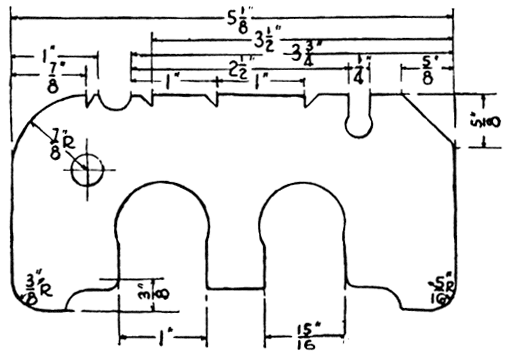
Fig. 9. Method of gauging flat spots.
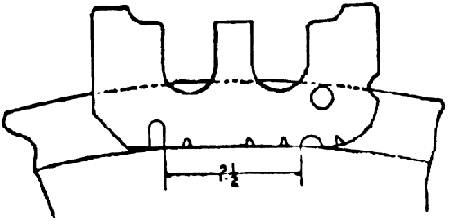
Fig. 10. Method of gauging thin flanges.
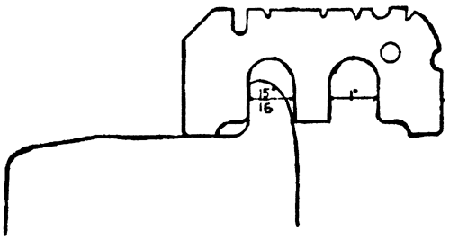
Fig. 11. Method of gauging vertical flanges.
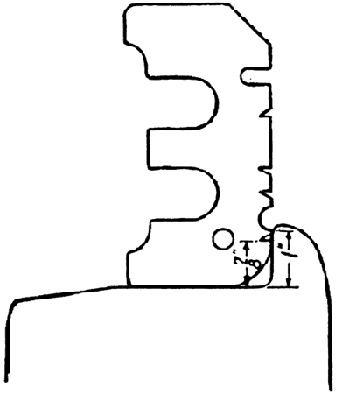
Fig. 12. Method of gauging broken rims.
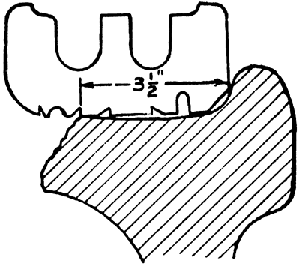
Fig. 13. Method of gauging broken rims.
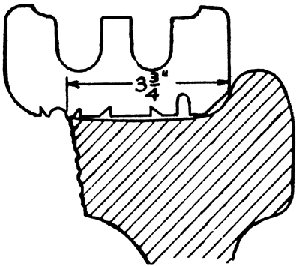
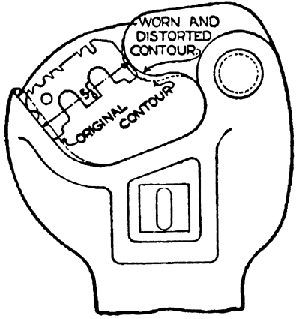
Fig. 14. Method of gauging worn coupler.
| 1. | Regulation originally made by authority of minister, by certificate, subject to approval of the Lieutenant Governor in Council (see R.S.B.C. 1948-285-7), since July 8, 1976, regulation made by authority of minister only. |
[Provisions of the Railway Act R.S.B.C. 1996, c. 395, relevant to the enactment of these regulations: sections 271, 170]