Note: This regulation has been placed in the Regulations Point in Time collection. This regulation is not repealed.
| B.C. Reg. 460/59 O.C. 2886/59; Certificate 10031 |
Railway Act
Part IX: Locomotive Cranes Regulations
Steam Locomotive Crane Regulations
Definitions
In these regulations, unless the context otherwise requires:
"Act" means the Railway Act of British Columbia;
"certificate" means a certificate of inspection made by an inspector;
"chief inspector" or "inspector" means an inspecting engineer, inspector or assistant inspector appointed under the provisions of the Act or of the Public Service Act;
"locomotive crane" means and includes the boiler, steam engine or engines, steam pipes and connections and every part thereof, and all apparatus and things attached to and connected therewith or used with reference thereto, and shall include steam shovels, ditchers, pile drivers and any other self propelled work equipment;
"locomotive crane engineer" means any person having charge of or operating a locomotive crane;
"owner" means any person, firm or corporation in possession of a locomotive crane, and includes the manager or other chief officer of such firm or corporation.
[am. B.C. Reg. 40/91, s. 6.]
Extent and Application of Regulations
Application
1 These regulations shall apply to all locomotive cranes operating under the jurisdiction of the government of British Columbia.
Portions of Boiler Code applicable
2 That portion of the regulations known as Parts I, III and IV of the British Columbia Railway Department Boiler Code, adopted by Order in Council No. 126 under the Railways Act on January 21, 1947, shall govern the design, registration and construction of all pressure parts used on locomotive cranes. In particular, Part I, relating to the design, registration and construction of power boilers, shall govern the design, registration and construction of locomotive crane boilers and their appurtenances; Part III, relating to the design, registration and construction of unfired pressure vessels, shall govern the design, registration and construction of unfired pressure vessels used on locomotive cranes; and Part IV, relating to the welding of steam boilers and pressure vessels, shall govern the welding of all pressure parts used on locomotive cranes.
General Inspection Regulations
Inspection frequency
3 Every locomotive crane shall be inspected before being put into service and at least every 12 months thereafter by an inspector of the ministry. Inspectors shall have the right, at all reasonable hours, to examine locomotive cranes and may refuse to grant a certificate for any locomotive crane found defective according to the provisions of these regulations. They may order out of service any locomotive crane which for any cause they consider unfit and dangerous to operate.
Reporting of defects
4 It is the duty of every locomotive crane engineer to inform the inspector of any defects known or believed to exist in the locomotive crane under his charge. The certificate of competency of any locomotive crane engineer refusing or refraining from doing so may be revoked by the inspector.
If boilers too hot for safety
5 Inspectors may decline to examine boilers considered too hot for safety and convenience, and shall refuse to grant certificates for same until a satisfactory examination can be made.
Thickness of plate
6 In order to satisfy himself as to the thickness of a plate or the internal condition of a boiler, the inspector may, should he deem it necessary, order holes to be cut therein and may demand such information by drawings and specifications of the several parts as will enable him to determine their strength. In the event of such information being unobtainable, he shall use a safety factor of 5.5, with such additions thereto as his judgment may dictate.
Removal of jacket and covering
7 At the first inspection of a locomotive crane the jacket and covering shall be removed by the owner or his agent, so that a thorough examination of the plates and rivets can be made. At subsequent inspections such jacket and covering or any part of same shall be removed upon the request of the inspector.
Lap joint longitudinal seams
8 Every boiler having lap joint longitudinal seams without reinforcing plates shall be examined with special care in order to detect any grooving or cracks at the edges of the seams.
Safety valves, etc.
9 Inspectors shall see that the safety valves, water gauges, test cocks, blowoff pipes, main steam pipes and all fittings and connections of boilers are in good order and sufficient in number, and that they comply with the requirements of these regulations.
Calculation of strength
10 Inspectors shall calculate the strength of locomotive crane boilers by formulae provided in the British Columbia Railway Department Boiler Code, and shall determine the safe working pressure thereof according to the calculated strength of the various parts and the workmanship and material of which they are composed, and shall record such working pressure upon the certificate of inspection. In cases where the necessary formula for any type of boiler is not provided, application shall be made to the chief inspector, who shall furnish same.
Reporting excess of pressure
11 In cases where inspectors find that a locomotive crane boiler is or has been carrying an excess of pressure beyond that which has been recorded on the certificate of inspection, they shall report same to the chief inspector for prosecution, and require the owner to install thereon a lockup valve of approved pattern to prevent the carrying of excessive pressure.
Issuance of certificate
12 A certificate shall be issued by the inspector for every locomotive crane found, after inspection and testing, to be in satisfactory working condition. Such certificate, showing date of last inspection and working pressure allowed, shall be placed under glass in the cab of every such locomotive crane.
Period of certificate
13 Certificates shall be issued covering a period of 12 months, but should the inspector consider it advisable, he may issue a certificate for a lesser period.
Suspension of certificate
14 Inspectors finding defects in any locomotive crane having an unexpired certificate may suspend such certificate until repairs are made or necessary fittings supplied.
Fees
16 The owner of a steam locomotive crane must pay the applicable fee prescribed in the Railway Fees Regulation for an annual inspection of the steam locomotive crane.
[en. B.C. Reg. 2/99, App. 4, s. 2.]
Interior Inspection of Boilers
Interior examination before boiler in service
19 Inspectors shall examine the interior of every boiler thoroughly before it is put into service and whenever a sufficient number of flues are removed to allow of examination.
What examination must cover
20 Inspectors shall examine the entire interior of the boiler for cracks, pitting, grooving or indication of overheating, and for damage where mud has collected or heavy scale formed. The edges of plates, all laps, seams and points where cracks and defects are likely to develop, or where an exterior examination may have indicated possible defects, must be given an especially minute examination. It must be seen that braces and stays are taut, that pins are properly secured in place and that each is in a condition to support its proportion of the load.
Exterior Inspection of Boilers
Exterior examination
21 Inspectors shall examine the exterior of every boiler thoroughly before it is put into service and whenever the jacket and lagging are removed.
How often examination must occur
22 The jacket and lagging shall be removed after 60 calendar months service, provided such service is performed within 6 consecutive years. The inspector shall examine the entire exterior of the boiler while it is under hydrostatic pressure. If the inspector considers it necessary, he may order the removal of the jacket and lagging at any time when leaks are indicated.
Hydrostatic Testing of Boilers
Frequency of hydrostatic testing
23 Inspectors may, whenever it is deemed necessary, and they shall, before a locomotive crane is put into service, and at least once every year thereafter, subject the boiler of same to a hydrostatic test 25% in excess of the working pressure allowed, using water at a temperature of 100° Fahrenheit; provided, however, that such test may be omitted for reasons to be stated in the inspector's report.
Owner must provide piping and fittings
24 For the purpose of such tests the owner or his agent shall provide the necessary piping and fittings to connect the inspector's pump to the boiler, and shall provide men to fill the boiler with water, make all joints, work the test pump and assist the inspector during the test.
Interior surface inspection
25 The handhole covers must be removed and the interior surface and connections of the boiler examined as thoroughly as conditions will permit.
Examination after repairs
26 When all necessary repairs have been completed, the boiler shall be fired up and the steam pressure raised, and the boiler and appurtenances carefully examined. All cocks, valves, seams, rivets and bolts must be tight under the pressure and all defects disclosed must be repaired.
Repair of defects and reinspection
27 In any case where defects are discovered or in which the test is unsatisfactory to the inspector, the defects shall be made good and the boiler reinspected before a certificate is issued.
Method of testing rigid bolts
28 The inspector must tap each bolt and determine the broken bolts from the sound or the vibration of the sheet. If staybolt tests are made when the boiler is filled with water, there must be not less than 50 pounds pressure on the boiler. Should the boiler not be under pressure, the test may be made after draining all the water from the boiler, in which case the vibration of the sheet will indicate any unsoundness.
Broken staybolts
29 No boiler shall be allowed to remain in service when there are 2 adjacent staybolts broken or plugged in any part of the firebox or combustion chamber, nor when 3 or more are broken or plugged in a circle 4 feet in diameter, nor when 5 or more are broken or plugged in the entire boiler.
Telltale holes
30 All staybolts shorter than 8 inches shall have telltale holes at least 3/16 inch in diameter and not less than 1 1/4 inches deep in the outer end. These holes must be kept open at all times.
Location of Gauges
31 Every boiler shall have at least one steam gauge which will correctly indicate the working pressure. Care must be taken to locate the gauge so that it will be kept reasonably cool and can be conveniently read by the enginemen.
Siphon
32 Every gauge shall have a siphon of ample capacity to prevent steam entering the gauge. The pipe connection shall enter the boiler direct, and shall be maintained steamtight between the boiler and gauge. The siphon pipe and its connections to the boiler must be cleaned each time the gauge is tested.
Time of testing
33 Steam gauge shall be tested at each hydrostatic test and also when any irregularity is reported.
Method of testing
34 Steam gauges shall be compared with an accurate test gauge or dead weight tester, and gauges found inaccurate shall be corrected before being put into service.
Stamping
35 The identification number and working pressure shall be stamped on the boiler above the firedoor, and if the boiler is lagged the lagging and jacket shall be cut away so that the stamping can be seen.
Safety valve
36 Each boiler shall have at least one safety valve, and if it has more than 500 square feet of water heating surface or a steam generating capacity exceeding 2 000 pounds per hour, it shall have 2 or more safety valves, the capacity of which shall be sufficient to prevent, under any condition of service, an accumulation of pressure more than 6% above the allowed steam pressure.
Setting of safety valves
37 Safety valves shall be set by the gauge used on the boiler to pop at pressures and not exceeding 3% above the allowed steam pressure; the gauge in all cases to be tested before the safety valves are set or any changes made in the setting. When safety valves are being set, the water level in the boiler must not be above the highest gauge cock.
Time of testing
38 Safety valves shall be tested under steam at least once every 3 months, and also when any irregularity is reported.
Water glass and gauge cocks
39 Every boiler shall be equipped with at least one water glass and 3 gauge cocks. The lowest gauge cock and the lowest reading of the water glass shall be not less than 3 inches above the fire line, which for horizontal, locomotive type and upright tubular boilers of submerged type shall be the highest point of the crown sheet or fire tube. In dry top upright tubular boilers where the tubes exceed 5 feet in length, the lowest gauge cock and lowest reading of the water glass shall be not less than 2/3 the distance between the tube sheets measured from the lower tube sheet.
Shut off and drain cocks
40 All water glasses shall be supplied with 2 valves or shut off cocks, one at the upper and one at the lower connection of the boiler, and also a drain cock, so constructed and located that they can be easily opened and closed by hand.
Cleaning of cocks
41 The spindles of all gauge cocks and water glass cocks shall be removed and cocks thoroughly cleaned of scale and sediment at least once each month.
Testing and maintenance
42 All water glasses must be blown out and gauge cocks tested before each shift, and gauge cocks must be maintained in such condition that they can be easily opened and closed by hand without the aid of a wrench or other tool.
Water glass shields
43 Water gauge glass mountings on all locomotive cranes must be protected by a suitable cage. These appurtenances must be so protected and located as to ensure a correct reading of the level of the water in the boiler at all times, and be in full view of both the engineer and fireman, and the lights so placed that there will be a clear and unobstructed view of the water in the mounting.
Water glass lamps
44 All water glasses must be supplied with a suitable lamp properly located to enable the engineer to see easily the water in the glass.
Condition of injectors
45 Injectors must be kept in good condition, free from scale, and must be tested before each trip. Boiler checks, delivery pipes, feed water pipes, tank hose and tank valves must be kept in good condition, free from leaks and from foreign substances that would obstruct the flow of water.
Time of washing
46 All boilers should be thoroughly washed as often as the water conditions require, but not less frequently than once each month. All boilers shall be considered as having been in continuous service between washouts, unless the dates of the days that the boiler was out of service are properly certified on washout reports and the report of inspection.
Plugs to be removed
47 When boilers are washed, all handhole and washout, arch and water bar lugs must be removed.
Water tubes
48 Special attention must be given the arch and water bar tubes to see that they are free from scale and sediment.
Office record
49 An accurate record of all locomotive crane boiler washouts shall be kept in the office of the railway company. The following information must be entered on the day that the boiler is washed:
(a) number of locomotive crane;
(b) date of washout;
(c) signature of boiler washer or inspector;
(d) statement that spindles of gauge cocks and water glass cocks were removed and cocks cleaned;
(e) signature of the boiler inspector or the employee who removed the spindles and cleaned the cocks.
Leaks under lagging
50 If a serious leak develops under the lagging, an examination must be made and the leak located. If the leak is found to be due to a crack in the shell or to any other defect which may reduce safety, the boiler must be taken out of service at once and the chief inspector notified before any repairs are made.
Leaks in front of enginemen
51 All steam valves, cocks and joints, studs, bolts and seams shall be kept in such repair that they will not emit steam in front of the enginemen so as to obscure their vision.
Specification card
52 A specification card, size 8 by 10 1/2 inches, Form No. 4, containing the results of the calculations made in determining the working pressure and other necessary data, shall be filed in the office of the chief inspector for each locomotive crane boiler. Every specification card shall be verified by the engineer making the calculations and shall be approved by the chief inspector. These specification cards shall be filed as promptly as thorough examination and accurate calculation will permit. Where accurate drawings of boilers are available, the data for specification card, said Form No. 4, may be taken from the drawings, and such specification cards must be completed and forwarded forthwith. Where accurate drawings are not available, the required data must be obtained at the first opportunity, when general repairs are made or when flues are removed.
When any repairs or changes are made which affect the data shown on the specification card, Form No. 4, a corrected card or an alteration report on a form, size 8 by 10 1/2 inches, properly certified to, giving details of such changes, shall be filed within 30 days from the date of their completion. This report should cover:
(a) application of new barrel sheets or domes;
(b) application of patches to barrels or domes of boilers or to portion of wrapper sheet of crown bar boilers which is not supported by staybolts;
(c) longitudinal seam reinforcements;
(d) changes in size or number of braces, giving maximum stress;
(e) initial application of superheaters, arch or waterbar tubes, giving number and dimensions of tubes;
(f) changes in number or capacity of safety valves.
Report of patches should be accompanied by a drawing or blueprint of the patch, showing its location in regard to the centre line of the boiler, giving all necessary dimensions, and showing the nature and location of the defect. Patches previously applied should be reported the first time the boiler is stripped to permit an examination.
Inspection certificates
53 (1) A certificate issued by the ministry showing date of inspection and steam pressure allowed shall be placed under glass in the cab of locomotive crane.
(2) A certificate issued by the ministry showing date of inspection and steam pressure allowed on all other equipment shall be placed in a conspicuous place on said equipment.
Damage reports
54 In all cases of damage to fireboxes in locomotive cranes by shortage of water, a report covering such damage must be promptly forwarded to the chief inspector.
Numbers of cranes
55 Companies shall file with the chief inspector a list showing the numbers of all locomotive cranes owned or leased by them; also a list giving the numbers of all additional locomotive cranes that may be purchased, built or leased by the said companies from time to time.
Inspection of Locomotive Cranes
Whistle
56 Every locomotive crane or other motive power used for hauling or switching cars shall be equipped and maintained with a whistle.
Inspection daily
57 Every locomotive crane shall be inspected after each shift or day's work, and any serious defects found shall be repaired before the locomotive crane is returned to service.
Steam or air brakes
58 It must be known before each shift that the brakes on locomotive cranes are in safe and suitable condition for service; that the air compressor or compressors, where used, are in condition to provide an ample supply of air for the service in which the locomotive crane is used; and that all other devices for controlling or regulating the steam or air pressure are properly maintained.
Testing main reservoirs
59 Every main reservoir, before being put into service and at least once after 12 calendar months service, provided such service is performed within 2 consecutive years, shall be subjected to hydrostatic pressure not less than 25% above the maximum air pressure. The entire surface of the reservoir shall be hammer tested each time the locomotive crane is shopped for general repairs, but not less frequently than once after 18 calendar months service, provided such service is performed within 2 consecutive years.
Draught gear
60 Draught gear and attachments on locomotive cranes shall be securely fastened and maintained in safe and suitable condition for service.
Compliance with safety appliance standards
61 All locomotive cranes shall comply with the safety appliance standards of the ministry with respect to the footboards, handholds, couplers, uncoupling levers, running boards, handrails and steps.
Headlights
62 Each locomotive crane used between sunset and sunrise shall have a headlight which will enable persons with normal vision in the cab of the locomotive crane, under normal weather conditions, to see a dark object the size of a man for a distance of 300 feet or more ahead of the locomotive crane, and such headlights must be maintained in good condition.
Cab lights
63 Each locomotive crane used between sunset and sunrise shall have cab lamps which will provide sufficient illumination for the steam, air and water gauges to enable the enginemen to make necessary and accurate readings from their usual and proper positions in the cab. These lights shall be so located and constructed that the light will shine only on those parts requiring illumination. Locomotive cranes used in road service shall have an additional lamp conveniently located to enable the person operating the locomotive crane to easily and accurately read train orders and timetables and so constructed that it may be readily darkened or extinguished.
Locomotive crane regulations
64 Locomotive cranes which are defective or do not comply with specification as prescribed in the following list must not be allowed to remain in service:
(a) Steam leaks — steam leaks from any part of a locomotive crane which render it impossible for engineer to see signals in sufficient time to enable him to bring his crane to a stop within the required distance.
(b) Steam or air brakes — Steam or air brakes on locomotive cranes not in serviceable condition.
(c) Wheels —
(i) Wheels shall be securely pressed on axles. Prick punching or shimming the wheel fit will not be permitted. The diameter of wheels on the same axle shall not vary more than 3/32 inch;
(ii) Wheels used on standard gauge track will be out of gauge if the inside gauge of flanges, measured on base line, is less than 53 inches or more than 53 3/8 inches;
(iii) The distance back to back of flanges of wheels mounted on the same axle shall not vary more than 1/4 inch.
(d) Cast iron or cast steel wheels — Cast iron or cast steel wheels with any of the following defects shall not be continued in service:
(i) Slid flat — When the flat spot is 2 1/2 inches or over in length, or if there are 2 or more adjoining spots each 2 inches or over in length;
(ii) Broken or chipped flange — If the chip exceeds 1 1/2 inches in length and 1/2 inch in width;
(iii) Broken rim — If the tread, measured from the flange at a point 5/8 inch above the tread, is less than 3 3/4 inches in width;
(iv) Shelled Out — Wheels with defective treads on account of cracks or shelled out spots 2 1/2 inches or over, or so numerous as to endanger the safety of the wheel;
(v) Brake burn — Wheels having defective tread on account of cracks or shelling out due to heating;
(vi) Seams 1/2 inch long or over, at a distance of 1/2 inch or less from the throat of the flange, or seams 3 inches or more in length, if such seams are within the limits of 3 3/4 inches from the flange, measured at a point 5/8 inch from the tread;
(vii) Worn flanges — Wheels on axles with journals 5 inches by 9 inches or over with flanges having flat vertical surfaces extending 7/8 inch or more from the tread, or flanges one inch thick or less gauged at a point 3/8 inch above tread. Wheels on axles with journals less than 5 inches by 9 inches with flanges having flat vertical surfaces extending one inch or more from the tread, or flanges 15/16 inch thick or less gauged at a point 3/8 inch above the tread;
(viii) Tread worn hollow — If the tread is worn sufficiently hollow to render the flange or rim liable to breakage;
(ix) Burst — If the wheels are cracked from the wheel fit outwards;
(x) Cracked tread, cracked plate or one or more cracked brackets;
(xi) Wheels out of gauge;
(xii) Wheels loose on axle.
Note: The determination of flat spots, worn flanges and broken rims shall be made by A.A.R. wheel defect gauge (Fig. 8).
(e) Forged steel or steel tired wheels — Forged steel or steel tired wheels with any of the following defects shall not be continued in service:
(i) Loose wheels; loose, broken or defective retaining rings or tires, broken or cracked hubs, plates, spokes or bolts;
(ii) Slid flat spot 2 1/2 inches or longer; or, if there are 2 or more adjoining spots, each 2 inches or longer;
(iii) Defective tread on account of cracks or shelled out spots 2 1/2 inches or longer, or so numerous as to endanger the safety of the wheel;
(iv) Broken flange;
(v) Flange worn to 15/16 inch or less in thickness, gauged at a point 3/8 inch above the tread, or having flat vertical surface one inch or more from the tread; tread worn 3/8 inch; flange more than 1 1/2 inches from tread to top of flange;
(vi) Wheels out of gauge.
(f) Springs — Locomotive cranes with defective springs on any part of the locomotive crane which are unable to carry their respective weights.
Accidents and Their Investigation
In case of explosion
65 In case of an explosion taking place in any locomotive crane, or other power, for which the owner or lessee thereof has not obtained a certificate of inspection, or if the certificate of inspection has expired, and any person be killed or injured thereby, or any property be destroyed or damaged, the owner or lessee of such locomotive crane or other power shall prima facie be deemed guilty of negligence, and liable for any injury occasioned by such explosion, and the onus shall be on the owner or lessee of such locomotive crane or other power to show that all reasonable and proper precautions had been taken to prevent such explosion or accident.
In case of accident from failure of boiler
66 In the case of an accident resulting from failure, from any cause, of a locomotive crane boiler, or other boilers, or any of their appurtenances, resulting in serious injury or death to one or more persons, the company owning or operating such locomotive or other boilers shall immediately transmit by wire to the chief inspector at his office in Vancouver, B.C., report of such accident, stating the nature of the accident, the place at which it occurred, and where the locomotive crane boiler or other boilers may be inspected. Such wire shall immediately be confirmed by mail, giving a full detailed report of such accident, stating, so far as may be known, the causes, and giving a complete list of the killed or injured.
Reporting of accident
67 On the occurrence of an accident to any locomotive crane or other equipment, the engineer in charge shall report such accident in writing to the chief inspector, or, in default, the inspector may cancel his certificate.
No interference with fittings until after inspection
68 Water glass mountings, all gauge cocks or any of the appurtenances in connection with the water supply of the locomotive crane boiler must not be removed from the boiler and in no way interfered with until after the chief inspector has completed his inspection.
Investigation regarding accident
69 The chief inspector may hold an investigation with respect to any accident to any part of a locomotive crane or other equipment to which these regulations apply, and with respect to any injury caused to any person or property by the alleged negligence or incompetence of an engineer holding a certificate; and he may summon witnesses and compel their attendance before him by the same process as courts of justice, and may administer oaths and examine witnesses touching the cause of such accident, and he shall forthwith report in writing thereon to the minister.
Appeal to minister
70 An appeal shall lie from any ruling or decision of an inspector to the chief inspector, and from him to the minister, whose decision shall be final.
Expert assistance
71 In any appeal the minister, if he thinks fit, may summon to his assistance any expert engineer, who shall attend and assist accordingly.
Charge or complaint against inspector
72 Any charge of neglect of duty or other complaint against an inspector shall be made in writing to the minister, stating the specific charge or charges.
Penalty
73 Every company or railway company violating any of the provisions of these regulations shall be liable to a penalty not exceeding $300 for each and every violation.
Locomotive Crane Engineers' Certificates of Competency
Certificate requirement
74 No person shall be employed as engineer, and no person shall act as engineer on any locomotive crane operation under these regulations, unless the person so employed or acting holds a certificate of competency issued under the Power Engineers and Boiler and Pressure Vessel Safety Act, or a certificate granted by the minister; provided, however, that in case of illness or unavoidable cause the engineer in charge is absent from duty, without fault or collusion of the owners or of any person interested, and an engineer holding such certificate is not available, then such deficiency may be filled temporarily until an engineer holding such certificate can be obtained, and the chief inspector shall be immediately notified of the temporary change by the owner of the locomotive crane and by the person acting temporarily as engineer.
Application for examination
75 Candidates for examination must fill out a form of application which can be obtained from the chief inspector, and when properly filled in should be returned to him, together with the applicable fee prescribed in the Railway Fees Regulation.
[am. B.C. Regs. 172/87, s. 4 (i); 2/99, App. 4, s. 3.]
Testimonials required
76 All candidates must produce testimonials as to service as engineers or firemen, such testimonials to be signed by their employers. Candidates must have at least 12 months service as engineers or firemen on locomotive cranes, or boilers, and must enclose with their application for examination a certificate from some qualified physician certifying to the condition of their eyesight and hearing, as required by the Visual Acuity, Colour Perception and Hearing of Railway Employees Regulations (B.C. Reg. 457/59).
Railway company examinations
77 Railway companies having mechanical and operating rules approved by the ministry must examine their employees as to general mechanical ability and knowledge of such rules before giving them employment or promotion. They must also notify the chief inspector at least one month before such examinations take place, in order that an inspector appointed by the ministry may be in attendance.
Term of certificate
78 Each certificate, unless stated therein, shall be granted for life or during good conduct, but if it be proven to the ministry that the holder is guilty of negligence or has refused to comply with any of the provisions of these regulations, his certificate may be suspended, marked or revoked.
Certificate replacement
79 If an engineer proves to the satisfaction of the chief inspector that he has lost his certificate, or that it has been destroyed, he may obtain a duplicate of the original upon payment of the applicable fee prescribed in the Railway Fees Regulation.
[am. B.C. Regs. 172/87, s. 4 (j); 2/99, App. 4, s. 4.]
Temporary certificate
80 Upon application in writing by the company, the chief inspector may issue a temporary certificate to a sufficiently qualified applicant to act as engineer on the locomotive crane specified, such certificate to be good only for one month from date of issue.
Penalty for defective work
81 Any person who constructs a boiler, or any part of a boiler, or who makes any repairs to same, such construction or repairs being known to be defective, shall be liable to a penalty of not less than $200 and not exceeding $500.
Penalty for alteration of safety valve
82 No person shall in any way alter the safety valve of a boiler, so as to carry a greater pressure than that allowed by the inspector, under a penalty of not less than $200 and not exceeding $500.
Safety valve testing
83 It shall be the duty of the engineer in charge to cause the safety valve to blow off steam often enough to satisfy himself that the valves are in good order, and it shall be his duty to report to the inspector any failure of such valves to operate.
Revocation of certificate
84 In case no such report is made and a safety valve is found to have been tampered with or put out of order, the certificate of the engineer having such boiler in charge shall be revoked, and the inspector shall have power to cancel the certificate of inspection for such boiler until another engineer has been placed in charge.
Penalty for alteration of steam gauge
85 Any person who alters or conceals or otherwise tampers with the steam gauge, so as to prevent the actual steam pressure of the boiler from being seen and ascertained by any person, shall be liable to a penalty of not less than $100 and not exceeding $500.
Penalty for operation of uninspected boiler
86 Any person operating a boiler, as well as the owner or lessee thereof, in case the same is being operated with his consent, without there being an unexpired certificate of inspection thereof, shall be liable to a penalty of $5 a day for each and every day that he shall operate such uncertified boiler, except in such cases where the owner has made a request in writing to an inspector to have such boiler examined, but for good and valid reasons such inspection has not been made.
Penalty for operation of unsafe crane
87 It shall be the duty of any person operating or owning any locomotive crane pronounced by the inspector as unsafe to cease to use the same until such repairs as are indicated by the inspector are made, and in case of failure to comply with the requirements of the inspection the person owning or leasing, as well as the person operating, any such locomotive crane shall be liable to a penalty of not less than $100, and shall also be liable for any damage to person or property resulting therefrom.
Spark arrest
88 Unless otherwise exempted by a special order of the ministry, every company whose railway is under construction or being operated shall cause all locomotive cranes and other steam engines, portable or stationary, to be fitted and kept fitted in good order with practical and efficient devices for arresting the escape of sparks or live coals, as hereinafter set out.
Smokestacks — coal burning locomotive cranes
89 The smokestack of every coal burning locomotive crane used on the railway shall have installed therein, so as to extend completely over the aperture through which the smoke ascends, a double crimped wire netting as follows:
(a) square mesh not larger than 2 2/3 by 2 2/3 per inch of No. 10 B.W.G. wire. The condemning limits for the netting shall be when the opening is 19/64 inch or the wire worn to 0.065 inch in thickness;
(b) oblong mesh not larger than 3/16 inch in width and 3/4 inch in length of wire, Warp No. 10, Shute No. 9 B.W.G. The condemning limit for the netting shall be when the opening is 7/32 inch in width and 25/32 inch in length, or when wires are worn to 0.065 inch in thickness;
(c) oblong mesh not larger than 3/16 inch in width and 1/2 inch in length of wire, Warp No. 10, Shute No. 9 B.W.G. The condemning limit for the netting shall be when the opening is 7/32 inch in width and 17/32 inch in length, or when the wires are worn to 0.065 inch in thickness;
(d) square mesh not larger than 3 by 3 per inch of No. 10 B.W.G. wire. The condemning limit for the netting shall be when the opening is 15/64 inch, or when the wire is worn to 0.065 inch in thickness;
(e) square mesh not larger than 3 by 3 per inch of No. 11 B.W.G. wire. The condemning limit for the netting shall be when the opening is 15.5/64 inch, or when the wire is worn to 0.06 inch in thickness;
(f) upon application from a company, tests or trials of fire protective devices other than as specified in this section may be made only on receipt of permission from the chief inspector.
Ashpans, etc.
90 (1) In no case shall there be an opening in the ashpan body, hoppers, slides or fittings thereof in excess of 1/8 inch in width; and the condemning limit of openings on ashpan and hopper doors when closed shall be 1/4 inch.
(2) Draught openings under foundation ring in ashpans of wide firebox type shall be protected by a coping or hinged door, closed in at each end, and extending 2 1/2 inches above the level of the bottom of the foundation ring; provided that where adequate protection by coping or hinged doors extending above the level of the bottom of the foundation ring cannot be applied, inside deflectors extending 4 inches below the bottom of the foundation ring shall be installed, or a combination of outside and inside coverage of not less than 4 inches shall be used. Standard mesh netting equal to that required in the smoke box may be used for the outside coping or hinged door where solid plate cannot be used.
(3) Draught openings in the side, front or back of wide or narrow type fireboxes, in which the hinged plate or coping is not used in accordance with section 90 (1), shall be protected by solid deflecting plates providing a total of not less than 2 1/2 inches coverage, such deflecting plates to be closed in at each end. Standard mesh netting equal to that required in the smoke box may be used for extra draught openings where solid deflecting plates cannot be provided.
(4) Draught openings of shallow ashpans shall be protected by standard smokebox netting.
(5) Openings in ends of ashpans through which grate rods operate shall be protected against escape of ashes or fire; grate rods shall be carried in sliding plates with clearance around rods not to exceed 1/16 inch when new; the condemning limit shall be 1/8 inch; or openings must be protected against the escape of ashes or fire by hoods or deflecting plates.
(6) Ashpan doors and slides shall be securely closed by a locking gear while the locomotive crane is in operation. Ashpan dumping gear shall be such that ashpans can be dumped only by a person standing on the ground. Air combustion tube openings and cleanouts opening from cinder trap in front of brick wall or arch shall be adequately protected against the escape of fire to the roadway.
(7) A device, with all necessary accessories, shall be installed to provide an adequate supply of water to all hoppers and ashpans. Sufficient water to dampen ashes and extinguish fire falling from the grates must be supplied from April 1 to October 31, both inclusive, in each year, or during such additional period as may be required in any particular territory by the chief inspector.
Smokestacks — steam engines
91 All steam engines, portable or stationary, having exhaust in stack and burning coal shall be equipped with a bonnet screen or double crimped wire netting mesh device on top of the smoke stack, as may be most practicable. All openings between the bonnet netting and the stack must be fitted so as to leave no opening larger than the mesh of the netting. The condemning limit of said netting shall be as prescribed in section 89.
Oil burning cranes
92 On every locomotive crane burning oil as fuel the following standards shall be observed:
(a) in such territory as may be designated from time to time by the chief inspector, the smokestack of every locomotive crane shall have installed thereon, so as to extend completely over the aperture through which the smoke ascends, a double crimped wire netting mesh, not less than 4 by 4 per inch, No. 12 B.W.G. The condemning limit of openings shall be 10.5/64 inch;
(b) linings of firepan and firebox shall be maintained in good order. Not less frequently than at each daily inspection, or prior to starting each shift, where there are facilities, the firebox shall be cleaned of any accumulation of fallen brick and loose carbonaceous material;
(c) all joints in the firepan and between the firepan and firebox sheets or foundation ring shall be maintained airtight;
(d) openings in firepan shall be protected in such manner as to prevent the escape of such matter likely to cause fire;
(e) burner shall be maintained in proper alignment and adjustment, clean and free from leakage;
(f) sand for sanding flues shall be free from inflammable matter.
Fire protective appliances
93 All fire protective appliances on locomotive cranes and other portable or stationary boilers shall at all times be maintained in good order. No employee of the railway shall do, or in any way cause, damage to the netting or other fire protective appliances on any locomotive crane or other portable boiler in service.
Inspection by company
94 The company shall provide adequate inspection where its locomotive cranes or other steam engines, portable or stationary, are housed or repaired, and at other points where equipment is in service, and cause
(a) an examination to be made at least once a week of all fire protective appliances;
(b) in case any of the said fire protective appliances are found to be defective, the said equipment shall be removed from service, and shall not be returned to service until such defects are remedied.
Disposal of live coals, etc.
95 Fire, live coals or hot ashes shall not be deposited upon the tracks or right of way, unless they are extinguished immediately thereafter, except in pits provided for the purpose. On no account shall ashes nor clinkers from firebox of locomotive cranes be thrown out on the right of way while running. Burning or smouldering waste taken from the hot boxes shall be immediately extinguished. Care should be taken in the handling of fusees and to avoid throwing them where fire can be communicated.
Operation near forest or woodland
96 The following provisions shall apply in respect of every locomotive, traction engine, logging engine, portable engine or stationary engine used or operated during the close season in or within 1/2 a mile from any forest or woodland:
(a) there shall be kept at or on every engine six 10 quart buckets, 6 shovels, 3 axes and 3 mattocks, all of which shall be painted red, kept in good repair, and used only in case of fire; provided that in the case of a traction engine or portable engine, while being used in a mobile capacity, it shall be sufficient compliance with the provisions of this paragraph if one 10 quart bucket, one shovel and either one axe or one mattock are so kept;
(b) in case the engine is operated by steam power, it shall be equipped with a safe and efficient device for arresting sparks, of a design approved in writing by the Ministry of Forests; and there shall be kept available at the engine at all times a sufficient supply of water for fire fighting purposes, and the engine shall be equipped with a pump capable of forcing water to a height of 50 feet above the pump and with not less than 200 feet of hose of not less than one inch inside diameter, which pump and hose shall always be kept ready for immediate use;
(c) in the case of an engine operated by steam power, other than a locomotive, if the engine is under steam, and the relative humidity of the atmosphere in the vicinity of the engine is below 50%, the surface of the ground surrounding the engine for a distance of not less than 200 feet in all directions therefrom shall be continuously kept wet by the application of water by means of a hose or other appliance to be provided and kept for the purpose.
Internal Combustion Locomotive Crane Regulations
Definitions
In these regulations, unless the context otherwise requires:
"internal combustion locomotive crane" means and includes the engine or engines, pipes and connections and every part thereof, and all apparatus and things attached to and connected therewith or used with reference thereto, and shall include all internal combustion derrick equipment self-propelled on rails;
"internal combustion locomotive crane engineer" means any person having charge of or operating an internal combustion locomotive.
Extent and Application of Regulations
Application
100 These regulations shall apply to all railways operating under the jurisdiction of the government of British Columbia.
Company responsibility
101 Every railway company will be held responsible for the general condition of all internal combustion locomotive cranes under its control. The mechanical officer in charge at each point where repairs are done will be held responsible for the inspection and repair for all internal combustion locomotive cranes and their appurtenances under his jurisdiction. He must know that all defects disclosed by any inspection are properly repaired before the locomotive crane is returned to service. The safe working pressure of all pressure parts shall be fixed by the chief inspector of the ministry after full consideration has been given to design, workmanship, age and condition.
Portions of Boiler Code applicable
102 That portion of the regulations known as Part III of the British Columbia Railway Department Boiler Code, adopted by order in council under the Railways Act on January 21, 1947, shall govern the design, registration and construction of all pressure parts used on internal combustion locomotive cranes.
General Inspection Regulations
Inspection frequency
103 Every locomotive crane shall be inspected before being put into service and at least every 12 months thereafter by an inspector of the ministry. Inspectors shall have the right, at all reasonable hours, to examine locomotive cranes and may refuse to grant a certificate for any locomotive crane found defective according to the provisions of these regulations. They may order out of service any locomotive crane which for any cause they consider unfit and dangerous to operate.
Reporting of defects
104 It is the duty of every locomotive crane engineer to inform the inspector of any defects known or believed to exist in the locomotive crane under his charge. The certificate of competency of any locomotive crane engineer refusing or refraining from doing so may be revoked by the inspector.
Approval for new crane
105 No company shall install or operate any new internal combustion locomotive crane without first obtaining approval thereof from the chief inspector. Every company shall submit with each application for approval designs and specifications of said locomotive crane.
[am. B.C. Regs. 172/87, s. 4 (k); 2/99, App. 4, s. 5.]
Other approval
106 No company shall install or operate any internal combustion locomotive crane without first applying to the chief inspector for, and obtaining from him, his approval for such internal combustion locomotive crane.
Requirements for approval
107 The chief inspector shall not grant his approval pursuant to sections 105 and 106 unless there is compliance with the following provisions:
(a) the locomotive crane must comply with the ministry's standards in respect to safety appliances, couplers, air brakes, headlights, footboards, sanding devices, whistle or horn, and bell;
(b) the locomotive crane shall comply with the Internal Combustion Locomotive Regulations made pursuant to the Railway Act as herein set forth;
(c) all pressure parts and appurtenances used on the locomotive shall comply with Part III of the British Columbia Railway Department Boiler Code;
(d) The position of the operator must be so arranged that he can have a clear view of the tracks, and see signals;
(e) in addition to air brakes, every internal combustion locomotive must have an efficient hand brake.
Issuance and display of certificate
108 A certificate shall be issued by the inspector for every internal combustion locomotive crane found, after inspection and testing, to be in satisfactory working condition. Such certificate, showing the date of last inspection, the horsepower and the weight on drivers, shall be placed under glass in the cab of every such locomotive crane.
Period of certificate
109 Certificates shall be issued covering a period of 12 months, but should the inspector consider it advisable, he may issue a certificate for a lesser period.
Suspension of certificate
110 Inspectors finding defects in any locomotive crane having an unexpired certificate may suspend such certificate until repairs are made or necessary fittings supplied.
Inspection of Locomotive Cranes
Equipment and inspection
115 (1) Every locomotive crane or other motive power used for hauling or switching cars shall be equipped and maintained with a bell and with a whistle.
(2) Every locomotive crane shall be inspected after each trip, or day's work, and any serious defects found shall be repaired before the locomotive is returned to service.
(3) Air brakes — It must be known before each trip that the brakes on locomotive crane are in safe and suitable condition for service; that the air compressor or compressors are in condition to provide an ample supply of air for the service in which the locomotive crane is used; and that all other devices for controlling or regulating the pressure are properly maintained.
(4) Testing main reservoirs — Every main reservoir, before being put into service and at least once after 12 calendar months service, provided such service is performed within 2 consecutive years, shall be subjected to hydrostatic pressure not less than 25% above the maximum air pressure. The entire surface of the reservoir shall be hammer tested each time the locomotive is shopped for general repairs, but not less frequently than once after 18 calendar months service, provided such service is performed within 2 consecutive years.
(5) Draught gear — Draught gear and attachments on locomotive cranes shall be securely fastened and maintained in safe and suitable condition for service.
(6) All locomotive cranes shall comply with the safety appliance standards of the ministry with respect to pilots, footboards, handholds, couplers, uncoupling levers, running boards, handrails and steps.
Lights
116 (1) Each locomotive crane used between sunset and sunrise shall have a headlight which will enable persons with normal vision in the cab of the locomotive crane, under normal weather conditions, to see a dark object the size of a man for a distance of 300 feet or more ahead of the locomotive crane, and such headlights must be maintained in good condition.
(2) Cab lights — Each locomotive used between sunset and sunrise shall have cab lamps which will provide sufficient illumination for the air and other gauges to enable the enginemen to make necessary and accurate readings from their usual and proper positions in the cab. These lights shall be so located and constructed that the light will shine only on those parts requiring illumination. Locomotive cranes used in road service shall have an additional lamp conveniently located to enable the person operating the locomotive crane to easily and accurately read train orders and timetables and so constructed that it may be darkened or extinguished.
Defective cranes
117 Locomotive cranes which are defective or do not comply with specification as prescribed in the following list must not be allowed to remain in service:
(a) Air brakes — Air brakes on locomotive cranes not in serviceable condition.
(b) Wheels —
(i) Wheels shall be securely pressed on axles. Prick punching or shimming the wheel fit will not be permitted. The diameter of wheels on the same axle shall not vary more than 3/32 inch;
(ii) Wheels used on standard gauge track will be out of gauge if the inside gauge of flanges, measured on baseline, is less than 53 inches or more than 53 3/8 inches;
(iii) The distance back to back of flanges of wheels mounted on the same axle shall not vary more than 1/4 inch.
(c) Cast iron or cast steel wheels — Cast iron or cast steel wheels with any of the following defects shall not be continued in service:
(i) Slid flat — When the flat spot is 2 1/2 inches or over in length, or if there are 2 or more adjoining spots each 2 inches or over in length;
(ii) Broken or chipped flange — If the chip exceeds 1 1/2 inches in length and 1/2 inch in width;
(iii) Broken rim — If the tread, measured from the flange at a point 5/8 inch above the tread, is less than 3 3/4 inches in width;
(iv) Shelled out — Wheels with defective treads on account of cracks or shelled out spots 2 1/2 inches or over, or so numerous as to endanger the safety of the wheel;
(v) Brake burn — Wheels having defective tread on account of cracks or shelling out due to heating;
(vi) Seams 1/2 inch long or over, at a distance of 1/2 inch or less from the throat of the flange, or seams 3 inches or more in length, if such seams are within the limits of 3 3/4 inches from the flange, measured at a point 5/8 inch from the tread;
(vii) Worn flanges — Wheels on axles with journals 5 by 9 inches or over with flanges having flat vertical surfaces extending 7/8 inch or more from the tread, or flanges one inch thick or less, gauged at a point 3/8 inch above tread. Wheels on axles with journals less than 5 by 9 inches with flanges having flat vertical surfaces extending one inch or more from the tread, or flanges 15/16 inch thick or less, gauged at a point 3/8 above the tread;
(viii) Tread worn hollow — If the tread is worn sufficiently hollow to render the flange or rim liable to breakage;
(ix) Burst — If the wheel is cracked from the wheel fit outward;
(x) Cracked tread, cracked plate, or one or more cracked brackets;
(xi) Wheels out of gauge;
(xii) Wheels loose on axle.
Note: The determination of flat spots, worn flanges and broken rims shall be made by an A.A.R. wheel defect gauge (Fig. 8).
(d) Forged steel or steel tired wheels — Forged steel or steel tired wheels with any of the following defects shall not be continued in service:
(i) Loose wheels; loose, broken or defective retaining rings or tires; broken or cracked hubs, plates, spokes or bolts;
(ii) Slid flat spot 2 1/2 inches or longer; or, if there are 2 or more adjoining spots, each 2 inches or longer;
(iii) Defective tread on account of cracks or shelled out spots 2 1/2 inches or longer, or so numerous as to endanger the safety of the wheel;
(iv) Broken flange;
(v) Flange worn to 15/16 inch or less in thickness, gauged at a point 3/8 inch above the tread, or having flat vertical surface one inch or more from the tread; tread worn 5/16 inch; flange more than 1 1/2 inches from tread to top of flange;
(vi) Wheels out of gauge.
(e) Springs — Locomotive cranes with defective springs on any part of locomotive crane which are unable to carry their respective weights.
Ventilation and electrical apparatus
118 (1) The exhaust gases from internal combustion engines shall be piped to exhaust above the top of the locomotive crane and shall be so arranged that exhaust fumes do not drift into the cab so they be breathed by the operator or the operator's helper.
(2) Cabs of internal combustion locomotive cranes shall be properly ventilated. Precautions must be taken to see that no exhaust or other obnoxious gases can enter or accumulate in the cab.
(3) Electrical apparatus must be properly installed and insulated. All contactors, circuit breakers and switches must be enclosed in approved panel boxes properly bonded and grounded.
Accidents and Their Investigation
Accident investigation
119 (1) In case of a failure of any appurtenance taking place in any locomotive crane or other power, for which the owner or lessee thereof has not obtained a certificate of inspection, or if the certificate of inspection has expired and any person be killed or injured thereby, or any property be destroyed or damaged, the owner or lessee of such locomotive crane or other power shall prima facie be deemed guilty of negligence, and liable for any injury occasioned by such failure, and the onus shall be on the owner or lessee of such locomotive crane or other power to show that all reasonable and proper precautions had been taken to prevent such failure or accident.
(2) In the case of an accident resulting from failure from any cause of an internal combustion locomotive crane's power appliances, or pressure appurtenances, resulting in serious injury or death to one or more persons, the company owning or operating such locomotive crane shall immediately transmit by wire to the chief inspector at his office in Vancouver, B.C., report of such accident, stating the nature of the accident, the place at which it occurred and where the locomotive crane may be inspected. Such wire shall immediately be confirmed by mail, giving a full detailed report of such accident, stating, so far as may be known, the causes and giving a complete list of the killed or injured.
(3) On the occurrence of an accident to any locomotive crane or other equipment, the engineer in charge shall report such accident in writing to the chief inspector, or, in default, the inspector may cancel his certificate.
(4) The chief inspector may hold an investigation with respect to any accident to any part of a locomotive crane or other equipment to which these regulations apply, and with respect to any injury caused to any person or property by the alleged negligence or incompetence of an engineer holding a certificate; and he may summon witnesses and compel their attendance before him by the same process as courts of justice, and may administer oaths and examine witnesses touching the cause of such accident, and he shall forthwith report in writing thereon to the minister.
(5) An appeal shall lie from any ruling or decision of an inspector to the chief inspector, and from him to the minister, whose decision shall be final.
(6) In any appeal the minister, if he thinks fit, may summon to his assistance any expert engineer, who shall attend and assist accordingly.
(7) Any charge of neglect of duty or other complaint against an inspector shall be made in writing to the minister, stating the specific charge or charges.
(8) Every railway company violating any of the provisions of these regulations shall be liable to a penalty not exceeding $300 for each and every such violation.
Internal Combustion Locomotive Crane Engineers' Certificates of Competency
Certificate requirement
120 Except as provided under section 127 of this Part, no person shall be employed as engineer and no person shall act as engineer of any internal combustion locomotive crane operating under these regulations, unless the person so employed or acting holds a certificate of competency as an internal combustion locomotive crane engineer, or a temporary certificate, granted by the minister; provided, however, that in case of illness or other unavoidable cause the engineer in charge is absent from duty, without fault or collusion of the owners or of any person interested, and an engineer holding such certificate is not available, then such deficiency may be filled temporarily until an engineer holding such certificate can be obtained, and the chief inspector shall be immediately notified of the temporary change by the owner of the locomotive crane and by the person acting temporarily as engineer.
Application for examination
121 Candidates for examination must fill up a form of application which can be obtained from the chief inspector, and when properly filled in should be returned to him, together with the applicable fee prescribed in the Railway Fees Regulation.
[am. B.C. Regs. 172/87, s. 4 (i); 2/99, App. 4, s. 3.]
Testimonials required
122 All candidates must produce testimonials as to service, such testimonials to be signed by their employers. Candidates must have at least 12 months service as engineers on steam or internal combustion locomotive cranes, or 12 months as engineer or engineer's helper on internal combustion locomotives, or be the holder of one of the following certificates granted by the minister: locomotive engineer, internal combustion locomotive engineer, locomotive crane engineer, Class A or B, or the holder of a permit to operate power cars, and must enclose with their application for examination a certificate from some qualified physician certifying as to the condition of their eyesight and hearing, as required by the Visual Acuity, Colour Perception and Hearing of Railway Employees Regulations (B.C. Reg. 457/59).
Railway company examinations
123 Railway companies having mechanical and operating rules approved by the Ministry of Transportation and Highways must examine their employees as to general mechanical ability and knowledge of such rules before giving them employment or promotion on internal combustion locomotive cranes. They must also notify the chief inspector at least one month before such examinations take place, in order that an inspector appointed by the ministry may be in attendance.
Term of certificate
124 Every certificate, unless stated therein, shall be granted for life or during good conduct, but if it be proven to the ministry that the holder is guilty of negligence or has refused to comply with any of the provisions of these regulations, his certificate may be suspended, marked or revoked.
Certificate replacement
125 If an engineer proves to the satisfaction of the chief inspector that he has lost his certificate, or that it has been destroyed, he may obtain a duplicate of the original upon payment of the applicable fee prescribed in the Railway Fees Regulation.
[am. B.C. Regs. 172/87, s. 4 (j); 2/99, App. 4, s. 4.]
Temporary certificate
126 Upon application in writing by the company, the chief inspector may issue a temporary certificate to a sufficiently qualified applicant to act as engineer on the locomotive crane specified, such certificate to be good only for one month from date of issue.
Permit holders
127 (1) Holders of "Permits to Operate Power Cars" granted by the minister may be employed and may act as engineers on internal combustion locomotive cranes, the rated horsepower of which does not exceed 150, or where the weight on the drivers does not exceed 30 000 pounds; provided that the chief inspector is satisfied that the holder of such permit is capable of fulfilling the duties of engineer on a locomotive crane of that horsepower and weight.
(2) Holders of locomotive or internal combustion locomotive engineer's certificate of competency or holders of locomotive crane engineer's certificate of competency, Class A, may be employed and may act as engineers on any internal combustion locomotive crane.
Some Obligations and Penalties
Penalty for defective work
128 Any person who constructs an unfired pressure vessel, or any part thereof, or who makes any repairs to same, such construction or repairs being known to be defective, shall be liable to a penalty of not less than $100 and not exceeding $300.
Penalty for operation of uninspected crane
129 Any person operating an internal combustion locomotive crane, or lessee thereof, in case the same is being operated with his consent, without there being an unexpired certificate of inspection thereof, shall be liable to a penalty of $5 a day for each and every day that he shall operate such uncertificated locomotive crane, except in such cases where the owner has made a request in writing to an inspector to have such crane examined, but for good and valid reasons such inspection has not been made.
Penalty for operation of unsafe crane
130 It shall be the duty of any person operating or owning any internal combustion locomotive crane pronounced by the inspector as unsafe to cease to use the same until such repairs as are indicated by the inspector are made, and in case of failure to comply with the requirements of the inspector, the person owning or leasing, as well as the person operating, any such internal combustion locomotive crane shall be liable to a penalty of not less than $100, and shall also be liable for any damage to person or property resulting therefrom.
Spark arrest
131 Unless otherwise exempted by a special order of the ministry, every company whose railway is under construction or being operated shall cause all internal combustion locomotive cranes to be fitted and kept fitted in good order with practical and efficient devices for arresting the escape of sparks from exhaust stacks.
Fire extinguishers
132 Every internal combustion locomotive crane shall be equipped with at least one fire extinguisher; such fire extinguisher shall be of the type not to cause shorts nor damage to the electrical apparatus, it shall bear a card showing its last filling, and be placed in a conspicuous place in the cab within easy reach of the engineer.
Fig. 8. Wheel defect, worn coupler limit, worn journal collar, and journal fillet gauge.
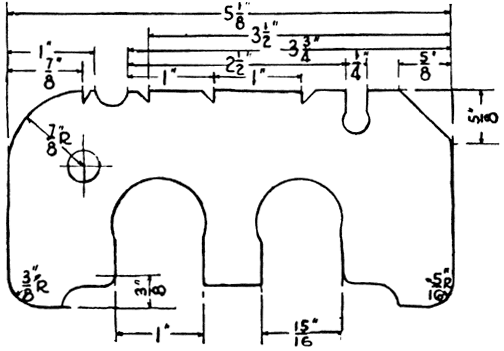
Fig. 9. Method of gauging flat spots
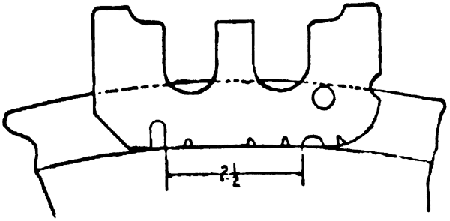
Fig. 10. Method of gauging thin flanges
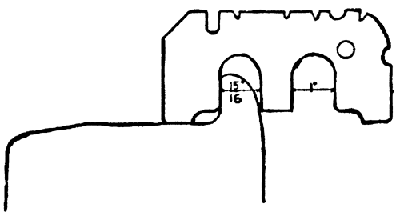
Fig. 11. Method of gauging vertical flanges.
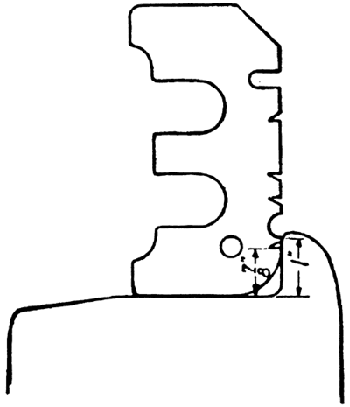
Fig. 12. Method of gauging broken rims
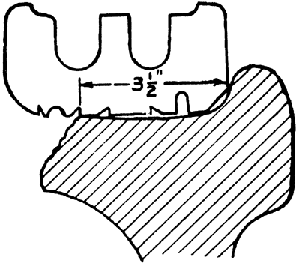
Fig. 13. Method of gauging broken rims.
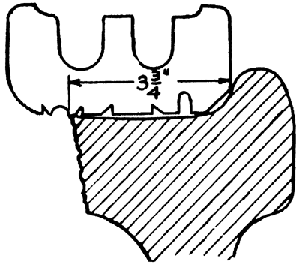
Fig. 14. Method of gauging worn coupler.
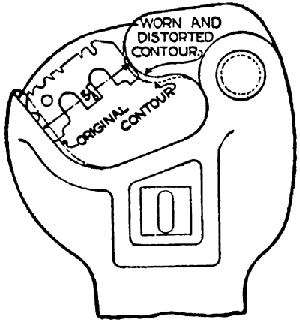
| 1. | Regulation originally made by authority of minister, by certificate, subject to approval of the Lieutenant Governor in Council (see R.S.B.C. 1948-285-7), since July 8, 1976, regulation made by authority of minister only. |
[Provisions of the Railway Act, R.S.B.C. 1996, c. 395, relevant to the enactment of these regulations: section 271]