| Copyright (c) Queen's Printer, Victoria, British Columbia, Canada |
Licence Disclaimer |
| B.C. Reg. 296/97 W.C.B. |
Deposited September 8, 1997 effective April 15, 1998 |
| This archived regulation consolidation is current to August 31, 2007 and includes changes enacted and in force by that date. For the most current information, click here. |
Workers Compensation Act
Occupational Health and Safety Regulation
[includes amendments up to B.C. Reg. 106/2007, July 26, 2007]
Note:
The Regional Health Boards and Community Health Services Societies administer the Industrial Camps Health Regulation.
If Board officers, in the course of their duties, find conditions in camps which may be of concern under the Industrial Camps Health Regulation, the matter will be referred to the attention of the appropriate officials.
Queries with regard to the administration of the Industrial Camps Health Regulation should be directed to the officials responsible for its administration.
Definitions
26.1 In this Part:
"active falling area" means the area within a 2 tree length radius of where a faller or mechanized falling equipment is located and equipped so as to be able to fall timber;
"backspar" means a tree rigged up at the back end of a work area to support a skyline;
"binder" means a wire rope, secured by a cinch, placed around logs on a logging truck or trailer to prevent the load from spilling;
"bucker" means a worker who cuts up trees on the ground;
"bunk" means the bottom section of the cradle assembly on a logging truck or trailer onto which logs are placed;
"butt rigging" means a system of swivels, shackles, links and hooks which connect the haulback and mainlines and to which chokers are fastened;
"cable clip" means a u-bolt cable connector;
"cable logging" means a yarding system employing winches, blocks and cables;
"dangerous tree" includes any tree that is hazardous to workers because of location or lean, physical damage, overhead hazards, deterioration of the limbs, stem or root system, or a combination of these;
"faller" means a worker who falls trees;
"forestry operation" means a workplace where work is done in relation to silviculture or harvesting trees, including constructing the means of access and transporting the harvested trees to a facility where they are processed or from which they are exported;
"haulback" means the cable used to outhaul the rigging or grapple when yarding;
"high lead" means a cable logging system in which running line lead blocks are placed on a lift tree to provide lift to the logs during yarding;
"intermediate spar" means a tree used to elevate a skyline between the yarder and the backspar in a multispan skyline system;
"landing" means the area where the yarder or loader is placed, and logs are yarded or skidded for sorting and preparing for transport;
"lift tree" means a tree rigged to support running lines;
"mainline" means the cable used to yard logs;
"mobile yarder" means a logging machine mounted on wheels, tracks or skids, incorporating a vertical or inclined spar, tower or boom used in a skyline, slackline, modified slackline, high lead, or grapple overhead cable logging system;
"molly hogan" means a single strand of wire rope rolled into a circle with 6 complete wraps that may be used as a temporary method of connecting the eye splices of 2 lines of the same size or in pin shackles to replace the cotter pin;
"skidding" means moving logs by the use of mobile equipment that travels while the logs are being dragged;
"skyline" means a cable on a yarder that supplies lift for yarding lines, blocks, rigging, carriage and logs;
"slackline" means a skyline that can be tensioned at the operator's discretion;
"spar" means a tree or mast on which rigging is hung for a cable logging system;
"strawline" means a small diameter cable used in rigging up or moving larger cables or blocks;
"turn" means one or more logs that are skidded or yarded to the landing at one time;
"yarding" means moving logs by the use of mobile or other equipment that does not travel while the logs are being moved.
Planning and conducting
26.2 The management of forestry operations must plan and conduct such operations in a manner consistent with this Regulation and with recognized safe work practices.
Training
26.3 (1) Workers in a forestry operation must receive training, appropriate to their duties, that is acceptable to the Board.
(2) The requirements of subsection (1) are deemed to have been met with regard to duties of a type performed before April 15, 1998 if
(a) the worker performed the duties regularly for at least 2 years prior to that date, and
(b) the duties performed were documented by April 15, 1999.
(3) The measures taken to comply with subsections (1) and (2) must be documented in a manner acceptable to the board and a copy must, upon request, be made available to the worker concerned or an officer.
Notice of project
26.4 (1) Before commencing a forestry operation, other than a silviculture operation that will last 5 working days or less at a workplace, notice of the operation must be sent to the nearest Board office in writing, or in another manner acceptable to the Board,
(a) by the employer, or
(b) if the operation involves workers of more than one employer, or workers and independent operators, by the owner or the person engaged by the owner to be the prime contractor.
(2) The notice required under subsection (1) must identify the
(a) location of the operation,
(b) name of the owner or licensee of the trees,
(c) name of the person conducting the operation,
(d) type of work to be performed,
(e) type of equipment to be used, and
(f) procedures to be used if trees are to be harvested by commercial thinning, selective logging, individual tree selection or other similar methods.
[am. B.C. Reg. 185/99, s. 72.]
Initial safety meeting
26.5 (1) A crew safety meeting must be held before commencing work in a new area.
(2) At the crew safety meeting, the workers to be employed in the area must be informed of potential hazards.
Working alone
26.6 The well-being of a worker working alone or in isolation in a forestry operation must be checked in accordance with the requirements of Part 4 (General Conditions).
Personal protective equipment
26.7 (1) Workers must wear highly visible outer clothing meeting the requirements of Part 8 (Personal Protective Clothing and Equipment) when
(a) they may be endangered by moving equipment,
(b) their location must be routinely checked, or
(c) they are involved in harvesting trees at night.
(2) Safety headgear worn in a forestry operation must be of high visibility orange or red colour.
(3) Repealed. [B.C. Reg. 312/2003, App. D, s. 27.]
[am. B.C. Reg. 312/2003, App. D, s. 27.]
Cutting cables
26.8 A hammer or axe must not be used to cut wire rope, unless designed for that purpose.
Metal in saw logs
26.10 A spike, drift bolt, nail, or any other metal must not be left in any recoverable log.
Dangerous trees
26.11 (1) If work in a forestry operation will expose a worker to a dangerous tree, the tree must be removed.
(2) Trees that will interfere with rig-up, the movement of lines and equipment, or that could be pushed or pulled into the work area must be removed.
(3) Saplings over 6 m (20 ft) tall, in an area where cable logging is being done, must be removed before yarding commences.
(4) If it is not practicable to comply with subsection (3), such as during partial cutting operations, alternative work methods or procedures which minimize the risk to workers may be used, and the work must be directed by a supervisor who has, as far as practicable, controlled the danger to any worker.
(5) Any dangerous tree, regardless of height, located within an active hand falling or cable logging operation must not interfere with safe falling or yarding practices, and if it does interfere, it must be removed.
(6) A dangerous tree in a forestry operation may be left standing during operations other than construction or harvesting if
(a) no significant ground vibrations are likely to be produced,
(b) no work will be done within reach of the tree when wind speed exceeds 20 km/h (12 mph), and
(c) a tree assessor who has completed a training program acceptable to the Board determines that the tree will not be dangerous to workers during the planned activity.
(7) If tree planting is to be done in an area that has more than 500 dangerous trees per hectare, the Board may approve a request to work without removing all the dangerous trees if, before work commences,
(a) a representative sample of the dangerous trees is assessed by a tree assessor who has completed a training program acceptable to the Board,
(b) any findings of the assessment as to the removal of dangerous trees or other trees are implemented, and
(c) no silviculture is done within reach of dangerous trees when wind speed exceeds 20 km/h (12 mph).
Non-slip floors and controls
26.13 If an equipment operator or helper is required to wear caulked footwear because of the nature of the work duties, then the floors, steps, and operating foot controls of the equipment being used must have a surface cover which provides an effective grip for the caulks.
Equipment clearance
26.14 (1) A minimum space of 60 cm (2 ft) must be maintained between the swinging portion of mobile equipment and any obstacle adjacent to the equipment.
(2) A worker must obtain permission from the equipment operator before proceeding through the operating radius of the equipment.
(3) An equipment operator must obtain permission from workers in the area before entering or proceeding through a work area where equipment movement could create a hazard to workers.
Log pile heights
26.15 Log piles must not be higher than the safe operating reach of equipment being used to handle the logs.
Slope limitations
26.16 (1) Repealed. [B.C. Reg. 312/2003, App. B, s. 58 (a).]
(2) If the manufacturers maximum slope operating stability limit for equipment is not known, written procedures that have been developed specifically for the worksite to ensure machine stability must be followed when the equipment is used on slopes.
(3) If the manufacturers information and information under subsection (2) is not available, the following limits apply:
(a) a rubber tired skidder must not be operated on a slope which exceeds 35%;
(b) a crawler tractor, feller buncher, excavator and other similar equipment must not be operated on a slope which exceeds 40%;
(c) any other forestry equipment specifically designed for use on a steep slope must not be operated on a slope which exceeds 50%.
[am. B.C. Reg. 312/2003, App. B, s. 58.]
Weather conditions
26.17 When weather conditions create hazards to workers, additional precautions must be taken as necessary for the safe conduct of the work.
Landslides/avalanches
26.18 In a forestry operation where there may be a risk of a landslide or avalanche
(a) the risk must be assessed in accordance with a standard acceptable to the Board,
(b) if a risk is found to be present, written safe work procedures must be developed meeting the requirements of the standard, and
(c) workers must be educated in the safe work procedures.
Forest fire fighting
26.19 (1) Before fighting a forest fire, workers must be trained in their fire fighting duties in accordance with a standard acceptable to the Board, and be physically capable of performing their duties safely and effectively.
(2) Workers required to fight forest fires must be retrained annually.
(3) The employer must keep training records for each worker required to fight fires.
(4) Except under emergency conditions, a worker engaged in firefighting must wear pants and a long sleeved shirt of cotton, wool, denim or flame resistant material.
Night operations
26.20 (1) Repealed. [B.C. Reg. 312/2003, App. D, s. 29.]
(2) If a forestry operation is conducted at night the sources of illumination provided under Part 4 (General Conditions) must be located and directed so that shadows and glare are minimized.
(3) Cap lamps or other local sources of illumination acceptable to the Board must be used if
(a) the light intensity in a work area is less than 22 lux (2 ft candles), and
(b) it is impracticable to provide illumination by any other means.
[am. B.C. Reg. 312/2003, App. D, s. 29.]
Faller qualifications
26.21 (1) An employer must not allow a worker to fall or buck trees until the worker has demonstrated to the employer that the worker is qualified.
(2) To determine whether a worker is qualified to fall or buck trees, the employer must apply the standards of a training program that is acceptable to the Board.
Faller training
26.22 (1) A worker in a forestry operation must, before commencing work as a faller, receive training for falling that is acceptable to the Board.
(2) The requirements of subsection (1) are deemed to have been met if
(a) the worker has performed falling duties regularly for at least 2 years before April 15, 1998, and
(b) the worker's falling activity is evaluated at the worksite and the worker is certified as a competent faller by a qualified supervisor or trainer, and
(c) the worker passes a written or oral examination on falling in the presence of a qualified trainer.
(3) Unless subsection (2) applies, a faller's training must include
(a) a period of basic training in falling trees, of a minimum of 30 days working, one on one, with a qualified faller or trainer,
(b) a written or oral examination on falling in the presence of a qualified trainer, and
(c) after passing the examination, working as a trainee faller under the close supervision of a qualified faller or trainer for a period of 180 days, or for a lesser period if the person supervising is satisfied the worker is competent.
(4) The person supervising the faller's training must
(a) keep weekly records of the trainee's progress, and
(b) certify in writing that the trainee is competent.
(5) The training required under subsections (1) to (3) must be documented in a manner acceptable to the Board, and a copy of the documents must be made available to the worker concerned or an officer, upon request.
Procedures
26.23 The employer must ensure that fallers and buckers follow written work procedures that include safe work practices for
(a) minimum and maximum distances between fallers and other workers,
(b) controlling the fall of trees and dangerous trees,
(c) bucking,
(d) using lines and jacks to fall trees, if required,
(e) summoning and rendering assistance to deal with a difficulty or emergency, and
(f) ensuring each faller's well-being at least every half hour and at the end of the work shift.
Responsibilities of fallers and buckers
26.24 (1) Before a tree is felled, a faller or an operator of a mechanized falling machine must ensure that all workers are clear of the area within a circle centred on, and having a radius not less than twice the height of, the tree.
(2) Before falling or bucking commences, the faller or bucker must ensure that obstructions to falling or bucking are cleared, and a safe escape route to a predetermined safe position is prepared.
(3) A tree must not be felled if it could strike any stationary or running line of any operational equipment.
(4) If it is necessary to pack or shovel snow to reduce stump height, the depth of the depression at the base of the tree must not exceed 45 cm (18 in).
(5) When falling a tree, the faller must ensure that
(a) a sufficient undercut is used,
(b) the undercut is complete and cleaned out,
(c) sufficient holding wood is maintained,
(d) the backcut is higher than the undercut to provide a step on the stump,
(e) wedging tools are immediately available and, unless the tree has a pronounced favourable lean, wedges are set, and
(f) the tree being felled does not unnecessarily brush standing trees.
(6) A faller may only use one tree to cause other partially cut trees to fall in succession if
(a) this procedure is being used to overcome a specific falling difficulty or hazard,
(b) a wedge is driven into the backcut of each cut tree, and
(c) only those trees necessary to deal with the falling difficulty are cut up.
(7) When a tree starts to fall, the faller must move quickly to a predetermined safe position, at least 3 m (10 ft) away from the base of the tree where possible, and take cover if available.
(8) A bucker must ensure that all workers are clear of the hazardous area before a tree or log is bucked.
Dangerous trees and logs
26.25 (1) Falling or bucking must not be started if
(a) a tree or log is in a dangerous condition, or
(b) there is reason to doubt that the cut can be completed.
(2) If a tree is not completely felled,
(a) the faller or the operator of a mechanized falling machine must clearly mark the tree, discontinue work in the hazardous area, alert any workers who may enter the danger area, and notify the immediate supervisor, and
(b) the supervisor must notify all workers who might be endangered, and must take appropriate measures to ensure that the tree is safely felled before other work is undertaken in the hazardous area.
(3) If a bucking cut is incomplete,
(a) the bucker must immediately cut or mark a distinct cross on the top of each end of the log, and must notify the immediate supervisor at the end of the work day, and
(b) the supervisor must notify the yarding or skidding crew.
Falling dangerous trees
26.26 (1) Where practicable, dangerous trees must be felled
(a) progressively with the falling of other timber but before falling adjacent live trees, and
(b) into open areas.
(2) When falling a dangerous tree,
(a) dangerous bark must be removed, where practicable,
(b) stump height must, in the judgment of the faller, allow maximum visibility and freedom of action,
(c) the tree must be felled in the direction of lean whenever possible, and the undercut must be as deep as necessary to minimize the use of wedges and resulting vibration,
(d) pushing with a green tree must only be undertaken to overcome a falling difficulty, and
(e) wedging over must be used only if there is no alternative, and after a careful assessment of the ability of the dangerous tree to withstand wedging.
(3) If conventional methods cannot be safely employed to remove a dangerous tree, blasting or other acceptable methods must be used.
(4) Falling, bucking or limbing activities must not be undertaken in an area made hazardous by a leaning dangerous tree, or a dangerous tree which has been brushed by a felled tree, until the dangerous tree has been felled.
Location of fallers
26.27 (1) Fallers and buckers must not work in a location where they or other workers will be endangered.
(2) A faller must not fall a tree in a normally inaccessible area if the faller's safety depends on a lifeline or similar device and the faller does not have the ability to move to a safe position.
(3) Subsection (2) does not preclude the use of a lifeline to prevent slipping or falling.
Summoning assistance
26.28 (1) Qualified assistance must be readily available to fallers in case of difficulty, emergency or injury.
(2) Fallers and buckers must have an effective means to summon assistance.
Entry to falling area
26.29 (1) Only workers with associated duties may enter an active falling area.
(2) Before entering the active falling area, workers must notify the faller or bucker and wait until advised by the faller or bucker that it is safe to enter.
(3) A worker, other than the faller, may be at the base of a tree being felled if the worker is
(a) a supervisor or manager controlling the operation,
(b) training as a faller, or
(c) required to assist the faller to overcome a specific falling difficulty.
Traffic control
26.30 If a tree being felled may create a hazard to a user of a travelled road, adequate traffic control must be used to stop or control approaching traffic.
Operator protection
26.32 Boom stops must be installed on equipment if pushing or pulling the boom too far back may cause the backstop to crush the operator's cab.
Mobile yarders
26.33 (1) A mobile yarder must not be used unless a legible and easily visible sign provided by the manufacturer or a professional engineer is permanently attached, showing
(a) the name of the manufacturer, and date of manufacture,
(b) the model and serial number,
(c) if the yarder is designed for skyline, slackline, or modified slackline systems, the maximum and minimum size of skyline, mainline, and haulback that can be used,
(d) the maximum diameter of the mainline,
(e) the minimum size, number and placement of guylines, if required,
(f) the placement and number of outriggers, if required,
(g) the permissible yarding angles, and
(h) auxiliary equipment that may be safely attached.
(2) A mobile yarder must be rigged and used according to the information included on the sign required by subsection (1).
(3) A mobile yarder must not be moved with the spar or tower in the vertical operating position unless the stability of the equipment can be maintained.
(4) Multiple throttle controls on a mobile yarder must be arranged to preclude the simultaneous operation of 2 or more controls.
(5) Each mobile yarder and attached equipment must be inspected frequently.
(6) Manufacturer's manuals must be provided and inspection and maintenance must be done as required by Part 14 (Cranes and Hoists).
[am. B.C. Reg. 312/2003, App. B, s. 59.]
Signalling
26.34 (1) Only a designated worker may signal for the movement of cable yarding equipment, but any worker may signal to stop cable yarding equipment, and that signal must be obeyed promptly.
(2) The worker designated to signal the yarder operator must
(a) not be otherwise occupied while the equipment is in motion, and
(b) not signal for the movement of the equipment until assured that no workers are endangered within the area for which the designated worker is responsible.
(3) The signals for rigging movement must be clearly discernible to the equipment operator, and to all workers who could be endangered by the movement of the equipment.
(4) A worker who directs or operates equipment, or who could be endangered by the movement of equipment, must be familiar with the meaning of the signals.
(5) The equipment operator must stop the equipment if a signal is not clearly understood.
(6) If voice signals are used, the equipment must not be moved until the equipment operator has repeated the voice signal by means understandable to all workers who might be endangered.
(7) If non-verbal signals such as whistles and hand signals are used to direct the operation of equipment, the signals specified in Tables 26-1 to 26-7 must be used.
(8) When audible signals are being used concurrently to direct the operation of more than one piece of equipment, the signal tones must be differentiated to clearly identify intended movement of each machine.
(9) Signalling devices must be tested at the start of each shift in a way that ensures that equipment will not be moved in response to the test.
(10) Defective signalling devices that might cause a hazard to workers must not be used, and repairs, alterations, or adjustments to signalling devices must be performed by qualified persons.
(11) A radio signalling device used to direct the movement of logging equipment must be designed, maintained and operated in accordance with a standard acceptable to the Board.
(12) Any signalling system using radio frequency transmission must operate on a frequency and at a transmission power assigned and coordinated by the Board.
Radio controlled machines
26.35 Equipment, including a yarder or a wheeled or tracked log skidder, which is controlled by radio remote control devices must be equipped with "fail safe" or "stop" devices that will become effective if the radio control device fails.
Climbing equipment
26.36 (1) A worker climbing a tree or a wooden spar must use a safety belt, climbing rope or strap, and climbing spurs meeting the requirements of Part 11 (Fall Protection).
(2) If a worker climbing a tree must disconnect the climbing rope or strap in order to move by an obstacle, a second climbing rope or strap must be used to ensure continuous protection while passing the obstacle.
(3) When climbing equipment is in use, a duplicate set of equipment must be available for immediate use at the site.
(4) If there is danger of the climbing rope or strap being severed, it must be made of wire rope or a rope with wire core construction.
(5) When a chain saw is being used, the climbing rope or strap must be made of material that cannot be severed by the saw, or a second climbing rope or strap must be used.
(6) Climbing equipment must be maintained in good order, and inspected by the worker before each use.
(7) When a worker is on a steel spar the worker must use a full body harness which has a lanyard anchored to the spar as required by Part 11 (Fall Protection), except when riding on a passline as specified in section 26.37 to thread lines, oil blocks, or to inspect rigging.
Hoisting workers
26.37 (1) A passline used for hoisting a worker as permitted by section 26.36 (7) must be
(a) fitted with links or rings, as guards to prevent the worker from being drawn into the blocks,
(b) inspected before use and replaced if not in good condition,
(c) free from knots except for splices at the terminals,
(d) of sufficient length to maintain at least 3 wraps on the hoisting drum, and
(e) secured against accidental disengagement at the points of connection.
(2) Repealed. [B.C. Reg. 420/2004, s. 12.]
(3) While a worker is being hoisted, another worker must be designated to ensure that the hoisting line is spooled onto the hoisting line drum according to recognized industry standards, and a hand or foot must not be used to guide the rope onto the drum.
(4) When a worker is suspended from a hoisting line, another worker must be designated to give signals to the hoist operator and must be
(a) otherwise unoccupied,
(b) clearly visible to the worker suspended from the hoisting line and the equipment operator, and
(c) clear of hazards from falling, flying or thrown objects.
[am. B.C. Reg. 420/2004, s. 12.]
Riding on rigging
26.38 (1) Except as permitted in subsection (2), a worker must not be transported on any cable system unless it is necessary and authorized for inspection or maintenance.
(2) Subsection (1) does not apply if the system is designed for the purpose of the transport of workers and meets a standard acceptable to the Board.
Location of workers
26.39 (1) A worker must not remain within the bight of any running line under tension, nor in a position where the worker could be struck by a line were it to break or come loose, or be tightened.
(2) A worker must be positioned in the clear to avoid being exposed to moving logs, saplings, root wads, chunks, rigging or other material.
(3) A worker must keep clear of rigging which is stopped by an obstruction until the rigging has been slackened to reduce the hazard.
Anchors
26.40 (1) A standing tree may be used for anchoring lines or fastening blocks only if
(a) a suitable stump is not available, and
(b) the tree is effectively tied back to another anchor, except that a secondary anchor tree need not be tied back.
(1.1) A standing tree must not be used to anchor guylines if a worker would be endangered were the tree to be pulled over.
(2) A stump or tree must not be used as an anchor for a line or for fastening a block until it has been determined that it is suitable for use as an anchor, and it must be inspected daily to determine that it remains suitable for continued use.
(3) A guyline must be secured to its anchor stump by
(a) a notch of sufficient depth to retain the wrapping lines, or by other means providing equivalent security, and
(b) sleeve shackles, knob and bell, screwy hooks or line clamps compatible with the guyline size, and
(c) a minimum of 2 1/2 wraps about the anchor if spikes are used.
(4) If spikes are used to secure a guyline to an anchor stump, there must be at least
(a) 8 spikes in the first wrap, 3 spikes in the second wrap and 8 spikes in the last wrap if the guyline is attached to the yarder, or
(b) 3 spikes in the last wrap if the guyline is attached to a back spar.
(5) If a log, pipe or other apparatus buried in the ground is used to anchor a guyline or skyline, the method and equipment used must be acceptable to the Board and
(a) the guyline or skyline must not be directly attached to the anchor,
(b) a suitable strap or line of equal size and strength to the guyline or skyline with eyes in each end must be used, with one wrap around the anchor, and both eyes attached to the guyline or skyline with a shackle, and
(c) the eye connection of the anchor strap must be visible for inspection.
(6) Artificial earth anchors must be installed and used in accordance with their design specifications and manufacturers recommendations or a standard acceptable to the Board.
(7) Rock bolt, wire rope and steel pin anchors must be grouted and installed, tested and maintained in accordance with the anchor manufacturers recommendations or a standard acceptable to the Board.
(8) If an anchor system has 2 or more legs, bridle blocks of adequate strength must be used to distribute the load equally.
[am. B.C. Reg. 253/2001, s. 19.]
Guylines
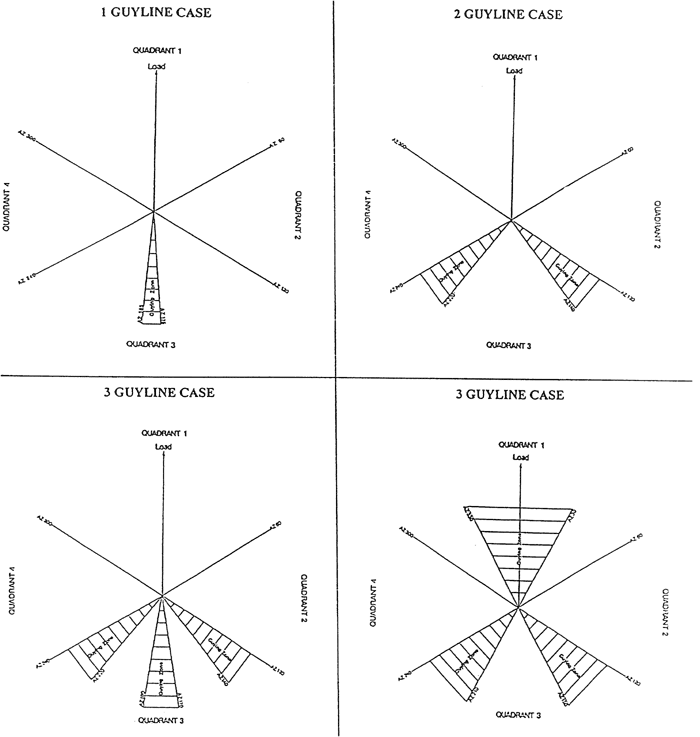
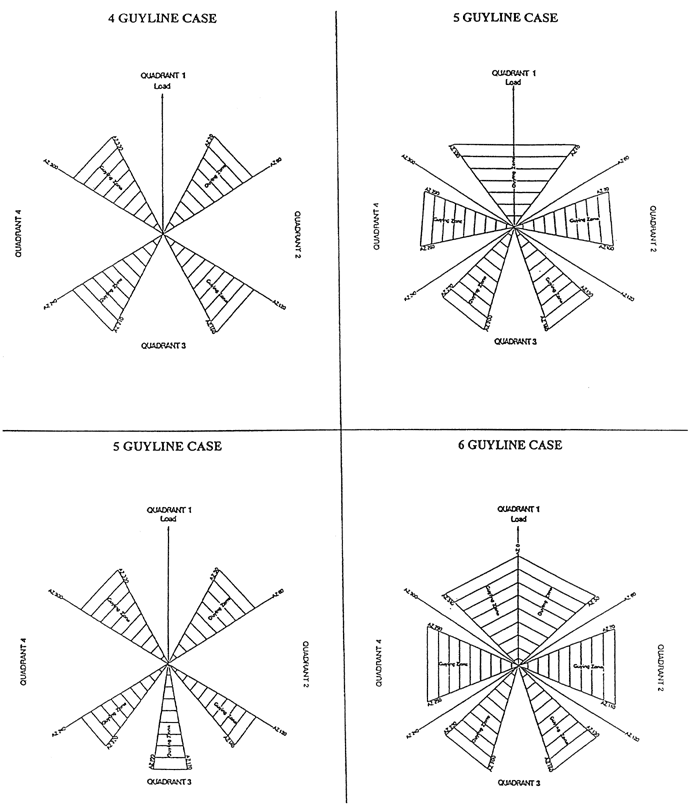
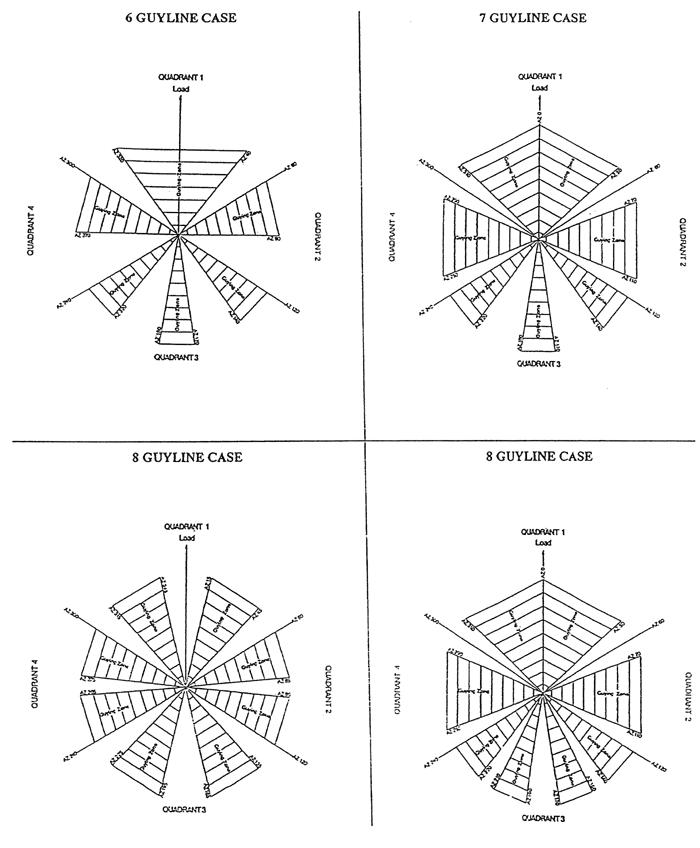
26.41 (1) Guylines for a mobile yarder must be positioned
(a) as specified by the manufacturer, or
(b) as shown in Figure 26-1 according to the number of guylines used.
(2) Guylines must be rigged to provide a 45 degree or larger angle between the guyline and a line drawn plumb through the guyline fairlead.
(3) If it is not practicable to comply with subsection (1) or (2), or if suitable anchors are not available, additional steps must be taken to ensure the stability of the yarder.
(4) Guylines must be attached to the supported structure by guyline shackles, or other fastenings providing equivalent security.
(5) Safety devices with breaking strength at least equal to that of the guylines must be installed at the top of mobile spars to prevent guylines or their assemblies from falling.
(6) Guylines over a travelled road must be rigged to clear all traffic, or if this is not practicable,
(a) the guylines must be conspicuously marked, and
(b) signs warning of limited clearance must be posted on the road.
Figure 26-1 Positioning guylines for mobile yarders
Rigging
26.42 (1) Rigging must be of a type and size for which the equipment is designed.
(2) Lines, blocks, and yarding and loading equipment must be rigged in accordance with accepted industry standards.
(3) Shackle pins on stationary lines must be secured with molly hogans or other acceptable means to prevent accidental dislodgment.
(4) Molly hogans must not be used to connect skylines, loading rigging, or any stationary lines.
(5) Screw pin shackles used on running lines must be tightened securely and routinely inspected.
(6) Rigging must be inspected at regular and frequent intervals by a qualified worker.
Hanging blocks
26.43 Straps for supporting blocks must be made from new wire rope or manufactured from synthetic fibre material and rigged to withstand the applied loads.
Winches
26.44 (1) When properly anchored to a winch, the minimum number of wraps of cable left on a winch drum must be
(a) for skylines, 1 1/2 layers, and
(b) for other types of logging equipment, 3 complete wraps.
(2) Subsection (1) does not apply to a skidding winch mounted on ground-based skidding equipment.
Prohibition of knots
26.45 A knot must not be used in any winch line or other rigging, except
(a) to effect temporary repair in the event of line breakage, or
(b) for tag lines on grapple log loaders or for hooks on strawline eyes.
Skyline anchors
26.46 (1) A skyline must be anchored to
(a) a stump or to a suitable manufactured anchor,
(b) the base of a standing tree if the tree is tied back to a secondary anchor, or
(c) a suitable piece of mobile equipment.
(2) A skyline must be secured to an anchor by
(a) a choker using a large sleeve-type knockout pin shackle or an approved safety pin-type shackle over the skyline with the pin through the eye,
(b) a strap acceptable to the Board, with both eyes hung in a shackle and the knockout pin or safety pin through the eye of the skyline, or
(c) a cable clip system acceptable to the Board.
(3) If anchor stumps in standing timber are used for slackline or other skyline operations, the skyline must be prevented from striking trees in the area, or the trees must be felled.
Skyline extensions
26.47 If a skyline extension is used
(a) the breaking strength of the extension must be greater than or equal to that of the skyline,
(b) the extension must not alter the safe capacity of the tower, and
(c) if the carriage runs over it, the extension must be attached by a regular long splice or by a flush pin straight side shackle connecting the 2 eyes.
Skyline spars
26.48 (1) Each skyline spar must be of adequate strength.
(2) An intermediate spar must be used in a manner acceptable to the Board.
(3) A backspar that is hazardous to top or is among standing trees need not be topped if workers will not enter the area made dangerous by the use of the tree when the skyline is loaded.
Skyline rigging
26.49 (1) When rigged in a backspar, a skyline must be anchored no more than 8° off-line from the rearward projection of the skyline.
(2) If a suitable anchor cannot be found to comply with subsection (1), another suitable anchor may be used provided that the backspar is stabilized by extra guylines.
(3) The rearward projection of the skyline must
(a) not be considered a guyline, and
(b) not make an angle greater than 50° measured from the horizontal as it leaves the backspar unless approved by a professional engineer.
(4) The method used to support a skyline at a backspar or intermediate spar must provide adequate support and protection for the line.
(5) A skyline must not be fastened directly to a backspar.
Backspar guylines
26.50 (1) A tree used as a backspar must be guyed with a sufficient number of guylines to ensure that the tree is adequately supported.
(2) If spikes are used to anchor a backspar guyline
(a) the guyline must have at least 2 1/2 wraps around the stump, and
(b) three spikes must be placed in sound wood on the last wrap.
(3) If cable clips are used to anchor a backspar guyline they must be secured in accordance with acceptable rigging practice.
Lift trees
26.51 A lift tree need not be topped or guyed provided it is of adequate strength and the lines run through tail hold block(s) located so as to minimize stress on the lift tree, and tail hold(s) are rigged and located so that if the lift tree were to be pulled over workers would not be endangered.
Corridor logging
26.52 When corridor logging is carried out, the corridor must be cleared to a standard acceptable to the Board.
Ground skidding operations
26.53 (1) Ground skidding, transport or processing equipment must not enter an active falling area.
(2) The operator of ground based skidding equipment must
(a) not winch at an angle that could cause an obstruction to upset the machine,
(b) if practicable, winch the turn up tight to the equipment before travelling to avoid obstruction hang-up and rollover,
(c) before climbing or descending grades, select a suitable gear in order to maintain control of the machine, and
(d) drop the turn to free an unchoked log if an unchoked log is picked up with a turn.
Equipment stability
26.54 Mobile equipment must not be operated where its stability cannot be assured.
[am. B.C. Reg. 312/2003, App. D, s. 30.]
Mainline release
26.55 A skidding winch on a ground based skidding machine must have a quick-release system to permit the winch line to run out freely and automatically disengage from its drum.
Log landings
26.56 (1) Log landings and other work areas must be
(a) located, constructed, arranged, maintained, and operated so that logs can be landed safely and workers may work in the clear of moving logs and equipment,
(b) located on stable and relatively level ground, and
(c) adequately illuminated in accordance with the requirements of this Regulation in areas where workers are required to work at night or in other conditions of limited illumination.
(2) Log piles must be maintained in a stable condition.
Equipment locations
26.57 Mobile yarders and loaders must be positioned to ensure that no worker on the landing will be exposed to incoming or runaway logs or other debris.
Limbing and bucking restrictions
26.58 (1) Hazardous limbs must not be transported on a log transporter.
(2) A worker must not stand on any part of a load of logs on a log transporter while limbing, bucking or carrying out any other activity.
Suspended logs
26.59 (1) A log must never be swung over a worker.
(2) A worker must not stand or pass under a suspended log.
Log handling equipment
26.60 Log handling equipment must not be moved with loads lifted higher than is necessary to provide unobstructed vision for operators.
Vehicle movement
26.61 (1) Vehicle movement signals must be used in accordance with section 26.34 where
(a) a loader operator is unable to see the loading operation, or
(b) trucks are moving at landings, load-out points, water dumps, dry land sorts, railway reloads or elsewhere close to workers.
(2) Vehicle movement signals must be initiated as follows:
(a) if the vehicle operator decides to move the vehicle, then a movement warning signal must be given by the vehicle operator;
(b) if the loading or dumping machine operator decides the vehicle should be moved or stopped, the signal must be given by the operator of the loading or dumping machine.
Maintenance
26.62 Landings, load-out points, water dumps, dry land sorts, and railway reloads must
(a) be kept in good repair and free from hazardous buildup of bark and other debris, and
(b) have an effective method of dust control.
Unauthorized persons
26.63 Only persons permitted by the workplace safe work procedures may be at landings, load-out points, water dumps, dry land sorts and railway reloads.
Bunk and stake assemblies
26.64 Bunk and stake assemblies, installed at a dry land sort for bundling logs, must have fixed stakes or be used with safe work procedures which ensure that no worker goes into the danger area adjacent to or below self-tripping stakes unless the stakes are secured from releasing.
Bullboards
26.65 (1) For the protection of the driver, each logging truck must have, at the back of the cab, a substantial barrier that
(a) is at least 15 cm (6 in) higher than the cab, and
(b) is at least as wide as the cab.
(2) The barrier at the back of the cab of a self-loading logging truck may be less than the height specified in subsection (1) but must not be less than the cab height.
(3) For the purposes of subsection (1), the barrier must be capable of withstanding a horizontal forward static load equal to 40% of the weight of the cargo being transported that may shift and contact the barrier, with this load uniformly distributed over the entire barrier.
(4) The barrier of the logging truck must be
(a) designed, constructed and maintained so that it has no aperture large enough to permit any item of cargo to pass through it, and
(b) installed in a manner acceptable to the Board to ensure that the rated capacity of the barrier is not diminished.
(5) The barrier must be
(a) permanently marked with
(i) the name and address of its manufacturer
(ii) the model number or serial number of the barrier, and
(iii) its rated capacity in terms of the cargo weight that may be transported in compliance with this section, or
(b) identified by carrying in the logging truck a copy of a letter that
(i) accurately describes the barrier,
(ii) certifies the model number or serial number of the barrier and its rated capacity in terms of the cargo weight it can carry, and
(iii) has been signed by the manufacturer or a professional engineer.
[en. B.C. Reg. 253/2001, s. 20; am. B.C. Regs. 73/2005; 18/2006, s. 1.]
Bunks and stakes
26.66 (1) Trucks, trailers and semitrailers used for transporting logs must be equipped with bunks and stakes of adequate design and construction to safely perform their intended function.
(2) Bunks must be able to rotate freely upon their pivots, if designed to do so.
(3) Stakes, extensions and stake lines must be installed and maintained so that the angle between bunks and stakes does not exceed 90° when loaded.
(4) Stakes must be constructed so that
(a) they can be released only from the opposite end of the bunk,
(b) keeper pins are secured against unintended release, and
(c) if they are over 1.2 m (4 ft) in height, springs or other mechanical means are fitted to facilitate their returning to a vertical position.
(5) Stake extensions must be secured against inadvertent detachment from the stakes.
(6) Stake cross-ties must not be used to secure stake extensions unless the unloading or dumping procedure protects workers from the hazard of flying stake extensions.
(7) Stake lines must
(a) not be made from swaged wire rope, and
(b) conform to the following specifications
| Bunk width | Stake line minimum diameter |
||
| metres | feet | millimetres | inches |
| up to 2.6 | up to 8 1/2 | 22 | 7/8 |
| 2.6 to 3.7 | 8 1/2 to 12 | 29 | 1 1/8 |
| over 3.7 | over 12 | 32 | 1 1/4 |
(8) Stake and bunk assemblies must be inspected daily, and must not be used if they show signs of excessive wear.
(9) If air operated stake releases are used
(a) the air supply must be taken from the "wet" air reservoir or from the accessory air line to a control valve that is normally closed,
(b) the control valve must be located in the cab and be accessible only from the operator's position,
(c) the control valve must be fitted with a spring-loaded cover or be otherwise guarded against inadvertent operation, and
(d) a separate air line must extend from the control valve to the tractor and trailer stake release chambers, and it must be clearly identified, or installed so that it cannot be mistaken for the air line of the trailer's braking system.
[am. B.C. Reg. 312/2003, App. C, s. 10.]
Load specifications
26.67 (1) Logs must not be loaded in a manner that will cause
a) the vehicle and its load to become unstable while in transit, or
b) excessive strain on the binder units, bunk stake lines, or stakes.
(2) To ensure that stakes remain at a safe angle, the first tier of logs must be laid tight, and arranged to minimize slack in the stake cables.
(3) Unless securely restrained by other means to prevent logs from slipping off, the bottom tier and the side rows of the log load must extend beyond the front and rear bunks and stakes
(a) at least 30 cm (12 in) on trucks with compensating reach type trailers, or
(b) at least 15 cm (6 in) on other types of trailers.
(4) The log length on trucks must not exceed 27.5 m (90 ft) unless prior permission is obtained from the local Ministry of Forests District Manager or other appropriate authority.
(5) A log whose length is not contained by the stakes must not be loaded above the level of the stakes unless the log
(a) is in a secure lay, and
(b) does not have excessive crook, sweep or deformity.
(6) Repealed. [B.C. Reg. 313/2001.]
[am B.C. Reg. 313/2001.]
Binders
26.68 (1) Unless the centres of all logs lie below the level of the top of the stakes,
(a) at least 2 binders must be installed to restrain the logs before the logging truck is moved, or if the logs are preloaded onto a trailer, installed immediately after the loading and before the trailer is connected to a tractor, and
(b) the binders must be checked in transit to ensure they are effective.
(2) A loaded truck may be moved within the loading area without the binders required under subsection (1) provided that no workers are endangered.
(3) If logs or log chunks could roll or slide off the truck, or the logs or log chunks are not contained within stakes, at least 2 binders must be used to secure the logs regardless of the height of the load.
(4) Each binder and attachment must have a breaking strength of at least 53 kN (12 000 lbs).
(5) Bundle straps or banding must not be used as binders to restrain logs during hauling.
(6) Binders must be positioned on the load so that they can be safely removed while the load restraining equipment is in position.
Unloading
26.69 Before binders are removed in preparation for unloading logs, the logs on a log transporter must be prevented from falling off the side where a worker will stand to release binders or stakes.
Unguarded equipment
26.70 (1) If it is not practicable to provide overhead protective guards on self-loading log transporters or similar equipment, the equipment must not be used if the absence of guarding presents a risk of injury to the operator.
(2) The heel bar on the operators side of the loader boom of a self-loading log transporter must be equipped with a deflector shield and must not be used for heeling logs.
[am. B.C. Reg. 253/2001, s. 21.]
Operating provisions
26.71 The operator of a logging truck on a forestry operation or other industrial road must
(a) not overtake another moving industrial vehicle, except on a signal from the other vehicle operator,
(b) use extreme caution when approaching vehicles coming from the opposite direction, and
(c) when following crew transportation vehicles, keep a safe distance, having due regard for road and grade conditions and visibility.
Warning devices
26.72 A logging truck must be equipped with a horn or whistle which
(a) is distinctly audible at a distance of 300 m (1 000 ft), and
(b) has a tone distinct from the whistles used by yarders or loaders in the vicinity.
Non-slip steps
26.73 Steps and working platforms for access to mobile equipment must be equipped with slip resistant surfaces.
Restriction
26.74 A worker must not stand on the cab platform of a logging truck when the truck is being loaded.
Riders
26.75 Only the operator and one other authorized person may ride in the cab of a loaded logging truck, except in an emergency.
Securing trailers
26.76 (1) Empty logging truck trailers, when loaded onto tractors, must be adequately secured against dislodgment.
(2) Handholds or other suitable facilities must be installed on trailer or semi-trailer reaches if workers are required to manually assist in coupling them to tractors.
Assistance on steep grades
26.77 If the braking power of equipment is insufficient to provide adequate control on a slope, the vehicle must be snubbed or assisted.
Transporting workers
26.78 The operator of a vehicle transporting workers on a forest operation road must not overtake and pass a moving and loaded logging truck or low bed transport truck, except upon a signal from the truck driver and only under suitable road conditions.
Haul road standards
26.79 Roads, bridges, elevated platforms, and other structures used by vehicles transporting workers, logs or other forest products in forestry operations must be constructed and maintained to a standard which will permit safe transit.
Creating additional hazards
26.80 Road or skid trail construction, including any blasting activity, must be carried out in a manner that prevents hangups, hanging broken tops or limbs, leaners, sidebind of pushed trees, or similar hazards which could endanger fallers or other workers.
Bull rails
26.81 The open sides of bridges, elevated truck weigh scales and associated elevated ramp approaches and other elevated structures used by logging trucks must be equipped with substantial and well secured continuous timber or log curbs or bull rails of sufficient height to prevent vehicles from running off the structure, but not less than 25 cm (10 in).
[am. B.C. Reg. 312/2003, App. D, s. 31.]
Roadside hazards
26.82 (1) Dangerous trees, loose rocks, stumps, or other unstable materials that are hazardous to road users must be removed or cleared for a safe distance back from roadsides or roadside banks.
(2) Brush, foliage or debris which prevents an adequate view by a vehicle operator of traffic approaching at roadway intersections or on sharp curves must be cleared and all possible precautions must otherwise be taken to control the hazards created by limited sight distance.
Traffic control systems
26.83 (1) When 2 or more vehicles are using a section of a road which is too narrow to permit them to pass, an effective traffic control system must be used by all vehicles on the road.
(2) The traffic control system must include
(a) turnouts, where required,
(b) vehicles operating with their headlights and, if fitted, flashing beacons, turned on,
(c) warning signs where required, and
(d) instructional signs, including kilometre and road name/number signs, and the radio frequency for traffic control if one is being used.
Weigh scales
26.84 (1) Repealed. [B.C. Reg. 312/2003, App. D, s. 32.]
(2) Weight recording house structures, forming part of a logging truck weigh scale unit, must
(a) be sufficiently offset from the scale balance platform to provide an adequate margin for log load clearance, or
(b) have an effective barrier erected between the weigh scale deck and the house.
[am. B.C. Reg. 312/2003, App. D, s. 32.]
Condition of boats
26.85 (1) A boat used in or about a forestry operation must be maintained in good mechanical and seaworthy condition.
(2) A boat must be inspected daily before first use, and thereafter as required, and defects must
(a) be reported immediately in writing to the supervisor or employer, and
(b) if they affect the safe operation of the boat, be remedied before the boat is used.
[am. B.C. Regs. 185/99, s. 73; 312/2003, App. E, s. 27.]
Boat equipment
26.86 (1) A boat must be equipped with
(a) effective machinery guarding that meets the requirements of this Regulation,
(b) effective guards or insulation on hot exhaust pipes or stacks,
(c) suitable cabins, screens or guards to protect operators against injury from towline breakage if the boats are regularly required to pull logs, booms or barges,
(d) suitable cabins, screens, or guards meeting the requirements of WCB Standard G606, Boom Boat Operator Protective Structures if operators are subject to injury from logs or limbs intruding into the control area,
(e) suitable hydraulic or other steering systems that will not transmit forces that could cause injury to the operator through feedback of rudder reaction,
(f) deck matting or other surface cover which provides an effective grip for caulked footwear, and
(g) effective heating.
(2) A boat operated in navigable waters during the period from sunset to sunrise, or in conditions of restricted visibility, must
(a) Repealed. [B.C. Reg. 312/2003, App. E, s. 28 (b).]
(b) have deck and cabin lighting, where necessary to provide safe levels of illumination aboard the craft, and
(c) have searchlights or floodlights, where necessary to facilitate safe navigation and to illuminate working or boarding areas adjacent to the craft.
(3) Buoyancy equipment meeting the requirements of Part 8 (Personal Protective Clothing and Equipment) must be worn by each worker on a boom boat or in an open boat.
[am. B.C. Reg. 312/2003, App. E, s. 28.]
Boat size
26.87 (1) A boat used for breaking down unstable groups of logs which are criss-crossed or difficult to break free must be of sufficient size to ensure that vessel stability is not compromised.
(2) A boat must not be used to tow booms or barges, that, by reason of weight, wind, current or sea conditions, are beyond the capacity of the towing craft to safely control.
Overloading
26.88 A boat must not be loaded with personnel or equipment so as to adversely affect its stability or seaworthiness.
Presence of operator
26.89 When a boat is used to push, pull or restrain log bundles during breaking operations, the operator must remain on the boat.
Wind and sea conditions
26.90 A boat designed for use in calm waters must not be operated in wind or sea conditions that adversely affect its safe operation.
Hand signals
26.91 If the movement of a boat is regulated by hand signals, the code of signals authorized by the Board must be followed.
Elevated work platforms
26.92 If it is impracticable to install a guardrail on an elevated work platform used in water operations, the platform must be at least 90 cm (3 ft) wide.
General requirements for booming
26.93 (1) Booms must be made up and sized according to industry standards with due regard for the size and quality of the available rigging.
(2) Booming grounds must be of sufficient width to safely accommodate booms that are being worked on.
(3) Booming grounds must be provided with safe access and suitable walkways.
Rigging
26.94 (1) Booming chains, swifters and related items of rigging used in booming operations must be maintained in safe condition.
(2) Rigging which is damaged or deteriorated enough to be a danger to workers must be removed from service.
(3) The owner of the facility receiving a completed log boom must ensure that boomsticks are
(a) stripped of excess rigging before they are returned into service, and
(b) secured in a manner that will prevent entanglement during transit.
Manual boom stripping
26.96 If boom stripping is done manually, the employer must ensure there are sufficient workers available to safely handle the rigging.
Dumping log bundles
26.98 The person causing a log bundle to be dumped must ensure that workers will not be endangered by the dumping process.
Rescue
26.99 (1) When work is done on or over water the employer must establish and maintain an effective means to carry out rescue operations.
(2) In circumstances where rescue or evacuation may be necessary by boat, the employer must have a suitable boat readily available.
Table 26-1: Audible call signals
| 7 LONG whistles | ACCIDENT |
| 1 LONG whistle, continued until emergent condition has ceased to exist | EMERGENCY HAZARD CONDITION |
| 1 LONG - several SHORT whistles, repeated | FIRE |
| 1 LONG whistle (*also used by the equipment operator to indicate a delay and must also be given before the equipment is again operated) | STARTING WHISTLE |
| 4 LONG whistles | CALLING SUPERVISOR |
| 3 LONG whistles | CALLING HOOKER |
| 3 LONG - several SHORT whistles | CALLING HOOKING CREW |
| 2 LONG - 1 SHORT whistles | CALLING SECOND RIGGER |
| 2 LONG - several SHORT whistles | CALLING SECOND RIGGER AND BACK RIGGERS |
| 1 SHORT - 1 LONG whistle | CALLING FOR WATER BAG |
| *When an operating delay has occurred and the equipment is ready to re-operate, the signal immediately following the "one LONG" re-start signal must be the repeat instruction signal. | |
Table 26-2: Audible signals for vehicle operations
| 1 whistle | STOP |
| 2 whistles | BACK UP |
| 3 whistles | GO AHEAD |
Table 26-3: Audible signals for high lead logging
| 3 SHORT | AHEAD* ON MAINLINE |
| 3 SHORT - pause - 1 SHORT | AHEAD ON STRAWLINE |
| 2 SHORT - pause - 2 SHORT | BACK* ON HAULBACK |
| 2 SHORT - pause - series of SHORTS | SLACK HAULBACK |
| Series of SHORTS | SLACK MAINLINE |
| 1 LONG (precedes any signal for slow operation) | SLOW |
| 1 SHORT | STOP ALL LINES |
| 3 SHORT - pause - 2 SHORT | TIGHTLINE |
| 2 SHORT | SLACK HAULBACK AND MAINLINE SIMULTANEOUSLY |
| 3 SHORT - 1 SHORT | WHEN BUTT RIGGING AT TREE SEND OUT STRAWLINE ON HAULBACK |
| 3 SHORT - pause - 1 SHORT - pause - 1 SHORT for each extension | WHEN BUTT RIGGING AT TREE SEND OUT STRAWLINE EXTENSIONS |
| 2 SHORT - followed by a number of LONGS indicates the number of chokers required | WHEN BUTT RIGGING IS AT TREE SEND OUT CHOKERS |
| 2 LONG | WHEN BUTT RIGGING IS AT TREE PUT ON/TAKE OFF SCAB BLOCK |
| 5 SHORT | WHEN BUTT RIGGING IS AT TREE INSPECT THE RIGGING |
| 2 SHORT - pause - 2 SHORT - pause - 2 SHORT - pause - 1 SHORT | TIGHTEN GUYLINE |
| 2 SHORT - pause - 2 SHORT - pause - 2 SHORT | SLACK GUYLINE |
| * "AHEAD" means haulage line moves toward machine * "BACK" means haulage line moves away from machine |
|
Table 26-4: Audible signals for slackline logging
| a) Regular Signals: | |
| 1 SHORT - pause - 2 SHORT | AHEAD ON SKYLINE |
| 3 SHORT | AHEAD ON SKIDDING LINE |
| 2 SHORT - pause - 2 SHORT | COME BACK ON HAULBACK |
| 3 SHORT - pause - 1 SHORT | AHEAD ON STRAWLINE |
| 3 SHORT - pause - 2 SHORT | TIGHTLINE |
| 1 SHORT | STOP |
| Several SHORT | SLACK SKYLINE |
| 3 SHORT - pause - several SHORT | SLACK SKIDDING LINE |
| 2 SHORT - pause - several SHORT | SLACK HAULBACK |
| b) Slow Signals: Any regular signal preceded by a LONG whistle is a slow signal. Any signal that the Engineer is not sure of is a "STOP" signal |
|
| c) Miscellaneous Signals: | |
| 3 SHORT - when carriage is going back | HOLD SKIDDING LINE TIGHT AND KEEP ON COMING BACK UNTIL 'STOP' SIGNAL IS RECEIVED |
| 2 SHORT - when carriage is going back | HOLD SKIDDING LINE TIGHT, START LOWERING SKYLINE, KEEP ON COMING BACK |
| A REPEAT - 2 SHORT | SLACK SKYLINE FASTER |
| 2 SHORT - when carriage is going ahead | PICK UP ON SKYLINE |
| TIGHTLINE SIGNAL (3 SHORT - pause - 2 SHORT) when carriage is going ahead | SKIDDING LINE IS WRAPPED AROUND SKYLINE |
| When carriage is going back and "STOP" signal (one SHORT) comes in - Engineer stops carriage and starts lowering skyline. If a slack skidding line signal (three SHORT - pause - several SHORT) comes in while lowering the skyline, it means slack skidding and skyline at same time so that chokers come straight down. | |
| d) Signals to Chaser When Carriage is at Landing | |
| 3 SHORT - pause - 1 SHORT | SEND BACK STRAWLINE ON HAULBACK |
| 3 SHORT - pause - 1 SHORT followed by a number of evenly spaced SHORTS | SEND BACK THAT NUMBER OF COILS OF STRAWLINE |
| 3 SHORT - pause - 1 SHORT - pause - 2 SHORT | SEND BACK END OF STRAWLINE HOOKED INTO CHOKER BELL FOR A DEAD LINE |
| 2 SHORT - pause - a number of evenly spaced LONGS | SEND BACK THAT NUMBER OF CHOKERS |
| 5 SHORT | INSPECT BUTT RIGGING |
Table 26-5: Audible signals for mechanical slack pulling and drop line carriages on skyline yarders or running skyline yarders (as applicable)
| a) Regular Signals: | |
| 1 SHORT - pause - 2 SHORT | PICK UP SKYLINE |
| 1 SHORT - pause - 2 SHORT - pause - several SHORTS | SLACK SKYLINE |
| 2 SHORT - pause - 2 SHORT | COME BACK ON HAULBACK |
| 1 SHORT - (when carriage is stopped by hooker then the machine operator automatically lowers chokers to ground by winding in slackpuller and paying out skidding line) | STOP ALL MOVING LINES |
| 1 SHORT | STOP PULLING SLACK |
| 5 SHORT | PULL SLACK AGAIN |
| 1 SHORT - etc. | STOP PULLING SLACK |
| 2 SHORT (this means HOLD haulback - slack the slackpuller - wind in skidding line) | PULL LOGS TO CARRIAGE |
| 3 SHORT (this means wind in skidding line and slackpuller and pay out haulback) | AHEAD ON SKIDDING LINE (use interlock if available) |
| 2 SHORT - pause - several SHORTS | SLACK HAULBACK |
| 3 SHORT - pause - several SHORTS | SLACK SKIDDING LINE |
| 3 SHORT - pause - 1 SHORT | AHEAD ON STRAWLINE |
| 3 SHORT - pause - 1 SHORT - pause - several SHORTS | SLACK STRAWLINE |
| 1 SHORT - pause - several SHORTS | SLACK SLACKPULLER |
| 3 SHORT - pause - 2 SHORT (line is wrapped around skyline) | TIGHTLINE |
| b) Slow Signals: Any regular signal preceded by a LONG whistle is a slow signal. Any signal the machine operator is not sure of is a "STOP" signal |
|
| c) Miscellaneous Signals: | |
| When carriage is going ahead to landing | |
| 2 SHORT | STOP CARRIAGE AND PULL LOGS UP CLOSER TO CARRIAGE |
| Several quick SHORTS | PICK UP SLACKPULLER FASTER |
| 1 SHORT - pause - 2 SHORT | PICK UP SKYLINE |
| Signals to chaser when carriage is at landing | |
| 5 SHORT | INSPECT THE RIGGING |
| 2 SHORT - pause - 1 LONG for each choker | SEND BACK THAT NUMBER OF CHOKERS |
| 3 SHORT - pause - 1 SHORT | SEND OUT STRAWLINE ON HAULBACK |
| 3 SHORT - pause - 1 SHORT - pause - 1 SHORT for each extension | SEND STRAWLINE EXTENSIONS (NOT COILS) ON HOOK |
| 1 LONG - pause - 2 SHORT - pause - 2 SHORT | SEND PREARRANGED MISCELLANEOUS RIGGING TO BACK-END ON HOOK (E.G. STRAWLINE COILS) |
Table 26-6: Requirements for radio controlled carriages
| These carriages are fitted with and controlled by an onboard computerized radio control system. This radio system is operated independently through a transmitter separated from that of the yarder. | |
| The yarding and carriage frequencies must be separate, registered and coordinated through the WCB co-ordination system to ensure that one does not interfere with the other or with another operation. Contact the WCB for more information. | |
| An audible signal must be sounded at the carriage and not at the yarder. This signal must have a tone different from that of the yarder signal. | |
| Standard skyline signals will apply at the yarder. | |
| a) Audible radio signals for hydraulic accumulator or motor driven slack pulling and dropline carriages with or without skyline lock | |
| 2 SHORT | LOCK SKYLINE CLAMP |
| 5 SHORT | SLACK THE DROPLINE |
| 1 SHORT | STOP PULLING SLACK |
| 5 SHORT, etc. | PULL SLACK AGAIN |
| 2 SHORT - pause- 1 LONG | UNLOCK SKYLINE CLAMP |
| If fitted with engine controls | |
| 1 SHORT - pause - 1 LONG | STOP ENGINE |
| 1 LONG - pause - 1 SHORT | START ENGINE |
| Carriages with variable dropline speeds must have a special signal for the speed changes. These signals must be different from standard yarding signals. | |
| b) Audible radio signals for radio-controlled motorized self-contained yarding carriages with or without skyline locks | |
| 2 SHORT | LOCK SKYLINE CLAMP |
| 5 SHORT | SLACK THE DROPLINE |
| 1 SHORT | STOP THE DROPLINE |
| 3 SHORT | PICK UP THE DROPLINE |
| 2 SHORT - pause - 1 LONG | UNLOCK SKYLINE CLAMP |
| If fitted with engine controls | |
| 1 SHORT - pause - 1 LONG | STOP ENGINE |
| 1 LONG - pause - 1 SHORT | START ENGINE |
| Carriages with variable dropline speeds must have a special signal for the speed changes. These signals must be different from standard yarding signals. | |
Table 26-7: Hand signals
A Cable logging
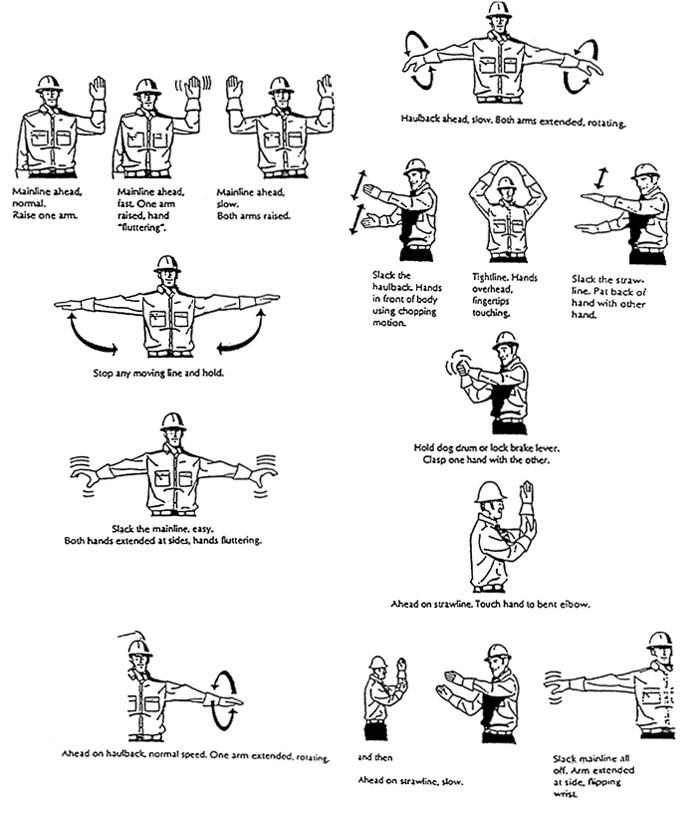
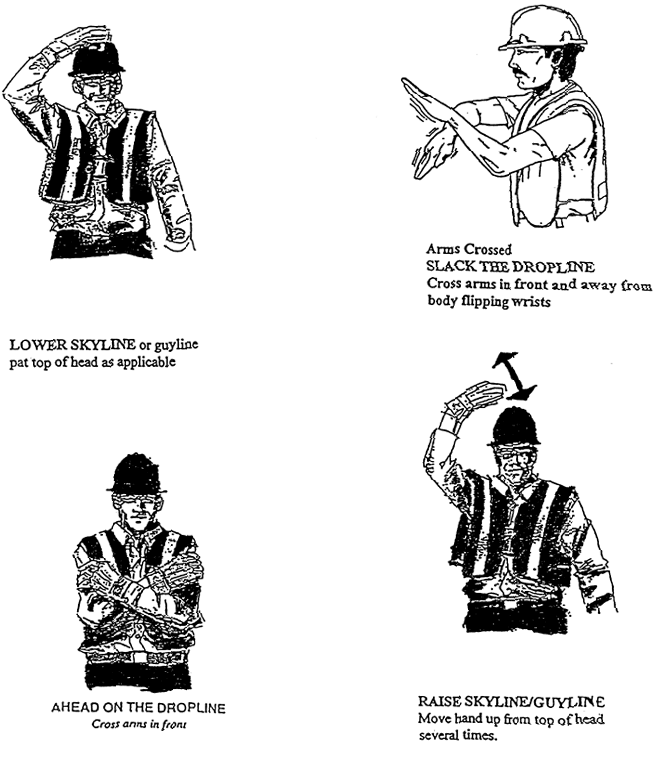
Table 26-7: Hand signals (Continued)
B Skidding
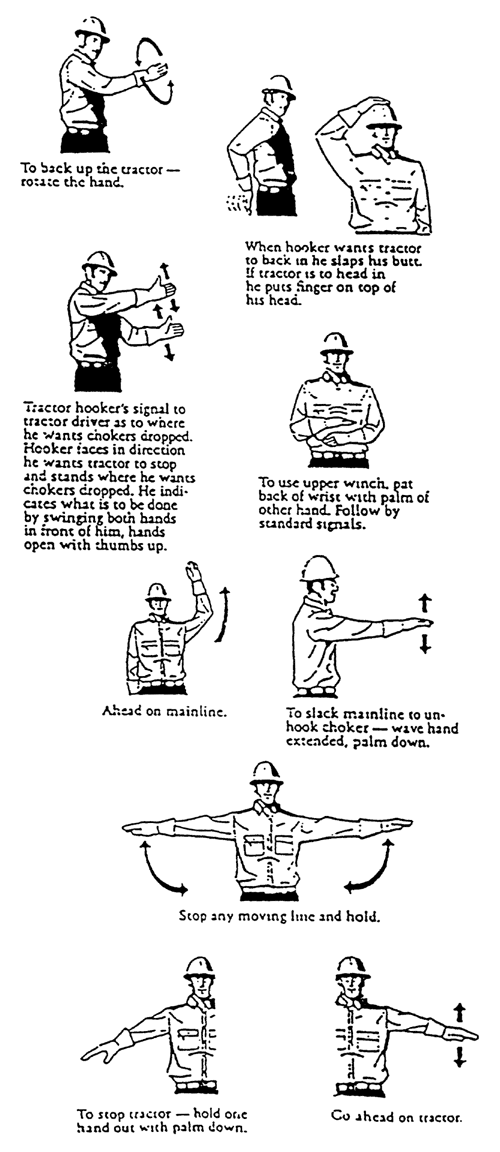
Contents | Parts 1-3 | Part 4 | Part 5 | Part 6 | Part 7 | Part 8 | Part 9 | Parts 10-11 | Part 12 | Part 13 | Part 14 | Part 15 | Part 16 | Parts 17-18 | Part 19 | Part 20 | Part 21 | Part 22 | Part 23 | Part 24 | Parts 25-26 | Part 27 | Part 28 | Parts 29-33 | Schedules
Copyright (c) Queen's Printer, Victoria, British Columbia, Canada